|
| The Master Builder |
In previous posts I argued that DNA is not the blueprint of life, nor the control center of the cell. But, there must exist some organizing principle. If that is not in our DNA, then where is it? We still need an explanation. The book of Alfonso Martinez Arias (2023) 'The Master Builder. How the New Science of the Cell is Rewriting the Story of Life' was very helpful for me in answering the problem how is an embryo made from a single cell?
Alfonso Martinez Arias' book is a lengthy and detailed defense of the cell-centric view of life. His arguments are based on first-hand experience with growing embryos in the lab. After reading this book, I realized that the hardest problem in evolution is neither the origin of species, nor adaptation by natural selection, but: how is an embryo made from a single cell? Without answering this central question, the major evolutionary transition [1] from single cell organisms to multicellular organisms will forever be a mystery. Without going deep into technicalities, I have selected a few important quotes from the book in order to give a sense of why the creation of an embryo out of a single cell is an extraordinary feat. "What a piece of work we are!" A newborn baby is estimated to have approximately 26 billion to 2 trillion cells all originating from a single cell. Imagine a robot constructing itself from a less than a 1 mm sized entity! That does not exist. A crucial milestone in the development of the embryo is the creation of the three body axes:
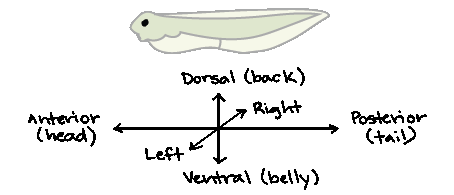
This is a spatial problem par excellence. The fertilized egg cell has neither a head-tail axis, nor a dorsal-ventral axis, nor a left-right axis. These must be created. All other developments such as the creation of organs in the right positions depend on the body axes. This is the work of cells, which are after all three-dimensional objects contrary to DNA.
|
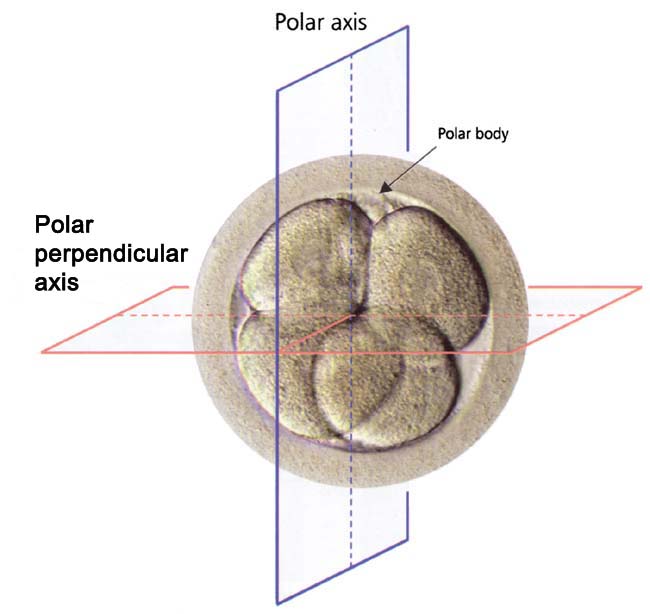
| CarnegieStage-2figure-4 (The Virtual Human Embryo). |
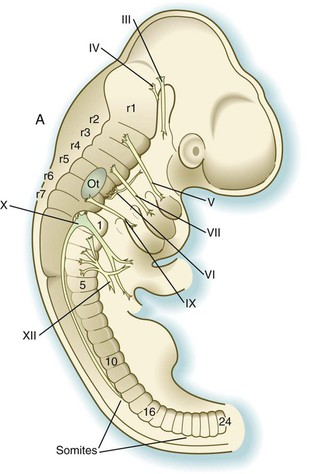 |
| (illustration not in the book) |
Alfonso Martinez Arias convincingly shows that "DNA cannot send orders to cells to move right of left within your body or to place the heart and the liver on the apposite sides of your thorax; nor can it measure the length of your arms or instruct the placements of your eyes symmetrically across the midline of your face. We know this because each and every cell of an organism generally has the same DNA in it. But cells can send orders, measure lengths." "If genes can't tell right from left or middle, they simply can't be responsible for doing everything involved in the making of you and me."
To get a grip on causes, cells are grown in vitro:
"Why do cells behave differently in culture versus in embryo? We found that when embryonic stem cells are left to roam on a Petri dish in certain conditions, they will become different from each other; they generate the different types of cells that make up the embryo but do so in a disorganized manner. If the same cells, with the same genes, are placed in an early embryo, however, they will faithfully contribute to the embryo. Same cells, same genes. So, something other than genes must be involved in making an embryo."
(the above quotes are slightly adapted from the Introduction and the first chapter of the book)
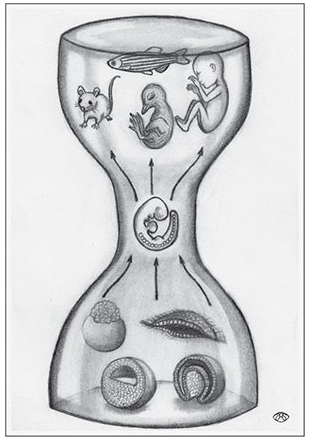 |
| Figure 18: Duboule's hourglass. Chapter 5. Starting from very diverse forms and going through a bottleneck of similarity, animals diversify. |
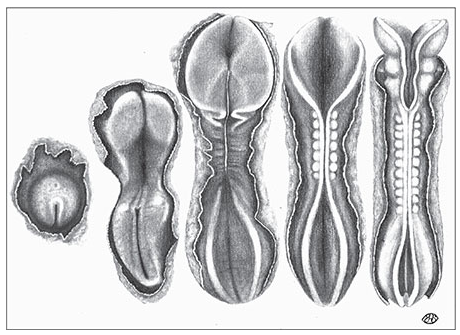 |
| Figure 27. Human embryos from Day 14 to Day 28. |
The 'embryo problem' becomes especially urgent when realizing that there is no miniature human being in the egg (preformatism !), so all body parts must be created 'out of nothing' (de novo)!
By placing a fertilized egg in a Petri dish in a lab, cells show what they are capable of outside the natural environment of the mother, and which external triggers are required. These experiments show: 1) that DNA is not enough, and 2) that cell-cell interactions are crucial.
Growing a human embryo in vitro beyond 13–14 days—approaching the time of gastrulation—presents profound technical challenges, primarily because laboratory conditions cannot fully replicate the complex, dynamic environment of the uterus. While recent research has pushed past the traditional 14-day limit using specialized techniques, standard methods fail because the embryo enters a phase requiring intricate, 3D interactions with maternal tissue, which are difficult to simulate [2].
The limited power of genes
"Identical twins have very similar faces because they share the tools and materials needed to build a face. It's like assembling bookshelves from a store kit: the final products look identical because parts in the kits are identical and adjusted to fit perfectly. ... Someone has to put the pieces together."
A genome neither creates an organism, nor does software create a computer.
"If you were to put DNA in a test tube and wait for it to make an organism, it would never happen. Even if you were to add all the ingredients that allow the reading and expression of the information in DNA – the transcription factors, plus some amino acids, lipids, sugars, and salts to help catalyze chemical reactions – it would still never happen. DNA needs a cell to transform its content into a tangible form. An organ or a tissue, and most certainly an organism, is no more the result of the activity of a collection of genes than a house is an aggregate of bricks and mortar." [3].
Tools:
"Understanding how animal (and plant and fungal) life emerged demands that we see genes not as the instructions or blueprint for an organism but rather as the instructions or blueprints for the tools and materials that cells use to build organisms." (Chapter 3).
"It is the cell that reads, interprets, and translates the tools or signals it is given." (Chapter 5)
Genes are agnostic
The genes are agnostic about anything except the protein that will be made after they're copied into RNA, and the genes that are copied because of signals being communicated between cells based on their environment. (Chapter 5) [4].
Gene-centric versus cell-centric thinking
"This way of talking about what is happening in cells differs greatly from the language used by geneticists. In their view, genes are the bosses, the engineers, the drivers of the events that decide when and where something happens. Yet, as we can already see, the cells are the ones who count and read signals from their neighbors and assess their position in the community, sensing not only the chemical signals they exchange with each other but also the physics of geometry, tension, pressure, and stress within and across a group." (Chapter 6).
Faustian bargain
"Cells are allowed to take control of the genome's hardware in order to build and maintain the organism, so long as the cells pass the genome along intact to the next generation through the germ cells: eggs and sperm." (Chapter 7).
Genes are not ignored!
"It was this idea that inspired me in 2003 to turn my attention away from fruit flies, which I had been working with for fifteen years, to embryonic stem cells." (Chapter 7). Arias has firsthand knowledge of genetics. Genes are not dismissed as unimportant. Genes get their rightful place in the story. Unlike other anti-gene-centric authors such as Denis Noble, Arias is an expert in genetics and developmental biology.
Conclusion
In order to give the reader a general idea of the position of the author, I decided to give striking quotes instead of all the data (which is anyway impossible to do). But I guarantee that the book contains all the details to convincingly substantiate the cell-centrism position. Furthermore, I've included some illustrations from the book to show the topics the author discusses.
For a geneticist the universe is made of genes, for an embryologist the universe is made of cells. Now it's time for both points of view to be merged.
Notes
- John Maynard Smith (1995) The Major Transitions in Evolution.
- quote from google-AI.
- Slightly edited quote from Chapter 1 Not in our genes. [IKEA bookcase!]
- I like to compare this situation with the Chinese Room experiment. Genes are inside the Chinese room and don't have any idea of what they are doing, and what the symbols mean, they are blindly following rules.
Previous blogs
- Gene-centrism is bad biology. Here is why. 17 Dec 2025
- What is DNA-centrism? Why is it wrong? 10 Nov 2025
- Embryo's zijn mensen, die kweek je niet 06 June 2016
Dr Korthof
ReplyDeleteThanks for this new contribution to the ‘cellular dogma’ (S. Brenner) !
this new contribution to Brenner's quip might interest you:
ReplyDeleteBringing the genetically minimal cell to life on a computer in 4D https://www.cell.com/cell/fulltext/S0092-8674(26)00174-1
press release:
Team simulates a living cell that grows and divideshttps://news.illinois.edu/team-simulates-a-living-cell-that-grows-and-divides/
Thanks! That is really amazing! the minimal artificial bacterium JCVI-syn3A contains 493 genes of which 92 have unknown functions! (they have downsized it from 1000 by eliminating 507 genes from the original!) and simulated every molecule! it is now time to test the model and compare it with the real thing! So, this is a whole-cell simulation. I wonder: how can they simulate a cell-division without knowing what those 92 genes are doing?
ReplyDeletemind the Biomolecular Condensates......
ReplyDeleteReally never heard of that !
ReplyDeleteWe ain’t seen nothing yet!
ReplyDeleteSee f.e. ‘Nuclear pore complexes’ , e.g. Patrick Onck (Groningen)
ReplyDelete