27 September 2021

Are humans produced in Senapathy's Primordial Pond? Yes and No! internal inconsistency in his theory

Updated 20 June 2025

A Human in the Primordial Pond?!
(this picture is not in Senapthy's book!)
©GK

I never noticed this specific huge internal inconsistency in Senapathy's theory of 'Independent Birth of Organisms' until Senapathy explained his request 'to remove humans from the Primordial Pond'.

The problem with his request is that one part of his theory says:  

  • (1) the Primordial Pond does not produce humans

and another part says:  

  • (2) the Primordial Pond does produce humans

In the previous blog I showed that according to his theory humans 'should' originate in the Primordial Pond. That is the second part of his theory explained in chapters 6-8 of his book Independent Birth of Organisms. Obviously, statement 1 and 2 are logically incompatible. That is a very serious problem for a scientific theory. Please note that nowhere in his book he makes explicit statements about the origin of humans! Senapathy confirmed this by email [1].

Update 3 July 2023: However, later I found a crucial passage in the Notes and References of his book:

"When such a high level of extreme order as found even in the genome of a worm can arise from the chaos of random genetic sequences, it is not comparatively more difficult to create the order in the genomes of organisms such as the complex human."  Note 62 on page 619 of his book. [4]

and:

"In this sense, humans, elephants, rats, earthworms and even the very small microscopic insects and invertebrates all have nearly the same genomic complexity in terms of the structure and function of the genome." (page 302 of his book.) [6] (added 20 June 2025)

It follows logically and necessarily from his theory. 

There is another passage in his book that supports the idea that humans can arise from the primary pond:

"When we consider the case of the independent birth of mammals, it is reasonable to think that a conglomeration of a large number of cells and biochemicals in the primordial pond could have formed an environment akin to that of the placenta and uterus of mammals. There, a seed cell can differentiate into an embryo and a full-grown offspring". (page 309 chapter 8). [5]

He didn't exclude humans. The amazing thing is, that in his email he denied that humans originated in the Primordial pond! This also contradicts his theory (part 2) that all eukaryotes arose in the Primordial Pond (previous bog). 

See for example:

"All the organisms could have come about just as they are, independently from the primordial pond.” (page 295)

He is silent about that so far. So, I am justified in claiming that there is an inconsistency in his theory. A rather big inconsistency. It is weird that I have to point out what his own theory predicts!

But the question about the origin of humans is not a minor issue. If you construct a complete new theory about the origin and evolution of life, your theory should explain the origin of humans. If Senapathy had stated it explicitly, he might have noticed the contradiction himself. 

So, how did he justify the first (1) claim? I did not explain that in my previous blog. Senapathy justifies his request 'to remove humans' with the first part of his theory. It is his 'solution' for 'the gaps in the fossil record'. He devoted many pages to 'gaps in the fossil record' ('missing links'!). He gives quotes from his book that proves this point. For example, on page 454 he claims that phyla, classes and orders arose by independent origin, and families, genera and species mostly by evolution (p.454) [3]. Since humans are on the species level and not on the level of phyla, classes and orders, humans originated by evolution and did not originate in the Primordial Pond, he wrote in his email. So, let's accept for the moment that his claim can be derived from his book, although it is not stated explicitly anywhere. Even then, it is not right to ignore the part of the theory that contradicts this claim. And it does not help to call part 1 'the core of the theory' [2]. 

We have assumed that Senapathy has shown quotes from his book that prove his assertion. Should we accept his defence for part 1? Senapathy clearly wants independent origin of 'distinct' organisms, so he asserted that they originated in the Primordial Pond. But that is nothing more than wishful thinking! Senapathy has to show that his Primordial Pond can only produce 'distinct' organisms 'unconnectable by evolution'. He has to show that a basic molecular mechanism produces the results he claims. Whatever the truth of the 'missing links', even if there are thousands and thousands of 'missing links', that does not automatically validate his own theory. He has to come up with a specific mechanism. It should have been present in chapters 6-8.

For me this particular inconsistency was a surprise, despite years of thinking and writing about 'independent origin'. I had pinned down the most fundamental error in his theory (the elephant in the room), and here you have a huge and new inconsistency.

Scientists don't want an inconsistent theory. Such a theory predicts A and non-A. So, if A is observed, the theory is true, and if non-A is observed the theory is true also. The theory is always true regardless A. The theory is unfalsifiable (regarding A). If scientists discover an inconsistency they try very hard to remove it. When this fails they discard the theory and construct a new one.

Professor Sharon Peacock (source)

The lesson of this is that any scientific theory should be examined for internal contradictions. It should be thoroughly debugged just as software. A scientist should have the courage to openly change his mind. I read an interview with virologist Prof Sharon Peacock, Director of the COVID-19 Genomics UK consortium, about the SARS-CoV-2 pandemic:

"There is reason to think the virus did emerge from an animal host," she said.  "I haven’t seen any definitive evidence it is an engineered virus or escaped. But what this virus has taught me is to be humble when I’m wrong, and I’ve been wrong quite a few times and have had to become nimble in changing my mind.
So if further evidence comes along that shows the virus as being engineered, I would be willing to consider that. But at the moment, in my view it has arisen from an animal." (source)

That's the real scientific attitude! Humbly admitting you were wrong! That commands respect and will certainly not damage your reputation. On the contrary!


Notes

  1. "As the foundation of my theory is the independent birth of organisms classified in the highest ranks, I have not focused on the origin of humans in my book. Thus, I cannot give you a quote where I mention that humans did not originate independently. However, as I described in my book, I believe that organisms classified in the lower ranks (families, genera, and species) have evolved over millions of years. (...) To provide a detailed assessment of humans was not the intention of my book, as I was focused on the independent origin of organisms in the higher taxa, and Homo sapiens is classified at the lowest rank of a species"  (from email Senapathy 17 Sep 21) [added 28 Sep 21]
  2. It has always been clear to me that part 2 was the core of his theory because it gives a description of the mechanism by which organisms arose from the Primordial Pond. In my review of the book I have shown that the mechanism doesn't work, but here I am describing his theory. [added 29 Sep 21]
  3. "by evolution" contradicts the title of his book "...Showing That Evolutionary Theories Are Fundamentally Incorrect" and: "genomes are immutable". [ 8 May 2023]
  4. quote added 3 July 2023 
  5. quote added 15 Apr 2025  
  6. quote added 20 June 2025 


Sources

Until the moment of publication of this blogpost Senapathy did not respond to my previous blogpost and 2 emails. 

Until today, 15 Apr 2025 Senapathy did not comment or email me.

Oct 13: added falsifiability.


19 September 2021

Senapathy's request to remove humans from the primordial pond

Senapathy's Primordial Pond
with worm, crab, frog, turtle, butterfly, fern.
All with 'tails' of a DNA double helix.
(image on the front cover of the book)


On 29th December 2002, I published a review of Periannan Senapathy's book "Independent Birth of Organisms. A New Theory That Distinct Organisms Arose Independently From The Primordial Pond Showing That Evolutionary Theories Are Fundamentally Incorrect" (1994). That is the full title of the book. 

On 6th September 2021, I received the following email from Periannan Senapathy:


Dear Gert,

For business reasons, I had to search for my name on Google today. When I did, I observed that your website was the third to be displayed on the results page, and the caption under the website title stated the following,

"Independent researcher Periannan Senapathy came up with an extraordinary solution: the independent origin of all organisms, including humans."

As you know, life in the animal kingdom is classified into the successive ranks of Phylum, Class, Order, Family, Genus, and Species. The core prediction of my theory is that fundamentally distinct organisms with unique body plans originated independently. By fundamentally distinct, I refer to the organisms that biologists had to separate into the highest-level taxa such as phylum and class. Humans are not classified in a high-level taxon, but the lowest rank of a species.

    For the reason outlined above, I would appreciate it if you could remove the statement "including humans" at the end of your description. It is a very prominent statement, which diminishes the core principle of my theory. What I had intended to stress in my book was that any fundamentally unique body plan, from the 'simplest' invertebrate to the most 'complex' vertebrate, must have originated independently. Nevertheless, organismal evolution would have worked on these body plans over millions of years, giving rise to numerous low-level taxa such as families, genera, and species, including humans. I hope this clarifies my view.

Best regards,

Sena


Removing "including humans"? This is human exceptionalism [5]. If you remove humans, logically, the meaning of the statement becomes:

"... the independent origin of all organisms, excluding humans."

That means humans did not originate from his Primordial Pond! So, how did humans originate? 

In his theory there are only two ways humans (or any organism) could originate: 

  1. by the spontaneous origin in the Primordial Pond by random DNA assembly
  2. by mutation and natural selection from 'simpler' predecessors

So, if not (1) , then (2) must be true. They must have evolved by mutation and natural selection from a more 'primitive' ancestor (Mammal, Primate, Ape?). He did not tell us [9]. But, that is evolution and that contradicts his own theory, as the full title of his book shows: Showing That Evolutionary Theories Are Fundamentally Incorrect. If evolutionary theories are fundamentally incorrect, he cannot use them in his theory. Furthermore, according to Senapathy genomes are essentially immutable, so evolution is impossible.

The first option, humans arose in  the Primordial Pond, is in fact prescribed by his own theory. Humans are eukaryotes. All plants and animals are eukaryotes. Eukaryotes are organisms with split genes. Split genes are genes with introns. Introns are random pieces of DNA that are removed before a protein is synthesized. According to his theory, eukaryotic genomes arose from the primordial pond by random DNA assembly. How could he prevent that humans (eukaryotes) were born in the primordial pond? [6].

Here is a quote from Senapthy (2008) about humans: 

"It is remarkable that all the characteristics of random DNA are still essentially present in the split genes of present day intron-dense large genomes such as those in the human." [3]

The following quote:

"In my opinion, without this fundamental finding about the genes which are central to life, it would be impossible to show that multicellular animals and plants could have directly originated in the primordial pond. " [4]
he claims that multicellular organisms without any restriction have directly originated in the primordial pond.

According to Senapathy's computer simulations, any eukaryotic gene can be found in random DNA sequences if those random sequences are sufficiently large. So, any eukaryotic genome can originate in the Primordial Pond. So, any eukaryotic organism can originate in the Primordial Pond.

As a consequence, the genomes of any eukaryote, including humans, can originate in the Primordial Pond. Making an exception for humans and not for chimpanzees? Why? Humans are eukaryotes just like the worm, crab, frog, turtle, butterfly, and fern in the cover illustration of his book. Note: this is according to his own theory. This is what he states in his book:

"it is clear that all organisms were born independently, and were — and are — also immutable. This is the secret of life, and of its origin and history." page 373. [2]

Furthermore, Senapathy writes about mammals:

"When we consider the case of the independent birth of mammals, it is reasonable to think that a conglomeration of a large number of cells and biochemicals in the primordial pond could have formed an environment akin to that of the placenta and uterus of mammals. There, a seed cell can differentiate into an embryo and a full-grown offspring". (Senapathy, p.309 chapter 8) [7]

So, if this is true for mammals, it is true for humans because humans are mammals. In my review, I formulated a thousand objections. But this is what his own theory predicts.

Further, he wrote:

"When I initially tried to explain my theory to my wife, I said, “All the organisms could have come about just as they are, independently from the primordial pond.”  (page 295). [8]

That is the reason, removing 'including humans' would violate his own theory as published in 1994. My review is about that book. Therefore, I did not remove them. So far.

So, I am waiting for a good reason to remove those two words. 

I invited Senapathy to continue the discussion on this blog.


Notes

  1. The review can be found on my Was Darwin Wrong? website: What's Wrong with Independent Birth of Organisms? (first published 29 Dec 2002)
  2. added: 4 Jul 2022
  3. added: 14 Jun 2023
  4. added: 3 Jul 2023
  5. added 23 Oct 2023. Human exceptionalism is the paradigm that humans are profoundly different from all other organisms. The question arises: did the closest relatives, the Chimpanzee, Bonobo, Orangutan arose directly from the Primordial Pond?
  6. These two sentences added for clarification  23 Oct 2024
  7. Quote added:  25 Oct 2024 
  8. Quote added:   5 May 2025
  9. There is a conspicuous absence of a discussion of (the origin of) the human genome in his book! See Note 459. 30 May 2025


Previous blog about Senapthy


15 September 2021

The birds of Tiengemeten (5)

In the last blog about the birds of the Dutch island Tiengemeten I showed pictures of 7 bird species. That does not mean that I now have shown all the birds of Tiengemeten! These are the birds I succeeded in taking decent pictures of during the four days I stayed on the island.

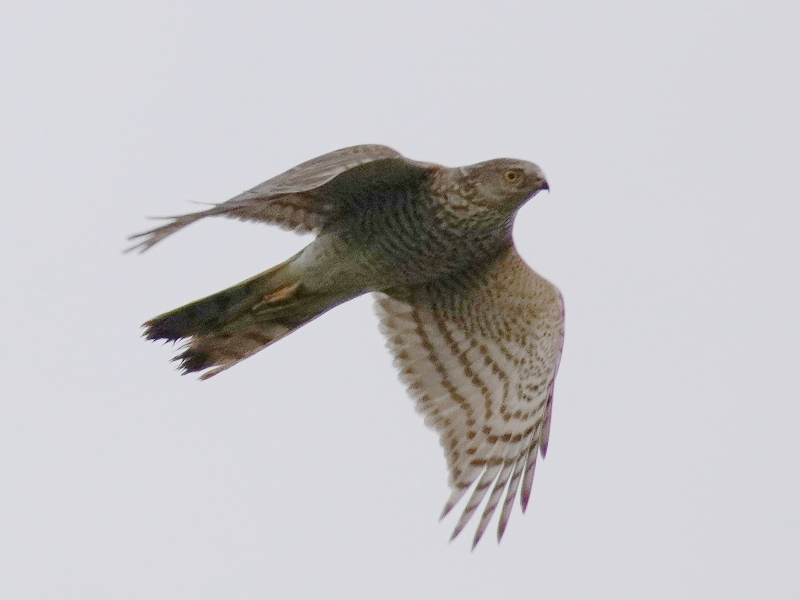
Eurasian sparrowhawk; Sperwer ©GK

Eurasian sparrowhawk; Sperwer ©GK

Eurasian sparrowhawk; Sperwer ©GK

As always I had my camera ready when I am outdoors for a walk, but I was not really prepared for what happened next. It all happened so quickly. The whole thing was over in a minute. A bird of prey was attacked by some crows (I think) and the birds flew quite low over my head. I managed to take only 5 pictures. Three of the best are shown here. These are my first pictures of a Sparrowhawk.

Common kestrel; Torenvalk ©GK

Superficially, the Common kestrel and the Sparrowhawk (above) look very similar. But the Common kestrel is smaller and has a black spot under his eye (among other things). The Common kestrel is famous for its ability to stay in exactly the same position while hovering above the ground. Even during windy weather.

Common redshank; tureluur  ©GK

Difficult to spot? Only against this background! The Common redshank (tureluur) is a wary and noisy bird species. It is a common bird in The Netherlands (at least in the neighbourhood of water).


Eurasian skylark; veldleeuwerik ©GK

The skylark can only be detected when it sings high in the sky. Nearly invisible. Only in springtime. I made a lot of attempts before I got this picture. It is a bird of open areas, that is becoming rare in the Netherlands. But on Tiengemeten there are plenty of open areas.


Eurasian wren; Winterkoning ©GK

Most birds are actively singing in the early morning. That is also the moment to capture them on camera. This wren is no exception. It is a really powerful singer.

European herring gull; Zilvermeeuw ©GK

The European herring gull is a little bit smaller than the Lesser black-backed gull featured in part 3 of The Birds of Tiengemeten. The colour of the wings is light grey. This individual is tasting a few bits of a dead fish. I am not sure whether it tasted good. The same fish as the European herring gull in part 3. 

There are no fences on Tiengemeten:

In the background: Garganey; Zomertaling ©GK

Garganey; Zomertaling (detail)  ©GK

You can walk everywhere. The only barrier is water. Thanks to this lady I was so lucky as to capture a Garganey (Zomertaling). My first.

That's it for this series. Thanks for visiting this blog!