20 October 2023

I discovered the beautiful Humming-bird Hawk Moth (Kolibrievlinder) hovering above flowers in a Dutch garden

Humming-bird Hawk Moth visiting flowers
31Aug 23 SRX06805A.JPG©Gert Korthof


This summer I was photographing butterflies in De Tuinen in Demen gardens, The Netherlands. These gardens have literally hundreds of flowering plant species. Unexpectedly, I found myself chasing a Humming-bird Hawk Moth, Macroglossum stellatarum (Dutch: Kolibrievlinder) hovering above the flowers. 

The butterfly was quite difficult to capture because it constantly moved from one flower to the next, and never sat down on a flower. Typically, they hover a few centimeters above a flower and stick their tongue out to enter a flower and quickly move to another flower. This is a very unique behaviour for a butterfly. Most butterflies sit down on a flower for some time. This exotic butterfly certainly deserves its name: it behaves like a hummingbird! It is really acrobatic to enter such a long tongue into flowers while hovering.

Later, when selecting the best pictures, I discovered the long tongue. At that moment I remembered the cover illustration of Mark Ridley's Evolution textbook:

cover Mark Ridley Evolution 3d edition

Ridley writes [1] that Darwin had seen specimens of the orchid Angraecum sesquipedale which has a very long spur. A nectar spur is a hollow extension of a part of a flower. Darwin speculated that a butterfly with a very long tongue must exist. But at the time he did not know such a species. Twenty years later such a butterfly was discovered: the hawk moth Xanthopan morganii pollinating an orchid. The butterfly I photographed, Humming-bird Hawk Moth, is not the same as the one on the cover of Ridley's Evolution. It is another genus. but it belongs to the same family [2]. The plant species my Humming-bird hawk moth visited is not an orchid. Now it gets interesting. Did my butterfly visit the 'wrong' flowers? There are no flowers present that fit the tongue of my Humming-bird Hawk Moth? Upon further inspection of my pictures I noted that the flowers also had a rather long spur:

Size of flower spur indicated with arrow.
31Aug 23 SRX06798A.jpg©Gert Korthof

But this spur is certainly not as long as Darwin's orchid. So, the particular plant species and my Humming-bird Hawk Moth don't seem highly adapted. They did not co-evolve.

This is a mystery. Are there plant species in the Netherlands or elsewhere in Europe which are better adapted to the Humming-bird Hawk Moth? Plant species with a very long spur? I don't know. More observations are needed. In the Netherlands our butterfly is often seen on a common garden plant: Buddleja davidii (butterfly bush, vlinderstruik) native to China and Japan. The problem is that in observation.org and waarneming.nl it is not required to identify the plant species when submitting an observation of a butterfly [3]. It is difficult to identify the plant species from the pictures. Above that, waarneming.nl discourages users to upload non-native plant species and it could be that precisely cultured garden varieties are visited by the Humming-bird Hawk Moth!

Another unique feature of this 'moth' are the eyes. They are looking at you:

He is looking at you!
SRX06802.jpg©Gert Korthof

It looks like a human eye!

Then its wings: rather exceptionally for a moth, its wings have orange patches!

Finally, another mystery: what about pollination? Since it doesn't sit down on a flower, the only point of contact is its tongue! Clearly, this is a wonderful and unique butterfly, or should I say a moth?


Additional nice pictures

https://waarneming.nl/observation/290848030/

https://waarneming.nl/observation/290782391/


Sources


Notes

  1. Mark Ridley (2004) Evolution, third edition, page 617. Ridley discusses the case in the paragraph 22.3 'Insect-plant coevolution'. But also that the case is more complex than just the coevolution of insect tongue length and flower spur length.
  2. Family: Sphingidae (pijlstaarten) is a very species rich family and the genus Macroglossum has nearly a hundred species.
  3. Buddleja davidii  (vlinderstruik), Lavandula species (lavendel), geranium, Valeriana spec (rode valeriaan), Phlox, Verbena officinalis (ijzerhard) are visited by the Humming-bird Hawk Moth.

13 September 2023

The true history of junk DNA (2)

Francis Crick
What Mad Pursuit.
paperback 1988

"The originator of the central dogma, Francis Crick, was well aware of genes that didn't encode protein. They don't figure into the central dogma." (Laurence Moran (2023) What's in your genome, chapter 8 paragraph 'Revising the central Dogma?') (my bold)

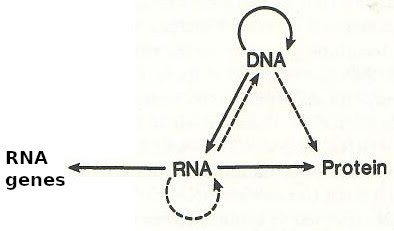
Exactly: They don't figure in the Central Dogma! That is precisely the problem! Crick omitted noncoding DNA from the Central Dogma. Had he included it in his scheme, a lot of confusion could have been prevented.

Central Dogma, from: Francis Crick, What Mad Pursuit, page 168.

Crick could have added an arrow from RNA to for example 'RNA genes'. He did not.

RNA genes added to Central Dogma (©GK)

In this blog I want to explore possible reasons for this omission. They have to do with the historical scientific context of the time that Crick proposed his central dogma. I hope this will show that scientists misinterpreting the Central Dogma are not fools and that Crick himself overlooked non-coding DNA when drawing his Central Dogma diagram. But first a second quote from Laurence Moran:

"Many scientists have a very different view of the central dogma. They were taught, incorrectly, that the real meaning of the central dogma is that DNA makes RNA makes protein and the only function of DNA is to encode protein ... They were somehow led to believe that there was only one kind of gene, namely, protein-coding genes." (Moran, 2023, What's in your genome, Chapter 8) (my bold)

Well, it is certainly not a mystery why many scientists were led to believe that there was only one kind of gene: there is only one kind of gene in Crick's illustration of the Central Dogma.

Why did Crick not add RNA genes to his diagram? It is important trying to understand the historical context at the time that Crick proposed his Central Dogma. Traveling back in time is not easy, therefore I use Crick's own account in What Mad Pursuit.

The central problem of biology at the time was: How could genes possibly construct all the elaborate and beautifully controlled parts of living things? It was known that each chemical reaction in the cell was catalyzed by enzymes. This is a defining property of life on earth. Furthermore, it was known before 1953 that enzymes are proteins. Crick realized that the key problem in biology was to explain how proteins were synthesized. In the 1940s a very influential hypothesis was proposed, the 'One gene - one enzyme' hypothesis. The next question was: How do genes control the synthesis of proteins? (Chapter 3 The Baffling Problem, page 33). Obvious today, but at the time it was a problem at the frontiers of science. Further, it was also known at the time that proteins were made of about 20 different amino acids. 

After the discovery that DNA consisted of a sequence of bases, the next question emerged: what is the precise relation between genes and proteins? Crick proposed the Sequence hypothesis: the sequence of bases in DNA is a necessary and sufficient condition for the sequence of amino acids in proteins. Crick:

"Rereading it, I see that I did not express myself very precisely, since I said "...it assumes that the specificity of a piece of nucleic acid is expressed solely by the sequence of its bases, and that is sequence is a (simple) code for the amino acid sequence of a particular protein." This rather implies that all nucleic acid sequences must code for protein which is certainly not what I meant." (Francis Crick, What Mad Pursuit, Chapter 10, page 108).

Then Crick explains that other parts of the DNA sequence could be used for control mechanisms (today: gene regulation) and he even mentions producing RNA for purposes other than coding (today: RNA genes). Crick concluded: "I don't believe anyone noticed my slip, so little harm was done." (page 109). Unfortunately, Crick underestimated the long lasting influence of the famous Central Dogma diagram.

According to Moran the meaning of the Central Dogma diagram is that the information in proteins cannot get out again. That, indeed, is what Crick himself says (page 109). Unfortunately, the Central Dogma diagram is a weird way to illustrate the non-existence of a specific type of information flow. It is as if one wants to illustrate the absence of something with the absence of something in an illustration. It isn't manifest. It seems rather impossible to me to do that [2].

In my view the point of the Central Dogma was to illustrate (albeit in a partial way) the solution of the central question of the time and indeed of all times: how can genes specify proteins? Crick himself expressed this clearly:

"I shall… argue that the main function of the genetic material is to control (not necessarily directly) the synthesis of proteins." [1] (my bold)

The Sequence hypothesis isn't a hypothesis anymore, and it isn't at the frontiers of science anymore, but 'The Sequence' is still and will always be one of the defining characteristics of life on earth [3]. This is certainly not an outdated idea from the pas. Life as we know it is impossible without enzymes (=sequences) and without genes (=sequences) coding for them. 

The 'protein universe' is very much at the frontiers of science, new protein structures are discovered today [4].


Appendix (1)

All the following concepts are about protein synthesis:  
  1. Mendelian genes specify discrete phenotypic characters (with the benefit of hindsight).
  2. The Sequence Hypothesis states that the sequences of DNA bases specify the sequence of amino acids in proteins. (Chapter 10 Theory in Molecular Biology)
  3. The Central Dogma states the direction of flow of information from DNA to RNA to protein and not back from proteins (chapter 10)
  4. The Genetic Code Table specifies which 61 DNA base triplets which amino acid ('sense' codons) and 3 base triplets which specify STOP chain ('nonsense' codons) Chapter 8 and Appendix B.
  5. The Adaptor Hypothesis  (Crick, Chapter 8 page 95) (the implementation of the Genetic Code in specific molecules: tRNA) doesn't make sense without protein synthesis.


Appendix (2)

The terminology used to describe genes makes only sense (!) in relation to protein synthesis: 

  • sense, nonsense, missense
  • sense, anti-sense strand
  • positive-sense, negative-sense 
  • coding strand, template strand
  • coding, noncoding
  • translation
  • STOP/START codons
  • the Genetic Code Table
  • triplets
  • in-frame/out of frame
  • ORF: Open Reading Frame
  • mRNA: messenger DNA
  • tRNA: transfer RNA
  • rRNA: ribosomal RNA

Also, the concepts: promoter (DNA sequence to which proteins bind) and enhancer (DNA sequence to which specific proteins bind) make only sense (!) in the context of protein synthesis, direct or indirectly, because they promote or enhance gene expression of protein-coding genes (mainly). Using these concepts implies protein synthesis on the basis of DNA sequences.  

However, there are concepts not (directly) related to protein synthesis: base pairing, double helixtranscription, directionality, replication.


Appendix (3)

I wonder whether there is a total absence of any coding signature in non-coding RNA genes. I found it difficult to find clear information about it. For example: do START and STOP codons occur in RNA genes? If so, do they have any effect? Do non-coding RNA genes have a triplet structure? Do single base deletions or insertions have similar effects on RNA genes as on protein-coding genes? (they don't disturb the reading frame). Are there functional RNAs completely independent and unrelated to protein (synthesis)? How did RNA genes originate? Did those they originate from coding sequences or from random sequences?


Notes

  1. Matthew Cobb (2017) 60 years ago, Francis Crick changed the logic of biology, PLOS BIOLOGY. Please note "(not necessarily directly)", this is a very ingenious way of including the indirect way of controlling protein synthesis: via enhancers and promoters. (added 22 sep 2023).
  2. Elsewhere Crick designed another diagram which prevents the dilemma of illustrating the absence of something, see: Larry Moran (2007) Basic Concepts: The Central Dogma of Molecular Biology blog.
  3. See for example my review of Tibor Gánti (2003) 'The Principles of Life'. 
  4. ‘A Pandora’s box’: map of protein-structure families delights scientists,  Nature 13 Dec 2023.


Previous blogs


31 July 2023

The true history of junk DNA

"By the late 1960s, knowledgeable scientists were used to the idea that genes occupied only a small part of the genome, and in 1974 the editor of the journal Cell, Benjamin Lewin, was expressing the consensus view of the experts when he wrote that the C-value Paradox could be resolved by assuming that much of the genome is composed of nonfunctional repetitive DNA (junk DNA)." (Chapter 2 of Laurence Moran (2023) What's in your genome.)

It may be that 'knowledgeable scientists' in the late 1960s knew that much of the genome is composed of junk DNA, but the 'consensus view' was not widely known in all sub-disciplines of the biological research community. Maybe the journal Cell was not read in the evolutionary biologist community. Probably, those experts were experts in a different field with its own journals and conferences.

Eli C. Minkoff (1984) Evolutionary Biology.

I checked the oldest textbook I have, Minkoff (1984) Evolutionary biology. There is no 'junk DNA' and no 'non-coding' DNA in the index, despite the 'consensus view'. Yes, there are tRNA and rRNA (p.16), but these RNAs are not labeled as 'non-coding RNA' or 'non-coding DNA'. They are in the business of producing proteins. They are the very embodiment of the genetic code. Therefore, it would be somewhat counterintuitive to call them 'non-coding'. Yes, there is 'genetic drift', neutral mutations, 'neutralism versus selectionism', 'genetic load', 'mutational load' in his book, but Minkoff did not connect these concepts with 'non-coding DNA'. The concept is absent anyway. 'Centromere' is mentioned once casually (p.19), I could not find 'telomere'. Anyway, 'centromere' is not labeled as 'non-coding DNA'. Why is non-coding DNA absent from the book? 

I think I found part of the answer in the following passage:

"One of the fundamental tenets of modern synthetic theory of evolution is that natural selection operates on the phenotype rather than the genotype. No genetic change can be influenced by natural selection unless it first produces some phenotypic change. It is largely for this reason that modern evolutionary biologists must be aware of the manner in which phenotypes are controlled." (p.114)
This was an eye-opener for me. The phenotype is the most important, the genotype is important only in so far it has an effect on the phenotype. Who cares about DNA that does nothing? Evolutionary biology has the task of explaining the organism.

A second foundational paradigm I found here:

"Proteins are among the most important of all biological molecules. (...) The great intricacies of living systems are all the result of enzyme-controlled activities (...) enzymes are therefore the chemical basis of life". (p.17).

Taken together these two principles explain the mindset of evolutionary biologists in those days. If they did know about non-coding DNA, it simply had no relevance to the goals of their daily research. On page 37 there is a table labeled as 'The Genetic Code for Translation of mRNA Codons into Amino Acid sequences'. The famous table. It makes sense in this context, because the Genetic Code is the link between DNA and proteins. The reason for the existence of the Genetic Code is to produce proteins. The Watson-Crick structure of DNA plus the chemical structure of the four bases is present in the book. Minkoff knows the necessary biochemistry. Unfortunate exception: introns and splicing are absent! Introns were discovered in 1977.

There is one isolated and thus mysterious remark which vaguely suggests something like 'non-coding DNA':

"Not all of the genotype is transcribed and translated into a portion of the epigenotype, nor are all the transcribable genes ever transcribed at the same time." (p.114) ['epigenotype' = "the polypeptides that result from the immediate transcription and translation of the genotype"]

That's all. Probably, Minkoff was vaguely aware of non-coding DNA. But why include it in his textbook? He did not elaborate the concept because in his opinion it was simply not relevant or nothing was known about it. DNA which is not transcribed and translated has nothing to contribute to the phenotype of the organism, consequently nothing to biology and evolution. It doesn't fit in the evolutionary biology paradigm of that time [1].

So, that is the 'true history' of non-coding DNA based upon Minkoff (1984) and that was taught to biology students at that time. He did not say that non-coding equals junk, but by omitting non-coding DNA, he implied that non-coding DNA is unimportant. If one makes statements about the history of junk DNA, one has to investigate the evolutionary biology textbooks, especially older ones. Minkoff was an eye-opener for me. I checked more evolutionary biology textbooks: 8 out of 17 do not have 'non-coding DNA' in the index.

"As Sandwalk readers know, there was never a time when knowledgeable scientists said that all non-coding DNA was junk. They always knew that there was functional DNA outside of coding regions." (Sandwalk)

I think one has to take into account that there are different scientific disciplines with their own paradigms, leaders, journals, conferences, and networks. 

Thanks for reading. Have a nice day!


Notes

  1. On page 18 he writes: "there are other sequences in each DNA molecule that do not appear to determine the amino acid sequence of any polypeptide. Some of these may function as "spacers", and others are believed to function as regulatory genes, which control the transcription of other genes." (page 18, chapter 2: Basic Principles of Genetics). Here he describes non-coding regulatory genes! He doesn't realize that these non-protein-coding DNA sequences must have indirect effects on the phenotype, and consequently are important for evolutionary biology! In the subsequent development of evolutionary biology, the evolutionary importance of regulatory genes became evident.  Added: 21 Aug 2023


Previous posts

  1. Junk DNA in the Evolution textbooks (2) from 1996 to 2023 26 Jul 23
  2. Junk DNA in the evolution textbooks. Bergstrom and Dugatkin 2023 12 Jul 23
  3. Periannan Senapathy (1994) claimed that the human genome consists of more than 90% junk DNA. 4 Jul 2023
  4. Scientists say: 90% of your genome is junk. Have a nice day! Biochemist Laurence Moran defends junk DNA theory 26 Jun 23