|
| Richard Dawkins |
I assumed Richard Dawkins promoted the blueprint metaphor of DNA because of his Selfish Gene theory, which is a gene-centric theory. That appears to be incorrect. I came across a video in which he explained why the blueprint metaphor of DNA is wrong! [1]. Does that destroy all my critiques of gene-centrism? No! Not at all! How so?
What is wrong with the blueprint metaphor?

|
| blueprint of a house |
The problem is that the blueprint is a two-dimensional ground plan with all the rooms, doors, windows, gas, water, electricity and so on. It is a kind of miniature house on paper, it is a final product. But DNA in a fertilized egg cell is not a miniature animal. The three-dimensional structure arises gradually during development. Every knowledgeable biologist rejects the blueprint metaphor for the workings of DNA. So does Dawkins. So far, so good.
|
|
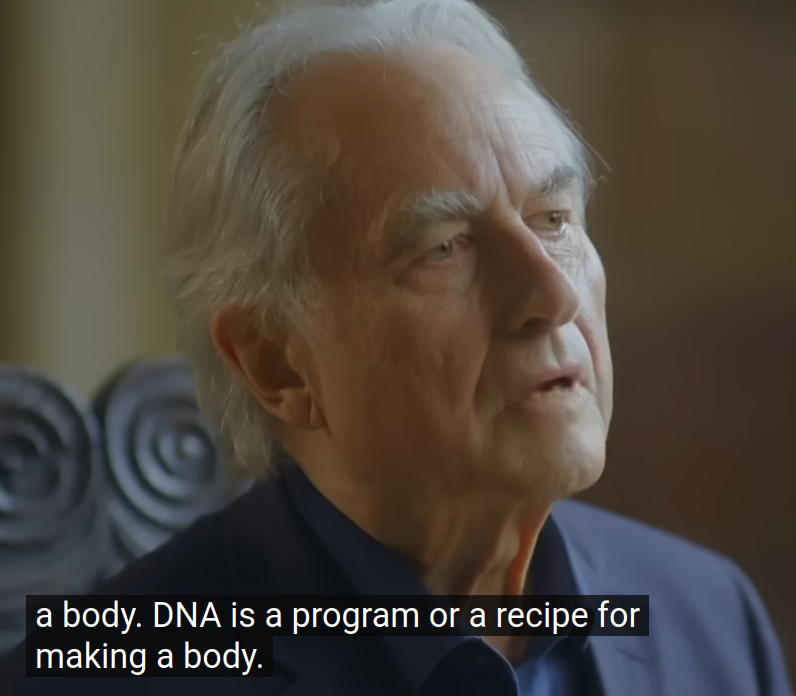
"DNA is a program or recipe for making a body." (2 min 36 sec) |
Dawkins: "DNA is a program for making a body"
Immediately after rejecting the blueprint metaphor, Dawkins explains that DNA is a program or a recipe for making a body. Is that any better? This metaphor does not use an animal blueprint as the starting point. Instead, the body is gradually built by a genetic developmental program. The 'program metaphor' looks appropriate because a computer program as well as biological development are deterministic processes which follow a fixed sequence of steps and seem to have inbuilt goals [2].
Why is "DNA is a program" a wrong metaphor?
The DNA-is-a-program metaphor is still wrong. Very wrong, indeed. Yes, metaphors can be wrong and misleading. Although there seem to be programs in animal and plant development, the program is not located in DNA. DNA is not a program. Where is the program? Scientists have sequenced thousands of genomes with high accuracy. They never found a program. I am serious. What did they find? They found thousands of protein coding genes which are interrupted with nonsense DNA (introns) located as small islands in large oceans of meaningless DNA. The protein coding genes are accompanied by a variable number of regulatory sequences (ON/OFF switches). Furthermore, the genes are arbitrarily distributed over a variable number of chromosomes (in humans: 46 chromosomes). There is no rhyme or reason to the order or distribution of the genes over chromosomes [3]. Genes are not located in the order in which they are executed. The genome is not logically and efficiently structured like a computer program. A computer program is a highly structured set of routines and subroutines, and does not contain superfluous code. On the other hand, the organization of animal and plant genomes is excessively complex [8] and balances on the edge of chaos. No human engineer would have designed such a mess [5]. DNA is not the place to look for a program.
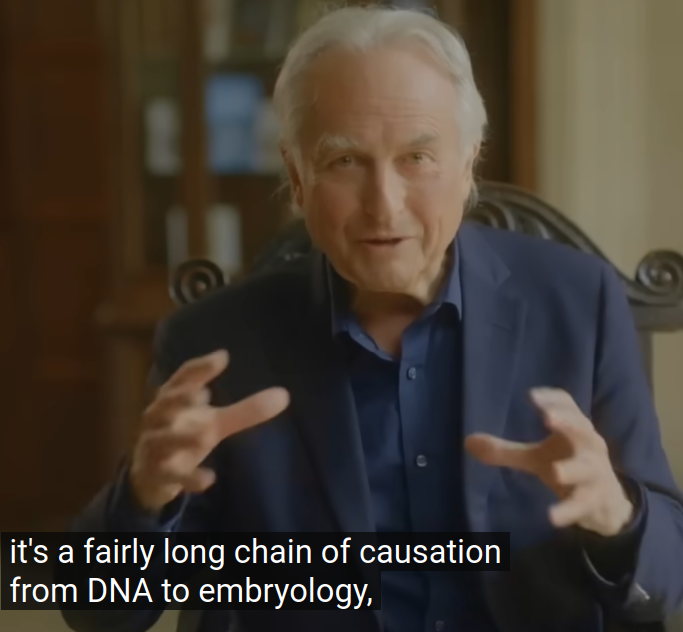 |
| "it's a fairly long chain of causation from DNA to embryology," (12:59 min in video) This is proof of his DNA-centric view of life! [9] |
Do regulatory sequences regulate gene expression?
The regulatory sequences are recognition sites for proteins [6]. They are sequences of A, T, C, G, just like protein coding sequences. They do not actively 'regulate' anything. They have to wait for proteins passing by. So, although their name 'regulatory sequences' suggests that they actively regulate gene expression, they are waiting to be read just like QR-codes:

|
| QR codes are data |
A QR code is not a program. QR codes are data. QR codes must be read by specific software.
Conclusion
A genome is a very large collection of data, not a program. A genome is not even remotely like a computer program. An unstructured collection of protein-coding genes, RNA-coding genes and regulatory sequences and a lot of meaningless nonsense (also called a 'genome') does not constitute a program. I am serious [4]. This is not trivial. Unexpectedly, Dawkins' failed computer program metaphor delivers a new argument against gene-centrism! Thank You. DNA is not the control centre which controls the cell. Then, who is in control? Who or what decides which proteins are synthesized and when and how much? Something must be in control, otherwise it will end in chaos. One starts to realize that it must be the system as a whole: the cell. The needs of the cell determine which genes are switched on or off. Is the cell in rest, is it growing, or is it dividing? [7]. All this should be obvious by now. Why do biologists still talk as if DNA is the control centre? Bad metaphors lead to bad ideas. Scientists should eliminate bad theories. Have a nice day!
Notes
- Dawkins discusses the blueprint metaphor in 'The Extended Phenotype', Chapter 9, page 175 (in my 1999 paperback edition). The video is here.
- Definition: "Developmental programs in embryology study the molecular and cellular mechanisms—such as fertilization, cleavage, and gastrulation—that transform a single zygote into a complex, multicellular organism." (AI). Clearly, fertilization, cleavage, and gastrulation are cellular processes.
- Additionally: A computer program doesn't create a computer, it requires a computer! If development were like a computer program, what is the first instruction? In what order must genes be executed? Start with reading chromosome 1 and continue until chromosome 22, or X, or Y?
- Of course, DNA is the carrier of hereditary properties. And DNA mutations can cause disease. Differences between chimps and humans result from differences in DNA. And, it is true that under normal circumstances, embryological development is a rather deterministic process with predictable outcomes. But, all these truths don't make DNA a computer program.
- Ironically, Dawkins uses an intelligently designed tool (software) to illustrate how an organism is created!
- Definition: "Regulatory DNA sequences refer to specific regions of DNA that control the expression of genes by serving as binding sites for transcription factors, thus facilitating the recruitment of cofactors and RNA polymerase to initiate transcription."
- "This means that new proteins must be synthesized every time a cell divides." (Larry Moran blog 14 Feb 2026) The funny thing is that the title of his blog suggests the opposite: "Protein concentration in bacteria is regulated primarily at the level of transcription initiation."
-
Complexity:
- "Apparently the complexity of the human genome has astonished scientists ever since the first human genome sequence was published 25 years ago."
- "alternative splicing can create hundreds of different proteins from a single gene and how regulatory sequences can lie thousands or million of base pairs away from a gene."
- Zimmer notes that, "But the more scientists studied the human genome, the more complicated and messy it turned out to be."
- In The Extended Phenotype, Dawkins writes: "The genome is ... a set of instructions which, if faithfully obeyed in the right order and under the right conditions, will result in a body." page 175 paperback. This is gene-, DNA-, and genome-centrism! [ added 18 Feb 2026 ]
Previous blog
- Think about this ... 9 Feb 2026


Dear dr Korthof
ReplyDelete"One starts to realize that it must be the system as a whole: the cell".
Indeed, it's time to abandon speculations on a function, or a characteristic, or a feature, in fact on an organisme as a whole, as the result, or outcome, of the gradual "accumulation" of (a lot of) single "infinitesimal small ('profitable') variations", and to start developing models and experimental research and testing hypotheses.
In short, its'about time for a paradigm shift. Or: What makes is a system more than the sum of its parts?
See f.e.
Pigozzi, F., Goldstein, A. & Levin, M. Associative conditioning in gene regulatory network models increases integrative causal emergence. Commun Biol 8, 1027 (2025). https://doi.org/10.1038/s42003-025-08411-2
you might also like:
MG Baltussen. Thinking in Molecules: On information processing and computation in chemical reaction networks
Radboud University, dissertation 2015
In The Blind Watchmaker, Richard Dawkins contrasts a blueprint with a recipe as metaphors for genetic information.
ReplyDeleteA blueprint suggests a detailed, one-to-one specification of the final product. Dawkins argues this is misleading. DNA does not contain a fully drawn plan of the organism.
A recipe, by contrast, consists of instructions for a process. The final organism emerges through step-by-step development, gene interactions, and environmental influences. Dawkins prefers the recipe metaphor because it better captures the dynamic, procedural nature of biological development and avoids simplistic genetic determinism.
The genome does not cease to be programmatic simply because it fails to mirror the structure of human software; biological programs are network-based, recursive, and chemically embodied rather than centrally scripted.
ReplyDeleteGood morning Altenoweb, thank you for your comments. In the past, we have had contact via your blog. I have seen that you blogged about De Groene Schildwants, and about my grandpa, nice! thank you!
ReplyDeleteAbout metaphors: you wrote: "The genome does not cease to be programmatic simply because it fails to mirror the structure of human software ...." that's a good point! But that would be rather a complicated metaphor. To be helpful for public understanding, metaphors need to be familiar to the public. Baking a cake is rather good one (it is present in his Extended Phenotype).
In the video Dawkins uses the program and the recipe metaphor interchangeably. So, I treated them together as opposed to the blueprint metaphor.
I added a screenshot of the video the moment he tells us "it's a fairly long chain of causation from DNA to embryology," (!) clearly demonstrating his gene- and DNA-centrism!
Please keep in mind, this blog is in a series of blogs criticising gene-centrism. His way of thinking is still centred around DNA.
It is difficult to invent a better metaphor for the function of DNA, however one should in the first place try to get the picture clear: DNA is an important but not an active participant in the life of the cell. It is a storage of big data! Maybe a data centre is the best metaphor. I will blog about that. Have a nice day!
dear Gert Korthof,
Delete"Please keep in mind, this blog is in a series of blogs criticising gene-centrism. His way of thinking is still centred around DNA."
I agree with you on the point of DNA-centrism. Programs stored in the DNA need a trigger. When I think of causation, I think of it as entering a circle: it doesn't really matter where you enter, because a circle has no beginning or end.
Well said! We are on the same track!
DeleteAltenoweb: “A recipe, by contrast, consists of instructions for a process.”
ReplyDeleteIndeed! I enter this discussion from a background in physics (engineering).
Lewis Wolpert compared pattern formation in animals with origami: a set of genetic instructions would program for several gradients of morphogen’s (molecules involved in pattern formation) and local thresholds – the position information model.
Alan Turing described pattern formation as a reaction-diffusion process and later on Hans Meinhardt and Alfred Gierer developed the activator-inhibitormodel. Here, gene regulatory networks (GRN) program for a process of genetic interactions in combination with molecular diffusion of transcription factors. Philip Ball, in his 2024 book How Life Works, showed that many embryonal processes are a cooperation of GRN and physical phenomena. Meinhardt and his followers emphasize that physical processes regulate gene expression. At the same time genes influence the physical processes. So there always is a kind of circular causality.
None of these things has anything to do with the blue print metaphor. That should be removed from textbooks etc. Finding an appropriate metaphor will not be easy.
Such a metaphor needs to include the different functions of genes (protein coding, non-protein coding, regulatory etc.) and the fact that many genes and proteins are part of complex networks (with feedback loops).
correction: "diffusion of transcription factors" read "diffusion of signalling proteins"
Deletedear Rolie Barth,
DeleteIn my quest to reengineer biology, I came across Jakob von Uexküll. His work focuses on circular causality (Funktionkreis) and signaling (biosemiotics is partly based on his work).
https://www.newworldencyclopedia.org/entry/Jakob_von_Uexk%C3%BCll
https://scispace.com/pdf/theoretical-biology-by-j-von-uexkull-3ghe65wo89.pdf
Thank you for the reference to Jakob von Uexküll. I need to think about it.
DeleteDear Dr. Rolie Barth, thanks for helping us remember embryologist Lewis Wolpert. He is important for his Positional Information and the Spatial Pattern of Cellular Differentiation. How do cells get positional awareness? How do they know their identity? Very important questions. It deserves a separate blog. These question cannot be answered by looking at DNA sequences. "The model uses the French tricolor flag to visually depict how embryonic cells interpret genetic code to create the same patterns" (Wikipedia). Exactly: cells interpret genetic code! This is the opposite of the DNA-centric view!
ReplyDeleteOrigami metaphor: Generative vs. Descriptive: "Just as it is difficult to describe a complex paper bird simply by marking a flat sheet of paper, it is difficult to understand development by looking only at the genome." Exactly!
"Does the DNA contain a full description of the organism to which it will give rise; is it a blueprint for the organism? The answer is: NO." Exactly!
The DNA centric view is not an old discarded idea, it is still alive and kicking at educational websites. Just ask google:
"is DNA the control centre that controls the cell?"
and you will be amazed!
Hi Gert, following your suggestion, my amazement concerns the AI answer:
ReplyDelete"Yes, DNA is the fundamental, coded "instruction manual" or blueprint for the cell, making it the molecular, genetic control center. However, the nucleus is generally referred to as the structural "control center" or "command center" of eukaryotic cells because it houses the DNA and regulates its expression."
When I look up the given references, non of them uses the term "blue print" or "control centre" for DNA. It is the nucleus that is called the control centre of the cell.
Rolie, my impression is also that the links that are displayed alongside a google-AI search are not always relevant. It seems that both are independent, that the 'sources' are the result of an independent google search and do not (always) match the AI answer.
ReplyDelete@Altenoweb
ReplyDeleteThe Functionskreis (see Febr. 22) is a cybernatic approach of the relation between inside and outside world of animals and humans (see Wikipedia). The reflex arc is an example of such circular causality.
Cells and organisms are full of feedback loops. For example, all homeostase processes contain negative (correcting) feedback loops to keep parameters within a certain range.
Many oscillating biosignals are generated by circuits applying positve (activating) and negative (inhibiting) feedback loops.
Hans Meinhardt and Alfred Gierer described a model for pattern formation based on a GRN with positve and negative feedback.
See my guest blogs (korthof.blogspot, 2024) "Circular causality, another secret of life" and "Rolie Barth replies to his critics: What have pufferfishes and plasmas in common?"
Rolie, in the blog about pufferfishes you wrote "The resemblance demonstrates that mutations of genes and natural selection did not make the pattern, but selected it from physical possibilities. "
ReplyDeleteAt the time, I thought that was rather exaggerated. But today, with what I learned from the gene-centric versus the cell-centric discussion, I think there is a lot of truth in it.
About explaining patterns in nature, I watched a beautiful video The Shape of Shells by mathematician Professor Alain Goriely. It is the best explanation I have seen sofar. He worked together with biologists, paleontologists and that resulted in new explanations. Recommended. A top scientist in his field.
Gert, thanks for your nice comment. Intriguing how our understanding can shift in the course of time after getting new inputs.
ReplyDeleteI made a start looking the video, very interesting.
Dr korthof,
ReplyDeleteThanks for the link: rehabilitation of the work of D’Arcy Thompson ( that ‘took a backseat in biology’)
Dr Anonymous, I guess you refer to D’Arcy Thompson, because of the video The Shape of Shells? One could say that Professor Alain Goriely is a modern successor of D’Arcy Thompson, indeed. However, I did not manage to read On Growth and Form. Although I did not understand the mathematical details, I enjoyed the video of Goriely very much; excellent scientist and excellent educator!
ReplyDeleteGert and Anonymous, the presentation of Alain Goriely is indeed very instructive. At the end he shows a morphological diagram of sea shells with all kinds of forms, depending on just a few parameters.
ReplyDeleteDuring my studies of pattern formation (see my book and website) I noticed a remarkable correspondence between snow crystals and many kinds of biological patterns. In all these cases shapes, structures or patterns can be modelled mathematically, giving morphological diagrams - a multitude of patterns combined in one "phase diagram" depending on only two or three parameters.
Besides snow crystals I found such diagrams for phospholipids, actin fibers, tubes of nanomaterials (amphiphilic surfactant depending on micelle concentrations), sea shells, the number of digits in limbs and also different types of protein folds.
There seems to be much more lawful organization in the biological world than we would expect.
https://dekosmoseenmeesterwerk.nl/
Very intersting blog.
ReplyDeletePerhaps next link helps you further.
https://www.quantamagazine.org/disorder-drives-one-of-natures-most-complex-machines-20260309/
Kees, thank you for this very interesting review of papers abnout the pores of the nucleus.
ReplyDeleteKees, thanks for the link; most of the stuff was new to me!
ReplyDelete