Showing posts with label fotografie. Show all posts

28 July 2026

Spiderweb colors violate the rainbow rule

Spiderweb (overview). Backlight [1]

According to the laws of physics, rainbows caused by sunlight always appear in the section of sky directly opposite the sun [2]. Here I show that spiderwebs violate this rule by pictures of spiderwebs with backlight resulting in rainbow-like colors as well.


Kruisspin / Garden Cross Spider / Araneus diadematus 

Detail. length ~ 1 cm / 0,4 inches

Straight white lines demarcate a sector of the spiderweb circle
that lights up selectively. The rest is faintly visible and colorless.
The lines meet at the center of the web,
and seem to point towards the sun.

detail of previous picture. Click to enlarge.

So the part of the spider web circle that lights up seems to be a segment which points to the sun [3]. Furthermore, as shown in the previous blog, the threads of the web consist of many small segments with different colors. Contrary to the previous blog, these pictures are taken towards the sun. The fact that colors are seen at all contradict the physical rules for the formation of a rainbow by the sun. A possible explanation could be that the spider web threads are not made up of water droplets but of proteins...   


Read more...

29 June 2026

Accidental discovery of the ultra finestructure of the web of the Garden Cross Spider [+additional pictures]

Kruisspin / Garden Cross Spider / Araneus diadematus ©GK
One radial line is visible.

Yesterday my attention was drawn by an orange coloured spider illuminated by the sun. I was forced to underexpose the photo by 2 stops to get the right exposure of the spider. It appeared to be the common Garden Cross Spider (Kruisspin). But what me surprised the most was one thread (fiber) of the web:


Here is a detail of the thread (cut into two parts). A remarkable pattern of very fine stripes with all the colours of the rainbow emerged. I've never seen such a pattern. I expected a continuous thread. Furthermore, lengthwise along the thread, I see 3 dark lines. That would imply that the thread is not one thread, but a combination several (four?) threads.  

detail, 2x zoom, high contrast, b&w.

Why in heaven's name this very detailed structure? What is going on? How does the spider manage to create this pattern? And what is its function (if it has a function at all)?

Afterwards I realized that I have been extremely lucky. First, the sun must illuminate the web at the right angle to make the thread and the pattern visible. Spider webs are supposed to be invisible to be effective! In the shadow, you see absolutely nothing. I was also lucky that a thread was nearly parallel to the camera sensor, which keeps it in focus over a sufficient length of the thread. Secondly, I underexposed the photo to get the spider right. As a side effect the pattern appeared. I almost never underexpose a photo. Normal or overexposure make the fine details disappear. Thirdly, I was lucky there was no annoying wind that could move the web. Because web threads are so thin, the slightest breeze brings them out of focus. Wind is the enemy of macrophotography. Finally, it was a clean and fresh web in the garden, so no house dust attached. 


The science behind it

I know that scientists have analysed the chemical composition of the threads. The threads are made of Spidroins proteins that form the majority of spider silk fibers. 

Major Ampullate Spidroin Structure. The repetitive domains of major ampullate (dragline) silk consists of alternating regions of polyalanine and glycine-rich sequences. These repetitive domains are important for the strong and elastic features of the dragline silk fibers ( Xu and Lewis,1990). (Synthetic Spider Silk Production)

It seems very unlikely that what we are seeing here are alternating regions of  Alanine and Glycine (Amino Acids) rich regions in the proteins. More likely we see crystalline and non-crystalline regions in the threads? Maybe different spidroins? I have really no idea. There is a lot to explore...

Surprisingly, I did not find similar pictures of the fine structure of spider web threads in the relevant Wikipedia pages, SpidroinsSpider silk and Spider web.


June 30 / July 1: some edits in the text, +1 picture.


Additional pictures

8 July 2026

[4684-detail] original positions. GK.

[4669-detail] main thread. GK.

[4658-detail] original positions. GK

[4657-detail] original positions. GK

 
[4654-detail] original positions. GK.

All pictures with a factor -2 to -3 stops under-exposure. Kruisspin / Garden Cross Spider. They are not enlarged. Macrolens Sony 90mm. Threads have direct sunlight from behind the photographer. No artificial light source. All threads except one [4669] are connecting threads. See here for the anatomy of a spider web.

What stands out is that no threads are the same.  Can all this be explained by pure optics??? That is: no internal structure of the threads???


9 July: Meanwhile, I have made pictures with the sun in front of the camera ('tegenlicht'). They also show the usual patterns depending on the angle of the sun's rays. Direct sunlight is necessary. The sun must not be wholly or partially covered by clouds. Also, the cross bands are never visible across the entire web at the same time. This can be interpreted either as differences in the structure of the threads themselves or as a difference in the angle at which the sunbeams strike the web. The fact that the visibility of structures highly depend on sunlight is in no way an argument against the existence of structures. In biology structures are always made visible by chemical or optical techniques. For example, chromosome bands are only visible when stained, but are absolutely real.


Further Reading

01 June 2026

A likely breeding case of the Common Hoopoe in the Netherlands

Common Hoopoe / Hop / Upupa epops ©GertKorthof

The Hoopoe is a rare and unique bird in The Netherlands. It has an unusual combination of a movable crest like that of a cockatoo, and a long beak curved slightly downwards like that of an Eurasian Curlew (wulp). The plumage is a combination of an inconspicuous brown and a striking black-and-white pattern. The food-seeking behavior is mostly on grasslands and clearings in the forest, but it breeds in tree cavities like a woodpecker.

©GertKorthof

Recently, I was fortunate enough to watch this beautiful bird in the wild in The Netherlands. It landed on a bare spot in the forest about 20 meters (65 Feet) away from where I was walking. From my position, I could observe, photograph, and film it perfectly. After a few minutes, it flew away. I was able to make a short video:

A short video clearly shows the hurried way of foraging.

Evidence for a breeding case

The bird is very busy gathering food for short moments during most of the day on different locations and returning again and again. It has been observed that the birds repeatedly fly with food in their beaks in the same direction. They are usually very relaxed, but this bird was very busy. I have seen pictures made by another birder that clearly show a Hoopoe flying away with an insect in its beak. That is the best, albeit indirect, proof of a nest with young. This is not the same as fledging, the stage that the young leave the nest. Only then can it be called a success.

I have submitted my observation to waarneming.nlThe image recognition system (ObsIdentify) resulted in a 100% certain identification. Not really a surprise for an easily recognizable bird. This observation appeared to be under embargo and is only visible to myself and authorized persons. So, I can't see how many observations have been submitted. My observation was automatically approved. This shows that manually approved observations of the bird on the same location must have existed already at that moment. Despite its rareness, there are a lot of Hoopoe observations visible in waarneming.nl at many locations in The Netherlands, but these aren't breeding cases.

Read more...

13 May 2026

Turkse Tortel (Streptopelia decaocto) met afwijkend oog en snavel

Turkse Tortel ( Streptopelia decaocto ) afwijkende snavelvorm,
normaal linker oog. (13 mei 2026) ©Gert Korthof


misvormd rechter oog en de
bovensnavel groeit over de ondersnavel heen.


de nekveren lijken ook niet normaal

Het beestje kon nog zaadjes oppikken van de grond ondanks de misvormde snavel. Er komen dagelijks Turkse Tortels op het vogelvoer af, en die zien er allemaal normaal uit, maar deze afwijkende vogel had ik nog niet eerder gezien. Hij/zij was redelijk actief, maar had moeite met zaadjes oppikken. Hij kon normaal vliegen. De volgende dag zag ik hem weer.

Read more...


25 January 2026

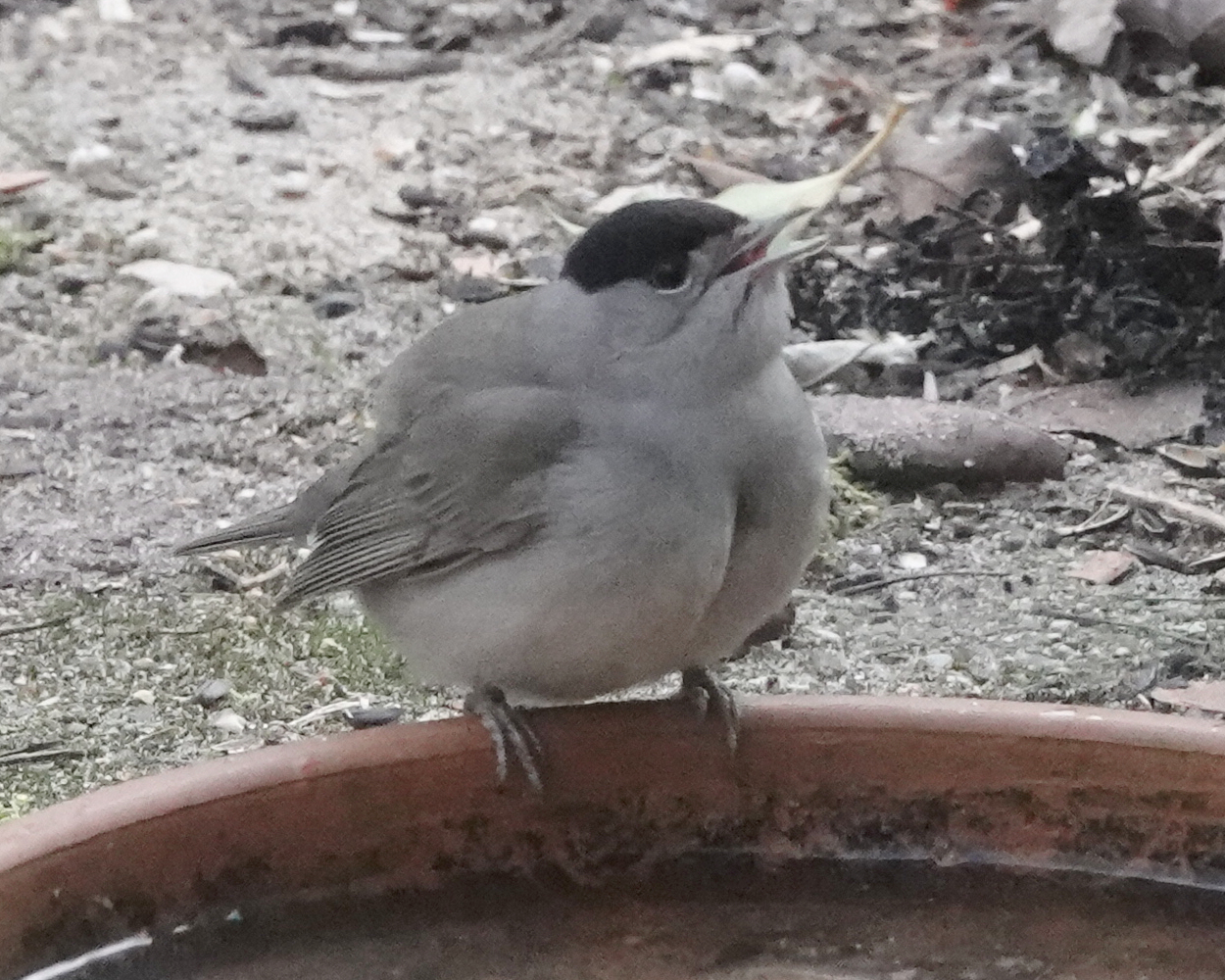
Overwinterende zwartkop! Overwintering Blackcap!


Zwartkop. 25 Jan 2026 Sylvia atricapilla 

Overwinterende zwartkop (mannetje)

Overwintering Blackcap (male)

25 January 2026 


Op 17 februari 2021 had ik een vrouwtje Zwartkop in de tuin! Zie dit blog. Op 8 februari 2021 weer een vrouwtje Zwartkop. 

Er zijn vandaag 25 januari in Nederland 11 automatisch of handmatig goedgekeurde waarnemingen van zwartkoppen, waarvan 9 met foto's, waarvan 3 vrouwtjes en 3 mannetjes herkenbaar op foto. In totaal zijn er in Nederland in de maand januari 187 goedgekeurde waarnemingen van de zwartkop. De provincies Utrecht, Zuid- en Noord-Holland hadden de meeste waarnemingen; de 3 Noordelijke provincies hadden de minste.

Maandag 26 januari 09:27 hij zit er weer! op de drinkbak! Op 3 februari zag ik hem weer. De dagen er na eet hij ook van een appel.

Het is bijzonder dat zwartkoppen overwinteren, want het zijn, net als andere kleine zangvogels zoals tjiftjaf en fitis, insecteneters en trekvogels. 


31 December 2025

Happy New Year!


Halsbandparkiet, Ring-necked Parakeet, Psittacula krameri


Happy New Year for all blog visitors!


Feasting on peanuts. Left: female. Right: male.


29 September 2025

Op heterdaad betrapt midden in de nacht: Segrijn slakken eten kitlaag van de ramen (met updates)

De schilder die ons huis aan het schilderen was, merkte op dat de kitlaag van de ramen aangetast was. Eerlijk gezegd was het mij nog niet opgevallen. Het kwam door slakken zei hij. Hij raadde dubbelzijdig plakband aan. Maar ik vond het nogal bizar dat slakken een (giftige?) kunststof zouden eten. Er is toch voedsel genoeg in de tuin?

Ik wilde eerst weten of het hele verhaal klopte. Ik had nooit slakken op de kitrand gezien. Dat zou dan 's nachts moeten gebeuren? Er was maar één manier om het raadsel op te lossen: die slakken op heterdaad betrappen. Ik wilde 's nachts de Seissiger wildcamera opstellen. Toen ik in het donker de tuin in liep, hoorde ik gekraak onder mijn voeten. En ja hoor: ik trapte op een slak. LED-lampje er bij gehaald: het wemelde van de slakken op het pad. Gefotografeerd en ingevoerd in waarneming: bijna allemaal Segrijnslakken. Ze hebben een grotere schelp dan de bekende huisjesslakken en de schelp heeft allerlei patronen en is fraai gekleurd. De soort komt van oorsprong uit Zuid-Europa. Volgens waarneming.nl heeft de soort inmiddels de status 'algemeen' en 'inheems' en dus niet 'exoot'. Ze eten vooral tuinplanten en zouden zelf ook goed te consumeren zijn [1]. Dat laatste was ik niet van plan.

Dit zijn de slakken die ik 's avonds tegen tienen aantrof op het tuinpad:

Segrijnslak 17 sep 21:36 FP5 ©GK

Segrijnslak 17 sep 21:37 FP5 ©GK

Segrijnslak 17 sep 21:38 FP5 ©GK

Segrijnslak 17 sep 21:39 FP5 ©GK

Zwartgerande tuinslak 17 sep 21:40 FP5 ©GK

Maar goed: 's avonds slakken op het tuinpad is nog geen bewijs dat ze ook van de kitlaag eten. Ik heb de wildcamera op timelapse gezet: iedere 5 min een opname. Op de sensor zetten werkt niet voor deze kleine en langzame dieren. En inderdaad, van 00:35 tot 03:30 u., was er een slak actief op de kitrand. Op heterdaad betrapt! Zo'n 3 uur op dezelfde plek!  

Seissiger wildcamera 19 sep 2025 00:30
Rode pijl: slak op de crime scene.
Groene pijlen: 2 aangetaste plekken.

Uit de opnames blijkt dat de slak naar een nieuwe plek is gekropen:

Seissiger wildcamera 19 sep 2025 00:35  
Op heterdaad betrapt. Rode pijl: slak.
Groene pijlen: 2 aangetaste plekken
 

Nadat hij zijn buikje vol gegeten had met de overheerlijke kit, verdween hij weer. De volgende ochtend was er een derde aantastingsplek te zien op de plek waar de slak bezig was geweest. Ik acht het voor 100% bewezen dat slakken de kit opeten. En voor 99% zeker dat het de Segrijnslak was. Omdat het donker was en de opnames in zwart-wit zijn, kan ik niet met 100% zeker concluderen dat het om deze soort gaat. Als je het 100% zeker wilt weten, zou je het DNA in de uitwerpselen moeten analyseren.  

De vraatsporen zijn vaak geribbeld en ongeveer 1 cm lang. Vaak vind je een langwerpig uitwerpsel in de buurt. Dat is een hint.  

Zo herken je de slak:
schade beeld in de kit met uitwerpsel
 

Segrijnslak in zijn natuurlijke milieu:

Segrijnslak op klimhortensia (SONY A6700 +macro)

detail van de kop

Gebeld met het schildersbedrijf. Ze stuurden vrij snel een glaszetter die de kitlaag begane grond verving door een ander product die de slakken niet zouden lusten. Ieder zijn vak. De kit is nu een week oud zonder schade.

Jika Sikaflex beglazingskit.

Update 7 Okt 25

Aan de voorkant van het huis was de kit nog niet vervangen en ik betrapte een 100% Segrijnslak op heterdaad op klaarlichte dag! 

100% Segrijnslak Cornu aspersum 7 Okt 2025 13:40u

Hij was op dat moment 'in rust', maar hij zat op een aangetaste plek op de kit. Het is nu 100% bewezen dat het Segrijnslakken de kit aantasten. Ik heb hem voorzichtig los gemaakt en in het bos gezet. Ik heb nog geen gewone huisjesslakken dit zien doen.


Hij was actief aan het kruipen toen ik hem naar binnen haalde voor de foto. Bij wijze van experiment heb ik hem op de nieuwe slakken-bestendige kit gezet. Hij had geen belangstelling, hij kroop gewoon weg. Het kan zijn dat al zijn buikje vol had... 
 

Noten

  1. Voor 90.000 euro aan slakken gestolen bij Franse kweker (NOS, 29 nov 2025). In het stuk staat niet vermeld dat het om de Segrijnslak gaat, maar de foto laat duidelijk Segrijnslakken zien. ObsIdentify is het er mee eens. Het is in Frankrijk een delicatesse!


Bronnen

Segrijnslak (wikipedia):  

  • "De segrijnslak is een nachtdier." (klopt!). 
  • "In Nederland en België is deze slakkensoort niet inheems, maar toch wijd verspreid". Waarneming.nl noemt de soort "algemeen, inheems".
  • Exoot: "In andere werelddelen is de segrijnslak een succesvolle exoot, die na de introductie tot plagen kan leiden."
  • "Segrijnslak als plaagdier": maar er staat niets over het eten van kit. Misschien kan hij bestanddelen van de kit (kalk?) gebruiken voor de opbouw van zijn huisje?
  • Gastronomie: "De segrijnslak is zeer gewaardeerd als escargot."


14 September 2025

Vrouwelijk topmodel gezocht en gevonden. Dit vrouwtje Wespspin blijkt het ideale fotomodel!

Wespspin ♀ 27 aug 2025 Sony A6700 + 90mm macro ©GK

Het gebeurt zelden dat een vrouwelijk fotomodel zich vrijwillig aanbiedt. Zeker niet om vervolgens 2 dagen en nachten stil te blijven zitten. En al helemaal niet dat ze toestaat om haar heel dicht te benaderen. 

Dit vrouwtje Wespspin bleek een ideaal fotomodel. Ze is exotisch mooi. Ze had zelf voor de ideale witte achtergrond gezorgd. Op ooghoogte. Perfecte keuze. Normaal bouwen wespspinnen hun web dicht bij de grond tussen het gras. Dan zijn ze moeilijk te fotograferen. Vandaar dat ik zo blij was met dit vrouwtje. Het is uitzonderlijk dat je macrofoto's kunt maken van een levende spin. Ik had nooit eerder een wespspin gezien. Dit was mijn eerste.

De Wespspin Argiope bruennichi (Wasp Spider) is een spin afkomstig uit Zuid-Europa. De soort wordt aangetroffen in graslanden die zelden gemaaid worden maar ook in heidevelden. Vandaar dat het belangrijk is voor natuurbeheerders om dit soort graslanden niet te maaien!

Wespspin 28 aug 2025 Sony A6700 90 mm macro f/14,0 1/125 ISO400 ©GK

Wespspin 28 aug 2025 Sony A6700 90 mm macro f/8,0 1/125 ISO100  ©GK

De spin heeft 2 primaire ogen en 4 extra secundaire ogen. De primaire ogen zijn naar voren gericht. Van de extra ogen is de linker naar links, en de rechter naar rechts gericht. Zij moet mij en de camera dus uitstekend gezien hebben! En toch blijft ze stil zitten. Wonderlijk! Hoewel, als je er over nadenkt, als er iemand een geduldig karakter zou moeten hebben, dan is het wel een spin. Hartelijk dank voor je geduld! Je bent het beste fotomodel dat ik ooit gehad heb!

De wespspin richt zich vooral op springende en laagvliegende prooien zoals sprinkhanen, libellen en kevers, die tussen de grassen leven. Ik heb inderdaad in het hoge gras rondom het huisje een Grote groene sabelsprinkhaan, een Bruinrode heidelibel en een Hennepnetelgoudhaan (is een kever) gezien. Dat zou dus allemaal kunnen kloppen. We hebben hier te maken met een klein deel van een ecosysteem!


Grote groene sabelsprinkhaan ©GK
Bruinrode heidelibel ©GK

Hennepnetelgoudhaan  ©GK


Bronnen

  • Waarneming.nl: Wespspin. Opmerkelijk: de soort wordt niet (meer?) aangemerkt als 'exoot'.
  • Jan van Duinen heeft een diepgaande studie gemaakt van de levenscyclus van wespspinnen in zijn tuin met ontzettend veel mooie foto's. 
  • Wespspin (wikipedia). 


Postscript

Rolie Barth maakte mij erop attent dat deze wespspin maar 5 poten heeft! Laat ik dat nu totaal 100% over het hoofd gezien hebben! Ik was zo gefocust op een goede foto maken dat ik niet gezien heb dat er 3 poten ontbraken. Een blunder. We hebben hier dus te maken met een beschadigd vrouwtje Wespspin. Ik weet niet of dat iets te maken heeft met haar lethargisch gedrag.