Showing posts with label genetica. Show all posts

15 January 2026

A review of 'The Music of Life' by Denis Noble. Noble is not a clown!

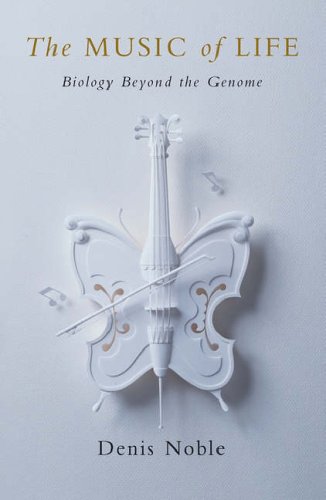
The Music of Life. 
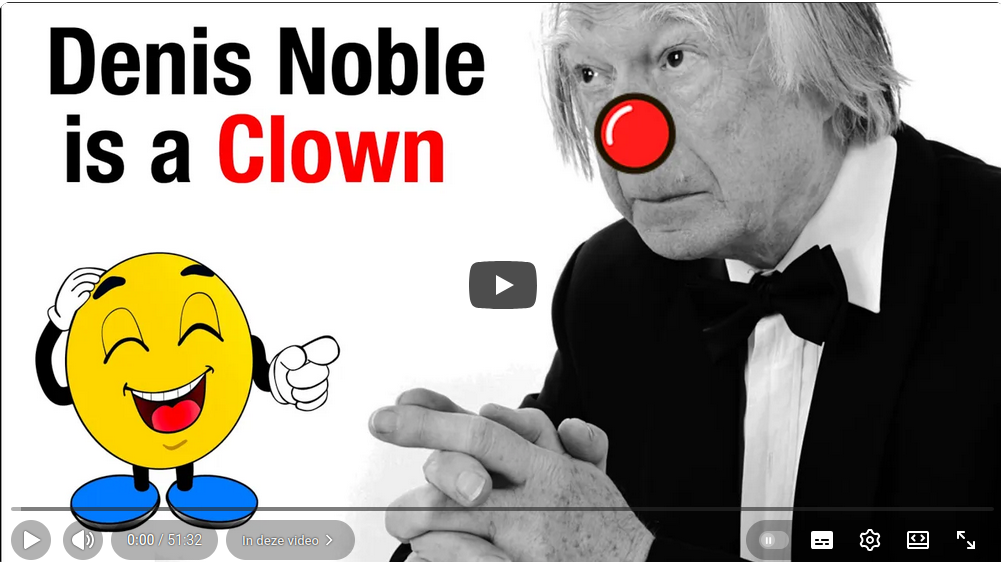
Denis Noble has been unfairly attacked. One YouTuber, 'professor Dave', called Noble 'a clown' [1]. Evidently, attacking a person rather than his theory is always wrong. One of Noble's books, The Music of Life. Biology Beyond the Genome [2], contains very valuable insights about problems of DNA-centrism. Noble has gone too far in later books, but it would be foolish to ignore the very valuable insights about DNA-centrism and 'the selfish gene' in this 2006 book. Here I give a summary of his insights. His insights are in agreement with ideas in my previous blog posts about DNA-centrism [3], [4] and some of his ideas are a useful addition to my ideas.

The amazing thing is that Noble's criticism doesn't contain controversial facts. His facts are all mainstream scientific facts. The facts are not the problem. It is just that the views about the precise role of DNA in organisms in mainstream science literature is an inaccurate description of what is really going on in a cell. Noble doesn't deny the importance of DNA. It is the routine mainstream science writing about DNA that is wrong. The way mainstream science writes about DNA is based on a bad habit that crept unnoticed into the literature after the discovery of the structure of DNA in 1953, and culminated in Richard Dawkins' The Selfish Gene in 1976. 

The book The Music of Life is about systems biology. It is about putting together rather than taking apart, integration rather than reduction. DNA is important, but is not 'the control centre of the cell'. The genome is not a privileged level of causality in biological systems. The genome is on a 'lower' level than the cell. The cell or the organism is 'the system'. The genome is part of the cell, and the cell is part of the organism. The genome only functions within a system. Reducing the cell to its genome is reductionism. Reductionism as a method to discover the parts of a system is necessary and should not be replaced by anything else. The system level must be built on successful reduction. 

According to Noble, DNA as a biological molecule does not do much. The real players are the proteins. DNA is in comparison rather passive. (How could a passive part control anything?). I think that Noble's statement:

'the cell reads the DNA code'

could be called 'the central dogma of systems biology or cell biology'. This statement must be printed in a bold, large font in every biology and evolution textbook. It is a perfect antidote to the DNA-centric worldview. Here, the cell is the active part. The cell is the system. From this principle, it follows that we must describe the genome as a database (or an archivelibrarytoolbox, memory ) that is transmitted to the next generation, rather than a 'program' that creates organisms. How could a database with protein-coding genes create an organism? There must be an organizing principle. Something has to choose which genes are to be read in which cells (in a multicellular organism like us). Our worldview influences how we describe what happens in a cell. So, the language we use to describe DNA is important. The language that scientists use, reveals the underlying worldview: DNA-centric or cell-centric.

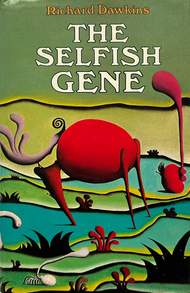
Richard Dawkins: The Selfish Gene

That is in particular true for expressions such as 'The Selfish Gene'. The way Noble analyses 'The Selfish Gene' idea is enlightening and new to me. 'The Selfish Gene' idea is in fact not a scientific theory at all, Noble says. No empirical test could possibly distinguish between 'selfish genes' and the opposite view  'genes as prisoners'. The genes are prisoners because they are trapped in huge colonies locked inside highly intelligent beings [5]. They are inside you and me; we are the system that allows their code to be read. The selfish genes do not create us, body and soul. Their preservation is totally dependent on our efforts to reproduce. We are the ultimate rationale for their existence. Additionally, Noble mentions that Dawkins agrees with him that the 'selfish gene' idea is not a scientifically testable hypothesis. I didn't realize that. Despite the fact that the selfish gene metaphor is not a scientific hypothesis, it continues to influence scientific research, thinking and writing. However, if it is an arbitrary view, then it doesn't deserve to be the standard view in biology and evolution. Noble presents us with an eye-opening alternative view.


Evaluation

I think, contrary to Noble, that there is a fact that can distinguish between the DNA-centric and cell centric view. That fact is that DNA as a molecule is passive. How could a passive molecule create you and me? A molecule that for every 'action', such as transcription, replication, recombination, repair or whatever, requires enzymes  [6]. In my view, this fact contradicts Dawkins' selfish gene view, because that view implicitly claims that genes actively control the actions of the organism. To be precise Dawkins says: we are robots obeying the commands of the selfish genes. I consider that claim as falsified. A database cannot dictate anything. Consequently, a theory of how an individual is created from a fertilized egg is far from complete by summing up all the necessary protein-coding and regulatory genes in the genome. The genes in our genome are an inventory that is necessary, but far from sufficient. Question: how do thousands of individual protein-coding genes and proteins create an individual? [7]. These are fundamental questions in biology which tend to be ignored by the standard gene-centric selfish gene account.

In several chapters, Noble elaborates the Systems view of the cell. It amounts to highlighting forgotten, uncontroversial facts. It certainly is worth reading, but I can not discuss it in this blog. My thoughts are this: molecular genetics after 1953 became a huge success, mainly because the discovery of DNA sequencing made it possible to identify genes and determine the fine-structure of genes. Additionally, genes can be experimentally modified, silenced and deleted. That enabled the determination of the functions of many genes. Furthermore, the expression of genes, even a large number of genes at the same time, could be detected. Undeniably, that is scientific progress. However, all these methods, taken together, strongly suggest that genes control everything: the development and daily running of the organism. Yes, genes are involved in almost everything, but strictly speaking, they do not control everything. The most fundamental and difficult question in biology remains unanswered: 
 
How do 25,000 protein-coding genes and proteins
 create an individual? [7]. 
 
How is that regulated? Who or what does orchestrate all this? There is more to organisms than DNA, genes, gene expression and protein synthesis alone.


Denis Noble is not a clown!

Professor Dave Explains: Denis Noble is a clown [1]

Contrary to what 'Professor Dave' claims: Denis Noble is not a clown! Don't let the loudmouths scare you away from reading The Music of Life and benefit from his insights. He is a serious and intelligent scientist. Don't be distracted by statements he made later in life.


Notes

  1. Professor Dave Explains: Denis Noble is a Clown 22 May 2025 is a video fiercely attacking the person Denis Noble.
  2. Denis Noble (2006) The Music of Life. Biology Beyond the Genome. In this review I use words and expressions from Noble's book to describe his position without giving page numbers. 
  3. Gene-centrism is bad biology. Here is why. my blog 17 December 2025
  4. What is DNA-centrism? Why is it wrong? my blog 10 November 2025  
  5. 'genes as prisoners' locked inside the nucleus of a cell: to me, it looks similar to the mitochondria which are also locked up in the cell and are completely depended on the host cell! Nice!
  6. The only 'exception' is self-splicing RNA. But RNA is not DNA, furthermore, RNA is the product of a transcription process that uses enzymes. 
  7. "one of the great unsolved mysteries of biology for nearly two centuries" from: Sean B. Carroll (2005) Endless Forms Most Beautiful (2005), page x Preface. I will return to interesting examples of Carroll's DNA-centric language.

10 November 2025

What is DNA-centrism? Why is it wrong?


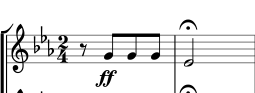
Question: is this music? Are the above symbols on a piece of paper music? What do you think?  My answer: of course not! It is encoded information. Only a specially trained person is able to read and translate that information into sounds with the help of specially designed devices. On their own, these ink stains are not music. 

Question: do the symbols on a piece of paper cause music? Are they the cause of music? My answer: of course not! The ink dots on a piece of paper are not the cause of the sounds we call music. Those symbols are dead and meaningless ink stains in themselves. One needs a person with specific knowledge of how to read and translate the symbols on paper. Furthermore, that person needs a special designed instrument. Do the hands cause the music? Or does the instrument cause the music? Or our ears? Or our brains? It is impossible to point to one cause. It is everything together. It is clear that here we have a chain of causal factors.


DNA centrism

"The basic principle is that if genes were abundantly available in the primordial pond, they could have randomly assembled to form various genomes, each capable of forming an organism." [1]

This is the most concise and extreme expression of DNA-centrism I know of. It is almost a definition of DNA-centrism in the context of the Origin of Life. The statement claims that life started with DNA. All you need is DNA and the organism will develop from it. On the other hand, in biology DNA-centrism means: DNA creates the organism. DNA is the cause of the organism. DNA controls every biological function in the organism. DNA-centrism in the context of Mendelian genetics is almost by definition gene-centrism because Mendelian genetics is not interested in the molecular details of how a gene affects the phenotype of the organism. For Mendelian genetics, the inner workings of an organism are a black box.

Now, let us ask the same questions about DNA as we did above about the musical notes on a piece of paper: does DNA cause an organism to develop, grow, breath and live? Of course not! Try it yourself: place a complete genome in a physiological saline solution in a Petri dish at 37°C and wait. Nothing will happen! But why? Because this is an unnatural environment? But if DNA has the power to create an organism, why does DNA do that? Apparently, DNA hasn't the power to create an organism. Apparently, the genome has to be in a cell and needs all the machinery to read and translate the information in the genome. Conclusion: it only seems that DNA is the cause of an organism because it is always in the right environment. We always assume the right environment.  

Compare this with the musical notes on paper: we are used to associating musical notes on paper with the sounds of music. Change a note (mutation) and the music changes (phenotype). But the musical notes on paper define, but do not create music. The right environment is required to create music [2]. We need a change of perspective to see this.

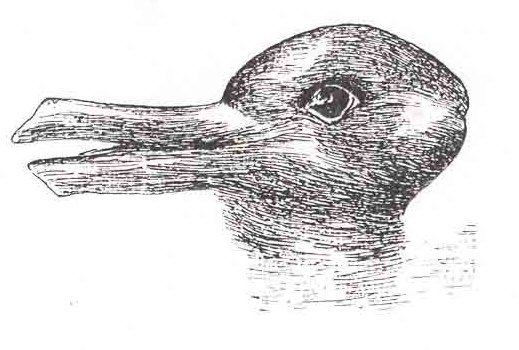
 Duck-Rabbit illusion (wikipedia)
Does DNA control the cell, or does the cell control DNA? 

We need a change of perspective because we have become the victims of the illusion that DNA itself controls everything. We forget that the cell controls the expression of genes. My eyes were opened at the moment that I realized that our DNA is a parasite in the same manner as a virus is a parasite. A virus is completely dependent on its host for its replication. A DNA genome is completely dependent on its host cell for its replication. DNA is replicated by the cell. DNA does not replicate itself. The cell delivers the resources for replication. The only difference with the virus is that 'our' DNA usually is for the benefit of the individual in which it is housed, whereas the virus DNA is detrimental to its host. But that does not give DNA special powers. In the Duck-Rabbit illustration above, the duck is DNA-centrism and the rabbit is cell-centrism. It is difficult to change perspective. It is even more difficult to see both perspectives at the same time. Since the birth of genetics, scientists always saw the duck (DNA controls the organism). Now it is time to see the rabbit. And when we have succeeded, we should try to see both. That takes some effort. But it is worth it because a scientific theory should not depend on one perspective. 


But what about genetic diseases?

Genetic disease seem to be a very strong argument against my position and for  DNA-centrism. What is the cause of Cystic Fibrosis? The answer: Cystic Fibrosisis is caused by a mutation in the CFTR gene. What is the cause of Huntington's Disease? Answer: HD is caused by a mutation in the Huntingtin gene. What is the cause of Duchenne Muscular Dystrophy? DMD is caused by a mutation of the dystrophin gene. What is the cause of Sickle cell disease? Sickle cell disease is caused by a mutation in the HBB gene. A clear case for DNA-centrism?

No. On closer inspection, it appears that genetic diseases are an argument against DNA-centrism. This is because all cells in our body have the same genome. If the fertilized egg (zygote) has a mutation, all cells in our body necessarily have that mutation. Yet, genetic diseases tend to affect specific organs in our body: blood, brain, muscles, heart, lungs, intestines, eyes, ears, etc. How could that be if all cells harbour exactly the same genome? Answer: it is the difference in expression of genes. Do genes express themselves? Of course not. Factors outside DNA trigger gene expression. Additionally, genetic diseases often start at different ages. For example, symptoms of Huntington's Disease typically appear in middle-aged people. How could that be? The genome doesn't change with age. Again: gene expression changes with age, not the gene itself. This is an argument against DNA-centrism because these examples show that DNA is passive, and factors outside DNA cause gene expression in specific organs at specific times. To understand this correctly, the whole cell should be in the centre ('cell-centric view of life'). 

Origin of Life 

The DNA-centric view of life spectacularly fails in the context of the Origin of Life. That's a hint that should make us think again. Life didn't and couldn't start with DNA. That is because DNA is a dead and meaningless molecule. It has no activity on its own. That is the famous vicious circle: the enzymes that transcribe and translate DNA must be present before those very enzymes can be produced.

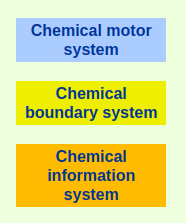
Another powerful reason why DNA-centrism is wrong is that DNA is only one of the three components that constitute life:

Tibor Gánti model of life [3]

All living entities have three components:
  1. chemical motor system: metabolism that produces the energy to run and maintain the organism
  2. chemical boundary system: cell membrane that separates the inside from the outside of the cell
  3. chemical information system: the hereditary material (DNA) 

Not one of the subsystems is dominant, all three determine the living organism. One subsystem is a chemical system and nothing more. 

This blog is an attempt to summarize my position, not a review of the literature. My position does not downplay the importance of DNA [4], I emphasize the passive role of DNA. This does not contradict any facts. However, my position appears non-mainstream due to sloppy language use in the scientific literature [5].


Acknowledgements

Susan checked my English. Thanks!


Notes

  1. Periannan Senapathy (1994) 'Independent Birth of Organisms. A New Theory That Distinct Organisms Arose Independently From The Primordial Pond Showing That Evolutionary Theories Are Fundamentally Incorrect'. Introduction page 5.
  2. Don't push the analogy with musical notation too far! Music is an event with a clear beginning and an end in time. It is produced by starting to read and translate the first note on paper, and to continue until the last note and stops there. Music or a book have a beginning and an end. This is not the way an organism is produced from a DNA genome. The genome has no beginning and end. There is no 'first' gene to start with in order to produce an organism. Secondly, the sheet music doesn't include instructions to build a musical instrument. On the other hand, there is a useful similarity here: musical notation on paper is a handy way to store and copy 'music'Just like DNA.
  3. Tibor Gánti (2003) The Principles of Life. (my review)
  4. Philip Ball (2024) downgrades DNA to an extreme degree. For example, he relegates the 1962 Nobel Prize for DNA to a footnote. A blunder. (see my blogpost). In that blog post, I have already made many of the same points I make in this post.
  5. For example: "Central to this are enhancers and promoters, DNA sequences that dictate the location, timing, and intensity of gene expression." in A tighter grip on gene expression, Science 3 Jul 2025. Note: "dictate", "timing". Especially, 'timing' is mysterious. How do DNA sequences dictate timing? I asked the author. No reply. I think this is a sloppy language caused by a DNA-centric view. [ 11-11-25 ]

29 October 2024

De lange voorgeschiedenis van de Covid-19 vaccins

update #46

Even een kort blogje over de bewering dat de Covid-19 vaccins niet grondig getest zijn, en veel te snel op de markt gebracht zijn. 

Dit naar aanleiding van de discussie op een blogpost van 2 jaar geleden over een publicatie van Ronald Meester over de vermeende dodelijke bijwerkingen van de Covid-19 vaccins. Maar vooral naar aanleiding van het boek The Catalyst: RNA and the Quest to Unlock Life’s Deepest Secrets door Thomas R. Cech dat dit jaar verscheen. In een volgend blog wil ik een wat uitgebreidere boekbespreking posten in het Engels. Hier ga ik uitsluitend kort in op de kwestie hoe het kon dat RNA Covid-19 vaccins zo snel op de markt kwamen.

De naam Thomas R. Cech is voor altijd verbonden met de ontdekking van de enzymatische (katalytische) werking van RNA. Hij ontving hiervoor de Nobelprijs in 1989. Alweer een tijdje geleden. Cech behandelt Covid-19 vaccins in hoofdstuk 10.

Belangrijkste opmerking:

"How did scientists do it so quickly? The short answer is, they didn't. While the Covid-19 vaccine did appear in record time, it was built on decades of scientific breakthroughs."

Door gebrek aan kennis begonnen er al snel complot (conspiracy-) theorieën te circuleren. mRNA vaccins zijn inderdaad nieuw. Tot nu toe werden delen van virussen of levende verzwakte virussen of  recombinant DNA-technieken gebruikt als vaccin (echt waar, zie rivm info). Dit gebeurt niet bij mRNA vaccins. Daar wordt een stukje boodschapper RNA in een vetbolletje gebruikt. Boodschapper RNA (mRNA) is een onmisbaar onderdeel van de eiwitsynthese in iedere cel. Het is dus geen menselijke uitvinding of zo. Fundamenteel onderzoek naar RNA werd in de jaren 80 van de vorige eeuw gedaan uit pure wetenschappelijke nieuwsgierigheid. Dat onderzoek was niet uit op welke toepassing dan ook. Daarna volgt een lange geschiedenis van nieuwe ontdekkingen op het gebied van RNA door talentvolle, creatieve wetenschappers die buiten de gebaande wegen durfden te gaan. De producenten van het vaccin, Moderna en BioNTech, waren in januari 2020 nog onbekende biotech start-ups. De rest is history. De hele geschiedenis plus alle andere wetenschappelijke en medische RNA toepassingen worden op een leesbare manier beschreven in het boek van Thomas R. Cech. Daarover in een volgend blog meer.

Het beloofde blog is: 

Thomas R. Cech (2024) 'The Catalyst'. Covid-19 vaccines were built on decades of scientific breakthroughs and Nobel Prizes. 18 Nov 2024

Voor alle SARS-CoV-2 blogs klik op het label:

28 July 2021

Molecular evolution pioneer Richard Lewontin dies at 92

Richard Lewontin (1929-2021)

Molecular evolution pioneer Richard Lewontin died at 92. His ground-breaking publication was The Genetic Basis of Evolutionary Change (1974). In 1979 he wrote together with Steven Jay Gould the famous article "The Spandrels of San Marco and the Panglossian Paradigm: A Critique of the Adaptationist Programme". He was also known for his Marxist writings criticizing genetic determinism, social inequality and racism: Not in Our Genes (1984, together with Steven Rose and Leon Kamin); Biology as Ideology: The Doctrine of DNA (1993); The Triple Helix. Gene, Organism, and Environment (2000);  and It Ain't Necessarily So. The dream of the human genome and other illusions (2001).

To understand what was so revolutionary about Lewontin's contribution to evolutionary biology, we need to go back to the time before DNA sequencing. Today we see thousands of SARS-CoV-2 sequences being published almost on a daily basis. We can follow the spontaneous origin, spread or disappearance of new variants over the planet. Variation is the cornerstone for Darwin's theory. But the only variation available to Darwin was morphological variation. When Lewontin started his research in the mid sixties certain variations of proteins were detectable by a technique called electrophoresis. This technique could detect protein size differences and differences in electrical charge. Lewontin applied this technique to detect mutations in natural populations of Drosophila. That is, mutations that changed the size or electrical charge of a protein compared to the wildtype protein. In this way he could measure the degree of heterozygosity. Heterozygous refers to having inherited different forms of a particular gene (or protein) from each parent. Lewontin and Hubby found to their surprise that an average individual was heterozygous at 12% of its genes. The other 88% is homozygous (two identical copies of a gene).

Why is this so important for evolution? Suppose there was no genetic variation in natural populations. All individuals are homozygous, as if they were clones. Or identical twins. Then natural selection could do nothing. No evolution. But as soon one of the two copies of a gene has mutated, natural selection could favour one over the other. Textbooks say: "variation is the raw material for evolution." Darwin was right about that.

This study was soon followed by many others. The results were always: every individual in a population is genetically unique because there are potentially hundreds to thousands of variants of each gene and each individual harbours different combinations of all those gene variants. That was big news at the time. It transformed the way scientists think about evolution.

Researchers wondered why all those variant forms were not eliminated? Why don't we see only the wildtype? Are they random variations with no effect on fitness? Why did natural selection not eliminate them? In other words scientists at the time worried there was too much variation. Natural selection is a costly process ('the cost of natural selection problem'). Selection requires differential survival or reproduction. Later these questions led Kimura to propose his now famous 'The neutral theory of molecular evolution'.

Still later protein and DNA sequencing revealed far more differences between individuals. The first study of genetic variation using DNA sequences was published in 1983. That is 30 years after Watson and Crick published the structure of DNA. The rest is history. Today the study of evolution is the study of variation at the DNA level. 

The popular science books I mentioned above are within a different category. Difficult to summarize. These books are a mix of political activism, science criticism, and popular science. Often written from a political perspective or highly critical to mainstream scientific views on adaptation, genetic determinism, development, and the role of the environment. Undoubtedly, the most famous is the article he wrote with Steven Jay Gould: 'The spandrels of San Marco and the Panglossian paradigm: a critique of the adaptationist programme' (1979). 


See also an obituary of Lewontin in Nature: Richard C. Lewontin (1929–2021). Pioneer of molecular evolution who campaigned against biological racism.


What the textbooks say about Lewontin

  • Douglas Futuyma (2005) Evolution. Lewontin is not in the index, but present in Literature list and a good discussion of the importance of his work can be found in the paragraph 'Genetic variations in proteins', page 203.
  • Stephen Stearns, Rolf Hoekstra (2005) Evolution: an introduction. Lewontin is not in the index, not in the Literature cited, but he is mentioned on page 31: "... Lewontin and Ayala, for gene products detectable by electrophoresis, ... have shown that a great deal of genetic variation is present in natural populations for many types of trait and organism." (page 31).
  • Freeman and Herron (2007) Evolutionary Analysis, 4th Edition. Lewontin is in index and discussed in paragraph 5.4 'Measuring genetic variation in natural populations'. 
  • Nicholas Barton et al (2007)  Evolution. Lewontin is in the index and S. J. Gould, Lewontin (1979)  is discussed in the text. 
  • 'Strickberger's Evolution' (2008). Lewontin is not in the index but in Literature cited. I could not find him in the text. 
  • Carl Bergstrom, Lee Alan Dugatkin (2012) Evolution. Lewontin is discussed in 8.5 'The Neutral Theory of Molecular Evolution', page 276. They consider the work of Lewontin as a prelude to The Neutral Theory of Molecular Evolution. 
  • Carl Zimmer, Douglas Emlen (2013) Evolution. Making Sense of Life. They have replaced Lewontin with modern day examples of genetic variation in populations.


08 June 2020

Waarom zijn corona virussen zo groot? KNAW lezing van Eric Snijder 19 mei 2020

Er is iets merkwaardigs met de corona virussen: ze zijn groter dan alle andere RNA virussen:


Corona virussen vallen op door hun uitzonderlijke genoomgrootte
dat geldt zowel voor SARS-CoV-1 als SARS-CoV-2 (Eric Snijder)


Corona virussen hebben een RNA genoom van plm. 30.000 bases en dat is 2x–3x groter dan de rest van de RNA virussen. Evolutiebiologen dachten altijd dat RNA virussen een beperkte grootte hadden omdat RNA een hogere mutatiefrequentie heeft dan DNA. Coronavirussen zijn geen retrovirussen, want op geen moment er is er DNA betrokken in de reproductie cyclus van het virus.

mutatiefrequentie mens t.o.v. virus (Eric Snijder)


De mutatiefrequentie van planten- en dierencellen is 1 op de 109. Dat is 1 fout op de miljard gekopieerde bases. Onvoorstelbaar nauwkeurig! De mutatiefrequentie van RNA ligt rond de 1 op de 104. Dat is 1 op de 10.000. Dat is een gigantisch verschil. Hoe kan dat? De verklaring is dat DNA stabieler is dan RNA èn dat op DNA gebaseerde organismes een uitgebreid foutcorrectiesysteem hebben. Een klein RNA virus overleeft een mutatiefrequentie van 1 op de 104 (zie rekenvoorbeeld in kader). Maar hoe kan een groot corona RNA genoom zich handhaven? Waarom gaat het niet ten onder aan een steeds groeiend aantal (schadelijke) mutaties? Coronavirussen leven boven hun stand!


In een interessante KNAW online college wijst moleculair geneticus Eric Snijder (Universiteit Leiden) er op dat de grotere corona virussen een foutcorrectie gen (nsp14-ExoN) hebben opgepikt van een gastheer in de loop van hun evolutie. En dat gen is zeer waarschijnlijk de verklaring voor het grotere genoom van de coronavirussen. Kleinere RNA virussen hebben het niet. De grotere wel. Dat is een belangrijke hint. Dit is een spectaculaire vondst. Dat is nieuw voor mij. Het geheim van corona: een RNA virus met foutcorrectie! Evolutie tekstboeken moeten herschreven worden.

Manfred Eigen
Het idee dat er een relatie bestaat tussen genoomgrootte en een maximum aantal kopieerfouten, is afkomstig van Nobelprijswinnaar Manfred Eigen. Een bekende en beroemde naam in de evolutiebiologie. Hij heeft de begrippen error threshold, error catastrophe, Eigen's paradox in de jaren 70 in de evolutiebiologie geïntroduceerd. Al weer 50 jaar geleden. Ze zijn van blijvende waarde omdat die begrippen zo fundamenteel van aard zijn. En Eigen was niet eens een evolutiebioloog. Een foutcatastrofe betekent dat boven een bepaalde mutatiefrequentie een genoom van een bepaalde lengte niet meer in stand gehouden kan worden. Er zijn neutrale, negatieve en positieve mutaties. Als de negatieve mutaties niet worden gecorrigeerd, krijgt een soort last van een sterke negatieve selectie. Er blijven steeds minder gezonde individuen in leven. Tot er een kantelpunt wordt bereikt. En het genoom instort. De populatie sterft uit.

Toren van Pisa


Toren van Pisa
≈ korter genoom
hogere toren
≈ langer genoom
valt eerder om


Speciaal voor onze vrienden in Italië: de toren in Pisa is een leuke illustratie van de error threshold. Een error threshold is vergelijkbaar met de hellingshoek van de toren van Pisa. Wanneer de hellingshoek groter is dan 5,5 graden (met gelijkblijvende hoogte) valt de toren om. Dat is letterlijk en figuurlijk het kantelpunt! Is de hellingshoek kleiner dan 5,5 graden dan kan hij nog eeuwen blijven voortbestaan. De maximale hellingshoek hangt af van de hoogte van de toren. Heb je een hogere toren dan is de maximale hellingshoek kleiner. Maak je de toren kleiner dan is het probleem ook opgelost. Maar als je technische maatregelen neemt om hem rechter te zetten of hem te verstevigen, dan blijft hij staan. En dat is gedaan met de toren van Pisa. Daarom valt hij niet om.
Vergelijk dit met het coronavirus. Een coronavirus (lengte 30.000 bases) is (voor zover nu bekend) groter dan alle overige RNA virussen. Het coronavirus 'valt om' als het 1 op de 10.000 of meer mutaties heeft [1]. Tenzij je een gen hebt dat het aantal fouten verlaagt tot bijvoorbeeld 1 op de 100.000. En precies dat is er aan de hand is met coronavirussen [2]. Coronavirussen hebben met een 'reparatiegen' hun genoom verstevigt zodat ze nog eeuwen kunnen blijven voortbestaan. Net als de toren van Pisa.


Corona virus gehoorzaamt Darwin


(Eric Snijder)
Prof. Eric Snijder benadrukt dat virussen de wetten van natuurlijke selectie van Darwin volgen. De evolutie van virussen speelt zich af in dagen, weken en maanden in plaats van miljoenen jaren. Dat zie je in de volgende 2 illustraties:

Links: rood = 1 virus deeltje. Rechts: na vermenigvuldiging
duiken twee blauwe mutanten op. (Eric Snijder)

in een andere gastheer is de blauwe mutant voordelig (Eric Snijder)
Er is positieve selectie voor de blauwe en negatieve selectie voor de rode mutant.
 

Genetische mutanten die het virus produceert komen in verschillende aantallen terecht in de volgende generatie. De gastheer bepaald welke mutanten het beste reproduceren. Het milieu selecteert. Dat heet natuurlijke selectie. In de plaatjes hierboven produceert een virus-stam behalve identieke kopieën (rood) ook een paar mutanten (blauw). In een andere gastheer is de oorspronkelijke virus stam juist ongunstig en kunnen alleen de nieuwe mutanten (blauw) vermenigvuldigd worden. De rode stam is vervangen door de blauwe stam. Eén mutatie, een puntmutatie, kan al voldoende zijn. En die variant produceert ook weer een paar mutanten (groen, oranje). There you have it: mutatie + selectie = evolutie. Prof. Snijder merkt op dat Darwin niets van virussen wist (klopt!), maar virussen gehoorzamen de wetten van Darwin. Dat komt omdat die wetten zo fundamenteel zijn. Alles wat zichzelf reproduceert met erfelijke variaties die voordelig of onvoordelig zijn afhankelijk van het milieu, is onderhevig aan natuurlijke selectie. Dat is evolutie.


Rekenvoorbeeld

-Stel je hebt een genoom van 100 bases en stel dat je een mutatiefrequentie hebt van 1:10. Dat wil zeggen dat er bij iedere kopieerronde 10 gemuteerde bases en 90 intacte bases ontstaan. Als je 10 kopieer rondes achter de rug hebt en als er geen selectie optreedt, en als er steeds andere bases muteren, zullen er 100 bases van de 100 originele gemuteerd zijn. Dus alles is gemuteerd. Het origineel is verdwenen. Een meltdown. 
-Stel dat je een mutatiefrequentie hebt van 1:100 dan zal er na 1 kopieer ronde maar 1 base van de 100 gemuteerd zijn en duurt het 100 kopieer rondes voordat alles gemuteerd is. 
-Stel dat je een mutatiefrequentie hebt van 1:1000 dan zal er pas na 10 kopieer rondes 1 mutatie opgetreden zijn in 1 nakomeling. En pas na 1000 kopieerrondes is het hele genoom van 100 bases gemuteerd.
Dit zijn rekenvoorbeelden. In werkelijkheid is een gemiddeld virusgenoom 10.000 bases lang en de mutatiefrequentie 1:10.000 en zal er dus na 1 kopieer ronde 1 base gemuteerd zijn. En duurt het theoretisch 10.000 kopieerrondes voordat het hele genoom weggemuteerd is (meltdown). Een coronavirus met een genoom van 30.000 bases zal met die mutatiefrequentie 3 mutaties hebben na 1 kopieerronde, en zal 3x zo snel tot meltdown komen.


Postscript: profetische uitspraken Mark Ridley


Twintig jaar geleden deed Mark Ridley profetische uitspraken in zijn voortreffelijke maar zeer ondergewaardeerd en vergeten boek Mendel's Demon dat in het jaar 2000 verscheen. 

Het boek heeft een blijvende invloed op mijn denken uitgeoefend. Hij schreef het vóór de SARS-1 en SARS-2 epidemie. Over RNA virussen schrijft hij de profetische woorden:
"Never has so much suffering been caused by so little nucleic acid" [5].
Inderdaad. Dat was naar aanleiding van polio, HIV en influenza. Zijn uitspraak is zeer van toepassing op SARS.
Ridley schat de mutatiefrequentie van RNA virussen op 1 : 103 tot 1 : 105. Als gemiddelde waarde neemt hij 1:30.000. Dat is toevallig de lengte van het SARS-CoV-2 genoom! Dat zou betekenen dat iedere kopie van het SARS-CoV-2 één puntmutatie heeft. En dit is te danken aan het RNA-polymerase die RNA moet kopieren. Zonder RNA-polymerase zou 1 op de 100 bases gemuteerd zijn, schrijft hij. Ridley wist toen nog niets van het unieke error-correctie mechanisme ExoN waar Eric Snijder het over heeft en waardoor corona virussen de uitzonderlijke lengte van 30.000 bases kunnen bereiken. Is de schatting van Ridley toeval? Of is de bovengrens van plm. 30.000 al 20 jaar hetzelfde? Misschien wijst de kloof in genoomlengte tussen corona en de andere RNA virussen (in de grafiek van Snijder) alleen maar op ontbrekende gegevens. Dat kan. Volgens Ridley hebben RNA virussen een genoomgrootte van 3.000 tot 30.000 bases. In dat geval ziten corona virussen gewoon aan de bovengrens van de genoomgrootte van RNA virussen. Verder meldt Ridley dat RNA virussen een variabele kopieerbetrouwbaarheid hebben. Ja, dat kan kloppen. De vraag is: is die variatie van dien aard dat je continuïteit moet verwachten in genoomgrootte of is het ExoN gen zo uniek en zo effectief dat er een kloof ontstaat in genoomgrootte? Verder onderzoek zal het leren. We hebben van Ridley geleerd dat er een noodzakelijk verband is tussen kopieernauwkeurigheid en genoomgrootte. Die het weer van Eigen heeft geleerd. 

Conclusie: het corona virus heeft een genoomgrootte dat aan de bovengrens zit van wat een RNA virus met een RNA-polymerase en een daarbij horende mutatiefrequentie kan bereiken

Wat er ontbreekt in het verhaal van Eric Snijder is de mutatiefrequentie van SARS-CoV-2 [7] en een berekening wat dat betekent voor de maximale lengte van het virus [6]. En nog belangrijker: hoe is de mutatiefrequentie met en zonder dat speciale proofreading gen ExoN? Ik vond in de literatuur [3] dat het experimenteel uitschakelen van ExoN in SARS-CoV-1 een 21-voudige verhoging van het aantal mutaties tot gevolg had! Dat is inderdaad een heel groot effect. De functie van het ExoN is daarmee voorlopig redelijk goed aangetoond: proofreading. Het is dan even niet zo belangrijk hoe het virus aan dat gen komt (gestolen of niet). Belangrijk is het effect dat het heeft. Dit zou de discontinuïteit van genoomgrootte kunnen verklaren:  er zijn virussen die ExoN hebben en zij die het niet hebben. De haves and have-nots. De coronavirussen als de elitevirussen!

Een andere vraag is: een hoge mutatiefrequentie is toch juist voordelig voor het virus? Denk aan HIV en influenza. Snellere evolutie is immers voordelig om je gastheer te slim af te zijn. Maar het nadeel is dat als je veel genen hebt die bepalend zijn voor je succes in de nieuwe gastheer (de mens), dan wil je die genen ook niet kwijtraken door mutatie. Ik geeft toe: dit is een lastig probleem. Misschien zijn er twee oplossingen voor hetzelfde probleem.

Ik vind een grote discontinuïteit evolutionair gezien onwaarschijnlijk. Er zullen vast vele manieren zijn om de replicatiebetrouwbaarheid te verhogen met tussenliggende betrouwbaarheden. Er is in ieder geval een groot verschil tussen single-stranded (ssRNA) en double-stranded (dsRNA), en tussen positive-strand en negative-strand RNA virussen [4]. dsRNA virussen lijken de kloof te overbruggen. Snijder heeft het niet over verschillende soorten virussen gehad. Bovendien is die discontinuïteit zeer waarschijnlijk een toevallig feit. Geen noodzakelijkheid zoals het verband tussen mutatiefrequentie en genoomgrootte.


Postscript 30 juni 2020

In een Scientific American interactieve visual wordt helemaal aan het einde prachtig uiteengezet dat het SARS-CoV-19 virus groot is en waarom. Aanbevolen. Vrijwel helemaal in overeenstemming met het verhaal van Eric Snijder. De hele visual is een absolute aanrader!
genoomlengte van 6 virussen vergeleken. ©Scientific American.
Ook hier is een gap te zien van plm 10.000 baseparen

For a static version of this content as it appears in the July 2020 issue of Scientific American, please click here.


Noten

  1. Want dat is de mutatiefrequentie van andere virussen. Dit is mijn veronderstelling want Snijder noemt de mutatiefrequentie niet. Het moet ergens tussen de 1 op de 104 en 1 op de 109 liggen. Waarschijnlijk dichter bij de andere virussen dan bij die van de hogere planten en dieren.
  2. Een virus profiteert van de machinerie van de gastheercel. Waarom zou hij dan niet kunnen profiteren van een error-correctie mechanisme van de gastheer? Dan hoeft het virus zijn eigen genoom niet met dit gen te belasten en kan zijn genoom kleiner zijn en tegelijk nieuwe nuttige genen in zich opnemen. Als de gastheer de error correction verzorgt is er geen grens aan de grootte van het genoom. Kan het zijn dat zoogdiercellen geen RNA error correction systeem hebben?
  3. Lance D. Eckerle et al (2010) Infidelity of SARS-CoV Nsp14-Exonuclease Mutant Virus Replication Is Revealed by Complete Genome Sequencing, PLOS Pathogens. Waarschijnlijk baseert Snijder zich op deze publicatie.
  4. Viral Genome Size Distribution Does not Correlate with the Antiquity of the Host Lineages, Frontiers in Ecology and Evolution, 2015. 
  5. Hoofdstuk 4 'The history of error' van Mendel's Demon is speciaal relevant voor de huidige covid-19 pandemie. Met name pagina 88-89 zijn zeer relevant. Zie ook mijn review van het boek op mijn WDW site. Nog iets leuks uit zijn boek: uit het bovenstaande volgt dat foutcorrectie (proofreading) en nauwkeurige replicatie de Achilleshiel van het virus is. Als je dàt kunt blokkeren, versnel je een meltdown van het coronavirus. Laat dat nu precies het voorstel zijn van Mark Ridley! In theorie kun je het virus zich kapot laten muteren!
  6. Ik kwam na het posten van dit blog een publicatie tegen met een mutatiefrequentie voor coronavirussen van: " ∼1 × 10⁻⁵ to 1 × 10⁻⁶ mutation per site per replication" (bron) dus oplopend tot 1 mutatie op de miljoen! Dat is een factor 10x tot 100x beter dan andere RNA virussen. Maar dat heeft gevolgen voor de potentiële genoomgrootte van coronavirussen! Ze zouden in plaats van 30.000 wel 100.00 tot zelfs 1 miljoen bases groot kunnen zijn! Als dit klopt zitten huidige Coronavirussen zeker niet tegen het plafond van genoomgrootte aan zoals Ridley dacht. Dan zou je je moeten afvragen: waarom zijn coronavirussen niet veel groter? [ 8 jun 2020 ]
  7. Een studie rapporteert een totaal van 198 verschillende mutaties in 7500 covid-19 virussen. Let op deze komen niet tegelijk in 1 virus voor, maar verspreid over alle virussen. Dit toont aan dat de kans op een nuttige mutatie veel groter is dan als je alleen maar kijkt naar de mutatiefrequentie. Genetic mutation study finds new coronavirus spread swiftly in late 2019,6 mei 2020. [12 jun 2020 ]


Bronnen / Verder lezen:


08 October 2019

The Resurrection of Darwin's Pangenesis theory?

©http://darwin-online.org.uk
Is Darwin's long forgotten and discredited theory of Pangenesis resurrected from the dead? A publication in Nature Reviews Molecular Cell Biology [1] suggests his theory is at least partly true and was the inspiration for a number of scientists after Darwin.

What is Pangenesis? Darwin published his Pangenesis theory in volume 2 of The Variation of Animals and Plants under Domestication (1868). According to the authors the Pangenesis theory proposed a mechanism for the flow of hereditary information between cells and between generations.
Strinkingly, this definition merges two completely different phenomena in one concept: cell-to-cell communication and the transmission of genetic information from parent to child. Next, the authors claim that "emerging evidence of cell-to-cell communication urges the reconsideration of this 150-year-old theory."

More precisely, the Pangenesis theory says (according to the authors) that in addition to cell division as a means of transferring information, every cell emits numerous gemmules. They travel through the body and unite with other somatic cells and germ cells. So, it appears that both parts of the theory cannot be separated. It is a complex theory. Darwin knew this.

Additionally, and importantly, gemmules can be modified by the environment. If those modified gemmules end up in germ cells, and are transmitted to the next generation, it is called 'Lamarckian inheritance'. The consensus in the biological community is that Lamarckian inheritance is not possible and should be rejected.

What is the new evidence according to the authors? They point to extracellular vesicles such as exosomes [2] which transport information in the form of RNA and proteins between cells, including germ cells. In particular small RNAs have been found in sperm. They are the carriers of acquired phenotypes such as diet-induced metabolic disorders and mental stress phenotypes. This is an extra-chromosomal type of inheritance. There is no integration in DNA. The authors propose that also circulating cell-free DNA and mobile RNAs could be viewed as instances of Darwin's pangenes. If these factors are indeed inherited, they seem to me a form of transient inheritance.

The transmission of exosomes is not the same as Transgenerational epigenetic inheritance because transgenerational epigenetic inheritance is the transmission of epigenetic markers of DNA or histones. Those markers are inherited together with chromosomal DNA and follow therefore a Mendelian pattern.
However, the authors also include epigenetic inheritance as evidence for Darwin's Pangenesis theory. This is confusing because these markers are not transmitted in exosomes. Exosomes carry small pieces of RNA and proteins and not whole genomes with epigenetic markings attached. Epigenetic markers cannot be transmitted as free floating individual molecules. They could not be viewed as modern incarnations of Darwin's gemmules. And gemmules are at the heart of Pangenesis. Therefore, I do not consider epigenetic markers an evidence in favour of Darwin's Pangenesis. In a more general sense, epigenetic markers could be  evidence for the rather vague idea of inheritance of acquired characteristics. But one should be careful to distinguish those different meanings.

I think it is a little far-fetched to interpret Darwin's gemmules in cellular or molecular terms as the authors do [5]. Darwin did sometimes use the word 'cells', but he certainly could not think in molecular terms. Furthermore, in my view his Pangenesis theory tries to unite too many different phenomena in one theory: ordinary heredity, the inheritance of acquired characteristics, recessiveness, causes of variation, and more.
I think it is confusing that the authors of the Nature article lump together chromosomal inheritance -which equals the complete genome of an organism- with modifications of that DNA, or a few small RNA molecules. The difference in the amount of information can easily be a million fold. Human sex cells contain three billion DNA base pairs. That is huge compared with what could be present for example in exosomes. Furthermore, chromosomal DNA is necessary to create a new organism (plant, animal) and inherited epigenetic modifications are mostly facultative additions.
The well-known role of histone methylation in animal development [3] has nothing to do with inherited epigenetic modifications, since those tissue-specific embellishments are necessarily newly created in the embryo. One cannot inherit tissue-specific instructions through one sperm and egg cell.
The authors downplay the fundamental difference of Darwin's theory of heredity with the current theory. Heredity means for Darwin the aggregation of the gemmules produced by all somatic cells. For Darwin gemmules are not an addition to the main mechanism, they are the main mechanism of heredity. We now know that this is completely wrong [4]. Furthermore, I think the authors do not present an overwhelming amount of new evidence to justify the resurrection of Darwin's Pangenesis theory.

Having said all that, I still think that the chapter about Pangenesis in The Variation of Animals and Plants under Domestication deserves a fresh study. It should be interesting to investigate how Darwin thought about the material basis of heredity without knowledge of Mendelian inheritance, chromosomes and DNA. I think it is interesting despite the fact that Darwin had a profound Lamarckian view of heredity. Darwin collected an enormous amount of data and his theory of Pangenesis was designed to explain them all. And as usual he discussed objections to his theory. I expect that reading Darwin will learn us a lot about his struggle with those objections, and how he tried to create a synthesis of the knowledge of his time, just as he did with his theory of evolution. Undeniably, it is one and the same person who created the theory of evolution and the Pangenesis theory.


Notes

  1. Yongsheng Liu, Qi Chen (2018) 150 years of Darwin’s theory of intercellular flow of hereditary information, Nature Reviews Molecular Cell Biology volume 19, pages 749–750 2018.
  2. Do not confuse 'exosomes' with 'exomes' because 'exome' refers to the part of the genome that codes for proteins in contrast to 'introns' which are eliminated from a gene before being translated in to a protein.
  3. Ashwini Jambhekar, Abhinav Dhall, Yang Shi (2019) Roles and regulation of histone methylation in animal development, Nature Reviews Molecular Cell Biology volume 20, pages 625–641 (2019)
  4. One of the main problems with gemmules (pangenes) as the mechanism of heredity is: if gemmules are continuously produced by all body cells and spread through the body, what mechanism guarantees that exactly the right amount and types of the gemmules, not too many, not too few of the same kind are collected in the germ cells (egg, sperm)? Imagine many copies of 20.000 free floating genes through the whole body! Total chaos! We now know that the function of chromosomes and cell division is to ensure that the daughter cells get the right amount of genes. I do not know whether Darwin was aware of that problem. [ 9 Oct 2019 ]
  5. Darwin knows about cells: "Virchow, the great supporter of the cellular theory" but the theory was not well established at the time. [ 9 Oct 2019 ]

Further Reading

04 February 2019

Jan Hoeijmakers: Emma is the first DNA repair syndrome patient who benefits from basic research. Paradiso lectures 2019

Jan Hoeijmakers (bron)

Summary

Jan Hoeijmakers and colleagues have examined the effects of dietary restriction in mouse models with defective DNA repair. Those mutant mice show aging at an accelerated rate similar to Progeroid syndrome children. Strikingly, a dietary restriction of 30% substantially increased lifespan in the mutant mice. Now, for the first time, dietary restriction in a child with the DNA-repair deficient syndrome TTD showed spectacular cognitive and motor improvements. These findings  have been presented on Sunday 3 February 2019 at the Paradiso lecture in Amsterdam.


Emma is het eerste DNA-repair syndroom patiëntje dat profiteert van fundamenteel onderzoek. Dit is een belangrijke en recente doorbraak in onderzoek dat al in 1981 begon in het lab van Prof. Jan Hoeijmakers. Hij bracht het nieuws tijdens de eerste Paradiso lezing van 2019 op zondag 3 februari 2019.

Emma is geboren met de zeldzame erfelijke ziekte TTD (TrichoThioDystrophy). De ziekte wordt veroorzaakt door een mutatie in één van de drie eiwitten die betrokken zijn bij DNA repair. Dit zijn DNA beschadigingen met name veroorzaakt door UV licht.
Emma heeft groei achterstand (ze is klein) en een intellectuele achterstand, kan niet zelfstandig lopen, en kan niet praten. Maar door een dieetrestrictie kan ze nu kleine stukjes zelfstandig lopen, is haar tremor (trillende handen) kwijt, kan haar eigen naam schrijven. Je mag dit wel een wonderbaarlijke genezing noemen. Vooral als je bedenkt dat dit bereikt is door 26% minder calorieën aan voedsel in te nemen (van 1150 naar 850 kCal). Dus geen extreem dure geneesmiddelen, maar simpel minder eten. Dieet restrictie werkt beter dan welke medicatie dan ook zegt Hoeijmakers. En de eerste verbeteringen waren na 2 weken al zichtbaar. Het was dus geen onomkeerbare schade aan haar zenuwstelsel.

Haar ouders, diëtist en arts waren eerst zeer sceptisch om zo'n kwetsbaar kind minder eten te geven. Hoeijmakers heeft hen kunnen overtuigen op basis van wat hij al eerder in zijn proefdieren (muizen) had gezien. Nog steeds vinden ze het emotioneel moeilijk om zo'n kind minder eten te geven. Maar Emma lijdt geen honger en ze zien spectaculaire verbeteringen.


Hoe kan dit? Hoeijmakers denkt dat dieetrestrictie ervoor zorgt dat er minder DNA schade ontstaat en daardoor beschermt tegen veroudering (en kanker). DNA-repair patiënten zijn overgevoelig voor DNA schade. Als er minder schade is, hebben ze er ook meer baat bij dan gezonde personen. Het zenuwstelsel profiteert het mest van dieet restrictie. Dus vroege Alzheimer patiënten zouden ook veel baat kunnen hebben van dieetrestrictie. 

Survival response

Hoeijmakers denkt dat de verklaring voor het opvallende effect van minder eten een survival response van het organisme is. In plaats van de beschikbare energie in groei te stoppen, wordt die in onderhoud en reparatie gestopt. Dieetrestrictie is de trigger die de switch maakt. Een evolutionair zeer oud mechanisme.

Ik kan dit begrijpen omdat er een trade off is tussen celdeling en kwaliteitscontrole. Kwaliteitscontrole van DNA kost tijd. Als je er veel tijd in kwaliteitscontrole stopt krijg je minder kopieerfouten. Maar daardoor vertraag je de celdeling. Als je sneller wilt delen, dan moet je meer fouten op de koop toe nemen.


Veroudering, Alzheimer, Kanker

Hoeijmakers kwam indertijd met de controversiële hypothese dat de mate van DNA-reparatie aan de basis ligt van veroudering. Ook denkt hij dat muizen waarbij een DNA-reparatie gen is uitgeschakeld, het proces van Alzheimer veel beter nabootsen dan de nu gebruikte muismodellen. Tenslotte is Hoeijmakers in het Princess Maxima Center onderzoek gestart om door dieetrestrictie de nadelige bijwerkingen van chemotherapie en bestraling tegen te gaan.

De lezing was om 1 uur afgelopen en hoewel ik normaal lunch om 12:30, heb ik geïnspireerd door zijn verhaal de lunch uitgesteld tot 14:30 (
dieetrestrictie!). Terwijl de rest van de aanwezigen na afloop van de lezing genoten van een gratis drankje en hapje.

Vorige blogs over dit onderwerp


update 14 feb: title in English

Bronnen