Showing posts with label wetenschap. Show all posts

10 November 2025

What is DNA-centrism? Why is it wrong?


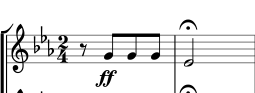
Question: is this music? Are the above symbols on a piece of paper music? What do you think?  My answer: of course not! It is encoded information. Only a specially trained person is able to read and translate that information into sounds with the help of specially designed devices. On their own, these ink stains are not music. 

Question: do the symbols on a piece of paper cause music? Are they the cause of music? My answer: of course not! The ink dots on a piece of paper are not the cause of the sounds we call music. Those symbols are dead and meaningless ink stains in themselves. One needs a person with specific knowledge of how to read and translate the symbols on paper. Furthermore, that person needs a special designed instrument. Do the hands cause the music? Or does the instrument cause the music? Or our ears? Or our brains? It is impossible to point to one cause. It is everything together. It is clear that here we have a chain of causal factors.


DNA centrism

"The basic principle is that if genes were abundantly available in the primordial pond, they could have randomly assembled to form various genomes, each capable of forming an organism." [1]

This is the most concise and extreme expression of DNA-centrism I know of. It is almost a definition of DNA-centrism in the context of the Origin of Life. The statement claims that life started with DNA. All you need is DNA and the organism will develop from it. On the other hand, in biology DNA-centrism means: DNA creates the organism. DNA is the cause of the organism. DNA controls every biological function in the organism. DNA-centrism in the context of Mendelian genetics is almost by definition gene-centrism because Mendelian genetics is not interested in the molecular details of how a gene affects the phenotype of the organism. For Mendelian genetics, the inner workings of an organism are a black box.

Now, let us ask the same questions about DNA as we did above about the musical notes on a piece of paper: does DNA cause an organism to develop, grow, breath and live? Of course not! Try it yourself: place a complete genome in a physiological saline solution in a Petri dish at 37°C and wait. Nothing will happen! But why? Because this is an unnatural environment? But if DNA has the power to create an organism, why does DNA do that? Apparently, DNA hasn't the power to create an organism. Apparently, the genome has to be in a cell and needs all the machinery to read and translate the information in the genome. Conclusion: it only seems that DNA is the cause of an organism because it is always in the right environment. We always assume the right environment.  

Compare this with the musical notes on paper: we are used to associating musical notes on paper with the sounds of music. Change a note (mutation) and the music changes (phenotype). But the musical notes on paper define, but do not create music. The right environment is required to create music [2]. We need a change of perspective to see this.

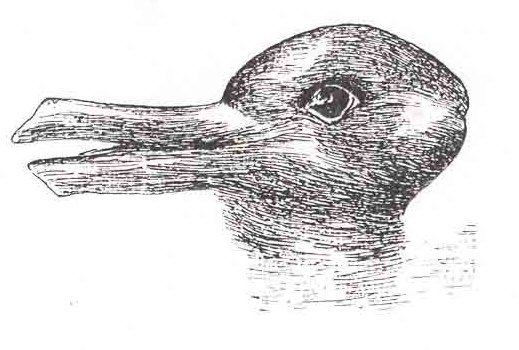
 Duck-Rabbit illusion (wikipedia)
Does DNA control the cell, or does the cell control DNA? 

We need a change of perspective because we have become the victims of the illusion that DNA itself controls everything. We forget that the cell controls the expression of genes. My eyes were opened at the moment that I realized that our DNA is a parasite in the same manner as a virus is a parasite. A virus is completely dependent on its host for its replication. A DNA genome is completely dependent on its host cell for its replication. DNA is replicated by the cell. DNA does not replicate itself. The cell delivers the resources for replication. The only difference with the virus is that 'our' DNA usually is for the benefit of the individual in which it is housed, whereas the virus DNA is detrimental to its host. But that does not give DNA special powers. In the Duck-Rabbit illustration above, the duck is DNA-centrism and the rabbit is cell-centrism. It is difficult to change perspective. It is even more difficult to see both perspectives at the same time. Since the birth of genetics, scientists always saw the duck (DNA controls the organism). Now it is time to see the rabbit. And when we have succeeded, we should try to see both. That takes some effort. But it is worth it because a scientific theory should not depend on one perspective. 


But what about genetic diseases?

Genetic disease seem to be a very strong argument against my position and for  DNA-centrism. What is the cause of Cystic Fibrosis? The answer: Cystic Fibrosisis is caused by a mutation in the CFTR gene. What is the cause of Huntington's Disease? Answer: HD is caused by a mutation in the Huntingtin gene. What is the cause of Duchenne Muscular Dystrophy? DMD is caused by a mutation of the dystrophin gene. What is the cause of Sickle cell disease? Sickle cell disease is caused by a mutation in the HBB gene. A clear case for DNA-centrism?

No. On closer inspection, it appears that genetic diseases are an argument against DNA-centrism. This is because all cells in our body have the same genome. If the fertilized egg (zygote) has a mutation, all cells in our body necessarily have that mutation. Yet, genetic diseases tend to affect specific organs in our body: blood, brain, muscles, heart, lungs, intestines, eyes, ears, etc. How could that be if all cells harbour exactly the same genome? Answer: it is the difference in expression of genes. Do genes express themselves? Of course not. Factors outside DNA trigger gene expression. Additionally, genetic diseases often start at different ages. For example, symptoms of Huntington's Disease typically appear in middle-aged people. How could that be? The genome doesn't change with age. Again: gene expression changes with age, not the gene itself. This is an argument against DNA-centrism because these examples show that DNA is passive, and factors outside DNA cause gene expression in specific organs at specific times. To understand this correctly, the whole cell should be in the centre ('cell-centric view of life'). 

Origin of Life 

The DNA-centric view of life spectacularly fails in the context of the Origin of Life. That's a hint that should make us think again. Life didn't and couldn't start with DNA. That is because DNA is a dead and meaningless molecule. It has no activity on its own. That is the famous vicious circle: the enzymes that transcribe and translate DNA must be present before those very enzymes can be produced.

Another powerful reason why DNA-centrism is wrong is that DNA is only one of the three components that constitute life:

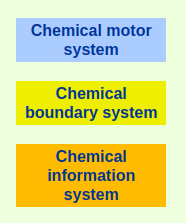
Tibor Gánti model of life [3]

All living entities have three components:
  1. chemical motor system: metabolism that produces the energy to run and maintain the organism
  2. chemical boundary system: cell membrane that separates the inside from the outside of the cell
  3. chemical information system: the hereditary material (DNA) 

Not one of the subsystems is dominant, all three determine the living organism. One subsystem is a chemical system and nothing more. 

This blog is an attempt to summarize my position, not a review of the literature. My position does not downplay the importance of DNA [4], I emphasize the passive role of DNA. This does not contradict any facts. However, my position appears non-mainstream due to sloppy language use in the scientific literature [5].


Acknowledgements

Susan checked my English. Thanks!


Notes

  1. Periannan Senapathy (1994) 'Independent Birth of Organisms. A New Theory That Distinct Organisms Arose Independently From The Primordial Pond Showing That Evolutionary Theories Are Fundamentally Incorrect'. Introduction page 5.
  2. Don't push the analogy with musical notation too far! Music is an event with a clear beginning and an end in time. It is produced by starting to read and translate the first note on paper, and to continue until the last note and stops there. Music or a book have a beginning and an end. This is not the way an organism is produced from a DNA genome. The genome has no beginning and end. There is no 'first' gene to start with in order to produce an organism. Secondly, the sheet music doesn't include instructions to build a musical instrument. On the other hand, there is a useful similarity here: musical notation on paper is a handy way to store and copy 'music'Just like DNA.
  3. Tibor Gánti (2003) The Principles of Life. (my review)
  4. Philip Ball (2024) downgrades DNA to an extreme degree. For example, he relegates the 1962 Nobel Prize for DNA to a footnote. A blunder. (see my blogpost). In that blog post, I have already made many of the same points I make in this post.
  5. For example: "Central to this are enhancers and promoters, DNA sequences that dictate the location, timing, and intensity of gene expression." in A tighter grip on gene expression, Science 3 Jul 2025. Note: "dictate", "timing". Especially, 'timing' is mysterious. How do DNA sequences dictate timing? I asked the author. No reply. I think this is a sloppy language caused by a DNA-centric view. [ 11-11-25 ]

18 November 2024

Thomas R. Cech (2024) 'The Catalyst'. Covid-19 vaccines were built on decades of scientific breakthroughs and Nobel Prizes.

Thomas R. Cech is the discoverer of the enzymatic properties of RNA for which he was awarded the Nobel prize in 1989.

Thomas R. Cech (2024)
'The Catalyst'
The title of his book 'The catalyst' refers to the enzymatic properties of RNA. An enzym is a biological catalyst. A catalyst is a substance that increases the rate of a chemical reaction. An important goal of this book is explaining how the 'dogma' ALL ENZYMES ARE PROTEINS was overthrown by himself and subsequently by others. That dogma was the textbook truth at the time when he made his discovery. No exceptions to the rule were known at the time. Indeed, after the discovery of DNA and the establishment of the 'CENTRAL DOGMA OF MOLECULAR BIOLOGY', it was generally accepted that RNA was the messenger that carried genetic information from DNA to the site in the cell where protein synthesis takes place. That was the function of RNA: a messenger. Hence its name messenger-RNA or mRNA. Both dogmas were powerful [3]. They determined which kind of research was done, which research questions were asked and how results were interpreted. Even today one reads in the Wikipedia article Catalysis: "In biology, enzymes are protein-based catalysts". Later the name ribozyme was coined for enzymatic RNA's (enzymatic Ribonucleic acids).

His own discovery is told in chapter 3. The rest of the book is about other discoveries about RNA. Cech explains that the dogma ALL ENZYMES ARE PROTEINS [4] led scientists astray and hindered progress in biology more than once. But first his own discovery. When doing experiments with RNA, Cech himself assumed that splicing out introns from mRNA was being catalyzed by protein enzymes (the power of the received wisdom!). Frustratingly, finding that particular splicing enzym failed. Confusingly, several experiments showed that splicing occurred without protein enzymes. Afraid of making an unforgivable mistake, Cech repeated his experiments in order to be 100% sure that there was no protein contamination in his test tubes. Finally, many experiments later, in 1982, he was convinced that he discovered a self-splicing intron in a RNA sequence and published it [1].

structure of self-splicing intron (wikipedia)

Another example of the powerful influence of the ALL ENZYMES ARE PROTEINS dogma, occurred in the lab of Sidney Altman. A control experiment in Altman's lab was supposed to produce negative results because the sample contained no proteins, but only RNA. Mysteriously, the control did produce positive results! The enzymatic activity had to be attributed to RNA, not to protein. Again enzymatic RNA. So, Altman independently discovered a different enzymatic RNA and shared the Nobel prize in Chemistry with Thomas Cech in1989.

A third example (Chapter 5 The Mothership) of the refutation of the dogma is the ribosome machine which is enormously complex and made of proteins and ribosomal RNAs (rRNA). The ribosome is the site where proteins are produced. Naturally, when scientists started to investigate the structure and function of the ribosome, they assumed enzymatic proteins must do the job. However, things turned out differently. It appeared to be the ribosomal RNA, not one of the ribosomal proteins, that did the job of binding tRNAs. Chapter 4 was, unexpectedly, a pleasure to read and I learned a lot new and interesting facts.

A fourth example of enzymatic role of RNA is telomerase (Chapter 7). Telomerase is a complex molecule constructed of both RNA and proteins. According to the standard view proteins are the active enzymatic part. Contrary to the expectations, it appeared that Telomerase activity was destroyed by RNAse (Ribonuclease) treatment. Conclusion: Telomerase activity appeared to require RNA. "So now RNA had been found at the heart of yet another critical life process – building out chromosome ends to secure the integrity of the genome."  Another exception to the law ALL ENZYMES ARE PROTEINS.

There are many more interesting insights and facts about RNA, some of them breakthrough discoveries that were awarded the Nobel Prize [2]. Cech typically describes how discoveries are made and which scientists were involved. However, I will now focus on the long history of mRNA covid19 vaccines as I promised in my previous blog. 


Covid-19 vaccines

In Chapter 10 Cech tells how fundamental RNA research prepared the way for mRNA vaccines. There are two different ways to produce proteins in cells of a person: by DNA or by RNA. DNA-vaccins were already being developed. The disadvantage of DNA vaccines: DNA could incorporate into our chromosomes and that is something you don't want to happen. Another disadvantage of DNA vaccines is that one doesn't need permanent production of those proteins. Only a short period is enough for the immune system. The advantage of a mRNA vaccine is that it is not a permanent modification of our DNA. The mRNA cannot by its very nature be incorporated in DNA. The scientific principle underlying all these mRNA therapeutics is simple: in every case where a protein is needed to stimulate the immune system or to replace a missing or mutated protein, it seems possible to use the corresponding mRNA instead to instruct our bodies to make that protein. 

Cech emphasizes that mRNA is not a secret military invention that was used to repress the people or things like that. RNA, just as DNA, is in every living cell on earth. RNA is as old, and likely older than life itself (RNA-world). The only thing that is foreign to the human body is the viral Spike protein which is encoded in the RNA. In this case RNA is only the messenger. The original Spike protein is located on the outside of the SARS-CoV-2 virus. It is recognized by the human immune system. By including the genetic code for the Spike protein in an mRNA and letting our own cells decode the mRNA and produce Spike proteins, the immune system is prepared for attacking the real SARS-CoV-2 virus. It is better and safer to introduce only a foreign protein, than the complete but weakened SARS-CoV-2 virus. To introduce a harmless protein in our bodies instead of the whole virus, that's the whole idea of this vaccination. And the mRNA method is a smart way to do it.

However, making a vaccine out of RNA is not that simple. Nobody had done it before. There were many technical obstacles. For example, how do you deliver the RNA? RNA on its own is unstable. Forty year ago using lipid membranes (liposomes) was challenging and unproven. But in 1989 it was shown for the first time that a foreign gene (mRNA) could be expressed in cells in Petri dishes. Subsequently, it was shown that this also worked in living animals. Other problems appeared, such as how to avoid that the body attacked the RNA before it could produce the protein [7]. Expert biochemical knowledge and creative thinking solved the problem. It was a breakthrough discovery and was awarded the Nobel prize [5]. This was before the SARS-CoV-2 pandemic in 2019 caught the world by surprise. In 2018 the RNA technique was successfully used in a clinical trial as a therapy for the hereditary disease ATTR. Cech writes: "It turned out that siRNA delivery would be a dress rehearsal for mRNA delivery a few years later." As soon as the pandemic started, and the DNA sequence of the SARS-CoV-2 virus was known, BioNTech (Germany) [6] and Moderna (USA) abruptly switched their research programs to covid-19 vaccines based on their new RNA techniques. Remaining scientific and technical difficulties were overcome. 

"In November 2020, the directors of Pfizer Inc. were waiting in nervous anticipation. They were about to hear the results of the clinical trial of the mRNA vaccine they were developing with BioNTech. As the vaccine's 95 percent efficacy rate was announced, a collective gasp arose--and then the group erupted with applause and shouts of triumph. The board had been hoping for at least 70 percent efficacy, which would have been a public health success. That would have put the Covid-19 vaccine between the influenza vaccine somewhere between the influenza (flu) vaccine (averaging 40 percent effective), with a year-to-year range of 10 to 60 percent) and the measles vaccine (97 percent effective). Ninety-five percent was beyond most expectations."

It is clear from this description that pharmaceutical companies neither carry out the clinical trials themselves, nor do they determine the outcome, nor do they give themselves the permission to bring their products on the market (if anyone thought this would be possible).

Thomas Cech: 

"It had taken 30 years for mRNA therapeutics to evolve from being generally disparaged -- "too unstable", "too difficult to get into cells", "too immunogenic"-- to being heralded as "A shot to save the world."

While writing this blogpost, an article appeared in Nature:

"Over the past few decades, RNA’s place in biology has transformed from being a mere intermediate between DNA and protein to a fascinating molecule with diverse activities that go well beyond simple transcription of genetic information." Nature 14 Nov 24

Indeed! It just shows that 'The Catalyst' appeared at the right moment!


About the book

This book was written by a scientist and Nobelist, not by a science journalist. Although science journalists do very good work, its a rare and welcome event that a Nobel prize winner takes the trouble to write a book. It results in a lack of unnecessary lengthy and distracting anecdotes. Yes, there are short anecdotal remarks, but they help to understand how science is done. For example Cech mentions how his first coworker and lab technician Art Zaug "has golden hands". Cech kindly and rightly includes him as a co-author of the publication that reported the discovery of self-splicing RNA [1]. The style of the book is factual and to-the-point without too many technical details, but enough to explain the science. The book was a pleasure to read. I consider it a good example of a successful popular science book. A basic knowledge of the relation between DNA, RNA and proteins is helpful. Again, it turned out to be true that writing a book review takes more time than reading the book! 


Update

The success of messenger RNA (mRNA) vaccine technology in the COVID-19 pandemic, marked by its rapid development and scalability, demonstrates its potential for addressing other infectious threats, such as HPAI A(H5N1) (highly pathogenic avian influenza). Source: An influenza mRNA vaccine protects ferrets from lethal infection with highly pathogenic avian influenza A(H5N1) virus, Science 18 Dec 2024


Notes

  1. K Kruger, P J Grabowski, A J Zaug, J Sands, D E Gottschling, T R Cech (1982)
    Self-splicing RNA: autoexcision and autocyclization of the ribosomal RNA intervening sequence of Tetrahymena, Cell.
  2. Nobel prize 2024 (MicroRNAs) (postranscriptional gene reguation) gives a good and detailed explanation (with illustrations)
  3. The Central Dogma of molecular biology. (wikipedia)
  4. the reverse "all proteins are enzymes" is not true, because there are non-enzymatic structural proteins.
  5. The 2023 Nobel Prize in Physiology or Medicine was awarded jointly to Katalin Karikó and Drew Weissman for their discoveries concerning nucleoside base modifications that enabled the development of effective mRNA vaccines against COVID-19. (Press release of the The Nobel Committee, with a good explanation of the science). 
  6. BioNTech was founded to develop RNA-based cancer immunotherapies.
  7. But how does the immune system distinguish its own RNA from foreign RNA especially when it is a mRNA of a new virus? My initial question was: why is this an issue, since the mRNA is located inside a liposome? So, it should be invisible for the immune system. However, this is (partly) explained on the Nobel prize page: "This was a paradigm change in our understanding of how cells recognize and respond to different forms of mRNA. Karikó and Weissman immediately understood that their discovery had profound significance for using mRNA as therapy. These seminal results were published in 2005, fifteen years before the COVID-19 pandemic." This shows again that the Covid-19 vaccins were not rushed to market.


Update 13 Dec 2024


Previous blogs

Personal note: I have been vaccinated with the BioNTech/Pfizer mRNA  vaccin (5x) and Moderna mRNA vaccin (2x). (The Netherlands). Between vaccination #6 and #7 I tested positive for Corona and had a few days symptoms of corona (coughing).

Update 21 Nov 2024: I changed the blog title to: "Thomas R. Cech (2024) 'The Catalyst'.  Covid-19 vaccines were built on decades of scientific breakthroughs."

29 October 2024

De lange voorgeschiedenis van de Covid-19 vaccins

update #46

Even een kort blogje over de bewering dat de Covid-19 vaccins niet grondig getest zijn, en veel te snel op de markt gebracht zijn. 

Dit naar aanleiding van de discussie op een blogpost van 2 jaar geleden over een publicatie van Ronald Meester over de vermeende dodelijke bijwerkingen van de Covid-19 vaccins. Maar vooral naar aanleiding van het boek The Catalyst: RNA and the Quest to Unlock Life’s Deepest Secrets door Thomas R. Cech dat dit jaar verscheen. In een volgend blog wil ik een wat uitgebreidere boekbespreking posten in het Engels. Hier ga ik uitsluitend kort in op de kwestie hoe het kon dat RNA Covid-19 vaccins zo snel op de markt kwamen.

De naam Thomas R. Cech is voor altijd verbonden met de ontdekking van de enzymatische (katalytische) werking van RNA. Hij ontving hiervoor de Nobelprijs in 1989. Alweer een tijdje geleden. Cech behandelt Covid-19 vaccins in hoofdstuk 10.

Belangrijkste opmerking:

"How did scientists do it so quickly? The short answer is, they didn't. While the Covid-19 vaccine did appear in record time, it was built on decades of scientific breakthroughs."

Door gebrek aan kennis begonnen er al snel complot (conspiracy-) theorieën te circuleren. mRNA vaccins zijn inderdaad nieuw. Tot nu toe werden delen van virussen of levende verzwakte virussen of  recombinant DNA-technieken gebruikt als vaccin (echt waar, zie rivm info). Dit gebeurt niet bij mRNA vaccins. Daar wordt een stukje boodschapper RNA in een vetbolletje gebruikt. Boodschapper RNA (mRNA) is een onmisbaar onderdeel van de eiwitsynthese in iedere cel. Het is dus geen menselijke uitvinding of zo. Fundamenteel onderzoek naar RNA werd in de jaren 80 van de vorige eeuw gedaan uit pure wetenschappelijke nieuwsgierigheid. Dat onderzoek was niet uit op welke toepassing dan ook. Daarna volgt een lange geschiedenis van nieuwe ontdekkingen op het gebied van RNA door talentvolle, creatieve wetenschappers die buiten de gebaande wegen durfden te gaan. De producenten van het vaccin, Moderna en BioNTech, waren in januari 2020 nog onbekende biotech start-ups. De rest is history. De hele geschiedenis plus alle andere wetenschappelijke en medische RNA toepassingen worden op een leesbare manier beschreven in het boek van Thomas R. Cech. Daarover in een volgend blog meer.

Het beloofde blog is: 

Thomas R. Cech (2024) 'The Catalyst'. Covid-19 vaccines were built on decades of scientific breakthroughs and Nobel Prizes. 18 Nov 2024

Voor alle SARS-CoV-2 blogs klik op het label:

12 September 2024

Het plezier van het ontdekken van een verklaring voor een vreemd verschijnsel

cirkelpatroon op vacuümglas

Wanneer het 's nachts koud en vochtig is geweest (buiten 7°C, binnen 21°C graden), kun je 's ochtends een zeer regelmatig patroon van cirkels zien op het vacuümglas (zie dit blog). Maar deze ochtend zag ik een afwijking in het regelmatige patroon:

een afwijkende cirkel

Eén cirkel was duidelijk groter dan de rest. Vreemd. Nooit eerder gezien. Waarom die ene? Dat vraagt om een verklaring. Toch maar even de zaak van dichtbij bekeken. Verrassing: die grote cirkel heeft in het midden twee in plaats van één micro-spacer! Een zeldzaam foutje in het productieproces van vacuümglas.


twee micro-spacers in de grote cirkel

Leuk om een verklaring te hebben gevonden op micro niveau. Niet schokkend, maar dat soort dingen vind ik nu leuk. Dingen willen begrijpen.


Bronnen


14 April 2024

Curieus patroon op vacuumglas na een forse regenbui

regelmatig patroon van cirkels op raam
 

Grote verrassing! En enige ongerustheid. Na het openen van de gordijnen 's ochtends vroeg zie ik condens op het raam met een mysterieus regelmatig patroon van allemaal evengrote doorzichtige cirkels. Nooit eerder gezien. Wat heeft dat te betekenen? Waar komen die cirkels vandaan? 

Het patroon zit over het hele raam. Aan de randen zit het niet. Het blijkt op de buitenkant van het raam te zitten. Het is condens. Het had de vorige dag flink geregend. Kennelijk geeft de combinatie van vacuümglas + hoge luchtvochtigheid buiten + kou buiten = condens. Alleen het patroon is totaal onverwachts. 

Detail: heldere cirkel rond afstandshouder
begrensd door condens
.

Bij nader onderzoek blijkt dat de doorzichtige cirkels, waar dus geen condens zit, precies op de plaats zitten van zgn. afstandhouders. De afstandhouders zijn de kleine zwarte puntjes en zijn het middelpunt van de cirkels. Deze afstandhouders zitten er om te voorkomen dat de twee glasplaten tegen elkaar aan klappen door het vacuum. Puur natuurkunde. Ik heb dit verschijnsel nooit ergens gezien of gelezen [1]. Ik heb het daarna niet meer gezien. Zeldzaam dus. Wel condens aan de binnenkant van het raam, maar nooit aan de buitenkant en zeker niet in dit regelmatige patroon. 

In feite is de condens aan de buitenkant een goed teken. Het betekent dat het glas aan de buitenkant koud is en aan de binnenkant warm [2]. Conclusie: isolatie werkt goed. Maar: condens aan de buitenkant betekent dat het raam koud is, dus het ontbreken van condens in die cirkels betekent dat het plaatselijk warmer is. En dat moet betekenen dat daar de warmte van binnen naar buiten lekt via de afstandhouders. Fysiek contact. Helaas kan vacuümglas niet zonder die afstandhouders. Dus die lekkage is onvermijdelijk. Ik weet niet hoeveel warmte er weglekt. Hoe kouder en vochtiger het buiten is, hoe kleiner de cirkels. Bijvoorbeeld, als de luchtvochtigheid buiten 86% is hebben de cirkels een diameter van maar 8mm. Als 's ochtends de buitentemperatuur stijgt en de luchtvochtigheid daalt zullen de 'warme' cirkels groter worden totdat alle vocht is verdampt.

Die afstandhouders lijken dus een nadeel, maar bedacht moet worden dat dit glas getest wordt met afstandhouders. Dat kan niet anders. De isolatiewaarde van glas wordt uitgedrukt in een U-waarde. Hoe lager de U-waarde, hoe beter het glas isoleert. De U-waarde van vacuümglas is 0,4 - 0,7 volgens Milieu Centraal. Die waarde is dus noodzakelijkerwijze inclusief de afstandhouders. Dus in theorie zou de U-waarde nog lager kunnen zijn als er minder of helemaal geen afstandhouders nodig zouden zijn! Maar dat gaat dan weer tegen de wetten van de natuurkunde in ...


Berekening totale oppervlakte cirkels *)

  • Het glas in bovenstaande foto heeft 29 rijen van 21 afstandhouders = 609 afstandhouders in totaal. 
  • de afstandhouders zelf zijn plm. 1 mm in diameter, maar de cirkels hebben een diameter van tenminste 2,5 cm
  • De oppervlakte van een cirkel met 2,5 cm diameter = pi x r2 = 3,14 x 1,25 x 1,25 = 4,90625 cm2. (2,5 cm is de minimum doorsnede)
  • De totale oppervlakte alle cirkels = 609 x 4,90625 = 2.987,9 cm2.
  • Het raam heeft een oppervlakte van 120x162 cm = 19.440 cm2
  • Het percentage cirkels van totale glasoppervlakte = 15,4 %
dwz 15,4% van het oppervlakte van het raam laat warmte door (op het moment van de meting). Maar er zijn ook cirkels met 3 cm en 4 cm diameter (afhankelijk van het stadium). Dus 15,4% is een minimum. De cirkels verdwijnen vanzelf na 1-2 uur afhankelijk van de zon.
 
*) 18 april: De tekst is aangepast naar aanleiding van een oplettende lezer.  Duidelijk is gemaakt dat de afstandhouders zelf maar plm. 1 mm dik zijn en het woord 'doorsnede' is vervangen door 'diameter'.
NB: een aardig filmpje dat uitlegt wat vacuümglas is en welke soorten er zijn.


Een half jaar later...

Het blijkt dat als je de condens aan de buitenkant weghaalt met een raamwisser, de cirkel patronen heel snel terugkomen. Maar dan in verzwakte vorm, minder intens. Het helpt tijdelijk een beetje Conclusie: je neemt de symptomen weg, maar niet de oorzaak! Het 'warmtelek' blijft bestaan en als het buiten nog vochtig en koud is, dan vormen de cirkels zich opnieuw. Heel fraai verschijnsel!
 

En wanneer het vriest...

Wanneer het gevroren heeft krijg je de cirkels niet weg! Het hele condens patroon is bevroren! Wachten tot de zon er op staat of tot dat de temperatuur is opgelopen. Ik neem aan dat eerst het condens neerslaat (aan de buitenkant!) en later in de nacht bevriest. NB: er zijn géén cirkels op de ramen waar rolluiken voor zitten! (die isoleren dus behoorlijk goed).
(11 jan 2025. -2,3 gr C)
 
 
close-up condenskristallen op buitenkant raam


Noten

  1. Iemand tipte mij dit filmpje waar op dit tijdstip precies hetzelfde patroon te zien is! [16 april]
  2. Ik heb de oppervlakte temperatuur aan de binnenkant van het raam laten meten met een 'warmtepistool': 20 graden! [15 april 2024]


Vervolg blog

25 October 2022

Solar eclipse 25 Oct 2022

Solar eclipse 25 Oct 2022

video created with SONY RX10 IV max zoom 600mm
ISO speed rating 80 (that is very low!)
It was cloudy weather, but the clouds functioned as a 'sunscreen' to protect the camera and at the same time it created a beautiful effect!
 
original video on YouTube  ©Gert Korthof
 
Solar eclipse. ©GertKorthof


picture:

underexposure: -2 EV (-2 stops)

exposure time: 1/25600 sec (extremely short)

ISO speed: 80 (very low)

local time: 11:46 (Amsterdam time zone)

Please note that I did not use a solar filter (I don't have one). This could be dangerous for your camera! Thanks to the clouds I could take pictures without damaging the camera. I am going to investigate which solar filter I could use for the next solar eclipse!


geographic visibility of solar eclipse (NOS)
(not visible in North and South America)


Vorige zonsverduistering

Zonsverduistering 10 juni 2021 groot succes! Sony A580 met eclipsfilter in 55-300 mm lens 10 juni 2021

18 October 2022

Johnjoe McFadden: Life Is Simple: How Occam's Razor Set Science Free and Shapes the Universe.

Johnjoe McFadden (2021)
Life Is Simple

The book Life is Simple by biochemist and molecular biologist Johnjoe McFadden is not about life, but is a history of Western science viewed from Occam's perspective. William of Occam was a thirteenth century theologian and inventor of what is now known as 'Occam's razor'. I really have to blog about this useful and entertaining book.

Occam's razor is the preference for the simplest solutions to scientific problems; theoretical entities should not be multiplied beyond necessity; plurality should not be posited without necessity; it is vain to do with more what can be done with less. This seemingly simple principle of parsimony revolutionized theology, philosophy and science. McFadden selects various scientific revolutions of the past six centuries to illustrate Occam's Razor in action.

Occam used his razor to strip away everything in medieval philosophy except God's omnipotence. Furthermore, he claimed that the only way to gain knowledge is through experience and observation. Not by syllogism. For Occam, this was another important distinction between science and religion. Science, he maintained, yields probabilities, not proof. A very modern understanding! Despite all this Occam never doubted the existence of God, nor the central tenets of Christianity. Only faith gives us access to theological truths, he wrote. Remarkably, McFadden does not comment on the fact that Occam did not apply his razor to the question whether God was a necessary entity in our worldview and whether the elimination of the God hypothesis could simplify our view of the universe.

A good example of the application of Occam's razor is the replacement of the geocentric model with the heliocentric model of our solar system. Copernicus argued that

"accepting that the earth rotates every day, rather than the sun, moon, planets and stars,  provides a much simpler cosmos." (214/687, ch 7).


(wikipedia)
In the geocentric model each planet has its own epicycle:


Epicycles of Mercury, Venus, Mars, Jupiter, Saturn
©Vliegende Schotels en andere Raadsels van het Heelal,1978

Copernicus eliminated five planetary epicycles and by placing the sun in the center of the system he removed all epicycles, thereby simplifying the whole solar system.

Furthermore, "Ptolemy's geocentric system could not explain why Mercury and Venus are always seen to be closest to the sun at sunrise and sunset". He added an arbitrary rule to account for this. But Copernicus positioned "Venus and Mercury to a position between the earth and the sun so that they became inner planets. In this position, their closeness to the sun in the sky is simply due to their closeness to the sun in reality. In this way, an arbitrary feature of the complex model becomes an inevitable consequence of its simple alternative." Furthermore, the mysterious behaviour of Mars, Jupiter and Saturn was explained in the heliocentric model by positioning them beyond the orbit of the earth: they became the outer planets.  This is a very convincing demonstration of the usefulness of Occam's razor. Although I knew the Copernican revolution, and I knew that heliocentrism was a simpler theory, I never made the connection with Occam. I never had any knowledge of the life and work of William of Occam. His philosophical approach reminds me of modern philosophers Gilbert Ryle and Alfred Ayer (see notes).

McFadden did a great job. He revisits the big revolutions in science and shows how Occam's razor is at work, whether or not the scientists involved acknowledge this. The writing style is certainly not dry or academic. There are a lot of anecdotes that contribute to the story and make one continuing reading. 

Galileo mentions Occam several times in his early lecture notes, and argued that "the single daily rotation of the earth is much simpler and more natural than having the sun, moon, planets and the stars rotating around the earth every day." (298/687). A perfect example of Occam's razor at work. Many of the most important scientists in the history of science were following Occam. McFadden writes: "The razor had made its way from the thirteenth century, via the via moderna, through to Leonardo, Copernicus, Kepler, Galileo, Boyle and now to Newton to become a central plank of modern science." (Ch11). Add to this list: Hobbes who took Occam's reductionist approach further than anyone previously dared and Lavoisier's dismissal of phlogiston. In biology the vital spirit was shown to be an entity beyond necessity. 

Life's razors

Occam was ahead of his time. Amazingly, he described a form of natural selection! He wrote that animal properties such as teeth might have arisen by chance and be retained because 'the animals survive'. Really amazing! But Darwin made the supernatural watchmaker superfluous. 

In chapter 14 McFadden reveals some rather remarkable facts about Darwin and Wallace. In 1855 Alfred Russel Wallace wrote a paper 'On the law which has regulated the introduction of new species'.  At the time he was collecting specimen for a living in Indonesia. He sent the manuscript to the editor of a British natural history magazine. The subject was the same as the one Darwin had been working on for the past 20 years. Wallace proposed that any theory about the origin of new species should explain nine bio-geographic and paleontological facts. Next he formulated a general law that captured all those facts, the Sarawak law. It was a descriptive law, without causal mechanisms. But it was a revolutionary idea. Never had such a law been formulated before. It was 4 years before Darwin published his Origin of Species. McFadden interprets the Sarawak law as an example of Occam's principle. I did not know about that manuscript. And McFadden rightly believes that it should be far more widely recognized as key to the development of the theory of evolution. In 1858 Wallace (still in Indonesia) wrote a letter to Darwin with his explanation of the Sarawak law: natural selection. This letter and the subsequent events are well-known. Except the following: "Despite Darwin's habit of keeping nearly all his letters, all those written to Darwin by Wallace, Hooker, Huxley or Lyell during that crucial year of 1858, including Wallace's original Ternate paper manuscript, have been lost." Have been lost! Very mysterious! Could that be an accident or is it intentionally 'lost'? The work of Wallace surely deserves further study. McFadden concludes that "natural selection is probably the most Occamist reduction of a multitude of arbitrary facts into a simple law."

Again a new and interesting fact: in 1867 J. D. Campbell noted in his Reign of Law that Darwin had in fact not explained the origin of new species. A criticism repeated many times by Darwin critics and evolutionary biologists in the years thereafter. Again an issue that deserves further study.

In chapter15 about heredity and genetics McFadden points out the DNA, the genetic code and mutation are a perfect example of explaining the diversity of life on earth with a few simple concepts. Indeed, DNA and the genetic code are universal for life on earth. However, I disagree with his claim that the genomes of biological species are very nearly as simple as they can be. They are not (pseudo-genes, junk DNA, introns, Alternative splicing, X-inactivation, mitochondrial-DNA, etc).

The Cosmic Razor

In Part IV The Cosmic Razor McFadden addresses the laws of physics, Einstein, general relativity and quantum mechanics. He concludes that Einstein made the universe less complex and more simple. All this is evidence of "the unreasonable effectiveness of Occam's razor."

In his final, and I would say speculative, chapter 'The Simplest of All Possible Worlds?' McFadden concludes that the universe is close to being as simple as it could be while remaining habitable.

This book is a dazzling tour through the history of science and the universe. It is also well-researched. McFadden is as equally at ease with theology, philosophy, biology, physics and astronomy as with the history of those sciences. The unifying theme is Occam's razor. I think it is a successful project. But an unfinished project, I think, because there are so many facts and issues that demand further exploration.

While reading Life is Simple I remembered that theologian Richard Swinburne based his argument for the existence of God on the same principle as science does: the simplicity principle or Occam's razor. Swinburne mentions Occam. But instead of demolishing the God hypothesis, Swinburne exploits it to argue that God is the most simple explanation of the universe! Far simpler than the materialist explanation. Not what one would expect. Is this a bogus or an ingenious claim? I have to read Swinburne's book again and find out. I would like to know McFadden's opinion about this! McFadden did not discuss whether Occam's razor would eliminate God.

Why am I so interested in the history of science? I think the history of science, as it is described by McFadden, gives us hope. There are things in this world that show progress in the long run despite a relapse to barbarism and war. Bombs, tanks and kamikaze drones can destroy cities and people, but cannot destroy scientific knowledge. That at least may give us hope.


Update 11-11-22

Sabine Hossenfeld video Dit the Big Bang happen?

In this video she uses Occam's Razor without identifying it as such.

the simpler the better (here)
"The simplest explanation that we have found is the standard model for cosmology, which is based on Einstein's equations. The requirement that an explanation is simple is super important. It's because without it we can't do science at all."

A simpler theory is better, because Occam's razor. (youtube)


Update 3 Jan 2023

"While Occam's razor is a useful tool in physical sciences, it can be a very dangerous implement in biology. It is thus very rash to use simplicity and elegance as a guide in biological research. While DNA could be claimed to be both simple and elegant, it must be remembered that DNA almost certainly originated fairly close to the origin of life when things were necessarily simple or they could not have got going. (...) The genetic code is a very good example of what I mean. Who could possibly invent such a complex allocation of the sixty-four triplets? Surely the comma-free code was all that a theory should be. An elegant solution based on very simple assumptions – yet completely wrong."

(p.138-139 Francis Crick (1988) What mad pursuit.)


Notes

I bought this eBook at KOBO bookstore because of its exceptional price: € 3,99 and the intriguing title.  I found out that McFadden is also the author of Quantum Evolution. Life in the Universe (which I listed on my website) and Life on the Edge. The Coming of Age of Quantum Biology.

The influence of Occam on Gilbert Ryle: "he claimed that much of his philosophical work amounted to "Occamizing" (the reference is to William of Occam and his so-called "Occam's razor," which states that the best explanation is the simplest, the overly-complicated concepts and work of other philosophers." (source).

About A. J. Ayer se: Ayer, Alfred Jules (1910–1989) (encyclopedia.com) and:  A.J. Ayer And The Elimination Of Metaphysics in which Ockam is discussed. 

I reviewed Richard Swinburne (1997) Is there a God? on my WDW website. But after reading McFadden I have to reread it and find out how Swinburne uses Ockam to prove God.

Website JohnJoe McFadden

03 August 2022

Lucy Cooke (2022) 'Bitch. On the Female of the Species': life without males?


Lucy Cooke (2022) 'Bitch. On the Female of the Species', Basic books.

Darwin proposed the theory of sexual selection to explain differences between males and females. His explanation involves females choosing a sexual partner: "The female, though comparatively passive, generally exerts some choice and accepts one male in preference to others" (Descent); "male animals have 'stronger passions' and the female 'requires to be courted', she is coy"; Darwin's 'Law of battle' means a struggle between males for the possession of the female and male dominance is considered a basic prediction of Darwin's sexual selection theory. Darwin's views on women: "man has ultimately become superior to woman".

one female golden orb weaver spider and many small males  (wikipedia)

According to Lucy Cooke all this is typically the
Victorian stereotype forced on to nature. She wrote Bitch to demonstrate that this view is one-sided and obsolete. It urgently needs an update. Cooke aims to give the reader a more complete and truthful picture of the role of females in evolution. One of the many examples is the vicious, promiscuous and dominant female golden orb weaver spider who devours her sex partner 'in the act'. Another is the lemur society with female dominance. Darwin and other male evolutionary biologists like Robert Trivers, Richard Dawkins and Stephen Jay Gould wrote a sexist theory. Apparently, a theory from the male perspective. Cooke argues that female competition over mates and resources, and male choice must be added to the picture. But, her book is more than a scientific argument. It becomes clear that her personal mission is to fight for equal rights for men and women (also known as feminism). She writes: "Females are not destined to be passive and coy". Example: "Female ducks are not passive victims but active agents driving their own evolution, along with that of males" (Ch.5). More than once feminism and biology seamlessly merge into one another: "Females across the animal kingdom began wresting back control of their sexual destiny...", "Once females are liberated from the responsibilities of pregnancy and lactation" (Ch.6) and uses anthropomorphic language: "female sexual autonomy", "consensual sexual activity", "from victim to victor", "even female insects enjoy sex", "sexually assertive females", "phallocratic", "second-class citizens" when writing about animals. Only when writing about lesbian albatrosses she explicitly recognizes that 'lesbian' is anthropomorphic language. Sometimes we encounter explicit political expressions such as "Sisters unite!" and "Termites are the original 'anti-capitalist anarchists". Or is this just popular science writing at its best? writing in an engaging way? So we can easily identify with the animals?  Certainly humour ('the singletons' bar', 'albatross discos', etc.) makes this book fun to read. And what about the title 'Bitch"! She could be dead serious and humoristic at the same time.

It could be that sexist and political language has been introduced by men in evolutionary biology in the first place. I guess Cooke doesn't want to write a 'feminist evolutionary theory' –her book is about non-human animals– but a theory that has the facts right. I hope she doesn't want to replace the male point of view by a female point of view. That would be just as one-sided as the male point of view.

In each of the different chapters of her book, Cooke presents animals that differ from the standard heterosexual male-female model, non-standard male-female behaviour, female promiscuity, mate choice, unusual sex organs and non-standard sex-chromosomes in animals such as the mole, spotted hyena, vole, songbirds, langurs, spiders, praying mantis, opossums, lemurs, chimps, bonobos and orcas. In addition, she writes about the struggle of female evolutionary biologists to get their revolutionary results  published. It costs a lot of energy to overthrow age-old myths, prejudices and paradigms such as the Male dominance, Monogamy Myth, the 'sperm is cheap' myth, Selfless Mothers, The Myth of Maternal Instinct, etc. That is certainly a recurring theme throughout the book. During reading and rereading this book, I realized that the evolutionary biology of sex itself is a battlefield of the sexes. The battle of the sexes in nature is continued on another level in the textbooks, universities and scientific journals. So deep is the divide of the sexes in the human species that an impartial theory of sexual selection is very difficult.
The diversity of sex and reproduction, parental care, sex determination, is so big, that it is impossible to give a summary here. Any summary would seriously diminish diversity.


     Was Darwin Wrong?

Was Darwin completely wrong in the eyes of Lucy Cooke? No, she is fair enough to admit: "Darwin wasn't all wrong on this score, by any means. Male competition and female choice do drive sexual selection, but they are just part of the evolutionary picture. Female choice is indeed a powerful evolutionary force" (Introduction). Despite recurring criticism of Darwin's androcentric Victorian views [1] she recognizes Darwin made an astonishing original claim: "Darwin's controversial claim was that females were not only sexually autonomous but had the wherewithal to make decisions that shaped male evolution" and even his brain! (Ch.2). There is even praise for Darwin's discovery of the rich diversity of sexual systems in Barnacles. DNA research has shown that Darwin was right.  He was way ahead of his time. In the Conclusion chapter she admits that feminist "ideas are now woven into modern evolutionary thinking."

Not withstanding this, In her book Cooke passionately tries to convince the public and scientists alike to correct the lopsided pictures of males and females.

 
Lucy Cooke (BBC)

Conclusion

Darwin cannot be corrected –he is dead– but the theory of evolution and sexual selection can and should be corrected. To a large extent feminism and the progress of evolutionary science go hand in hand, considering the current imperfect status of the field.

The theory of evolution should never be used to justify discrimination against any human. That would be committing the naturalistic fallacy. Evolutionary science should be free of male and female prejudice. Politics and religion should be banished from evolution textbooks. Facts unwelcome to feminists should not be downplayed or eliminated from the textbooks. Such as the fact that "in placental mammals the cost of reproduction is borne by the female" (ch.8). Ideally evolution textbooks should be written by male and female scientists. This is not the case. 'Feminist Darwinians' or ' feminist evolutionary biologists' should be an oxymoron. Both 'patriarchal' and 'matriarchal' animal societies should be reported as they are. Any hypothesis, feminist-friendly or unfriendly, should be published and tested.

We humans can change our society, not 'injustice' in wild animals in nature. Nature is just as it is. Would all non-human animal societies be matriarchal, still that does not justify unequal treatment of men and women or heterosexuals and homosexuals. That would be again committing the naturalistic fallacy. Cooke should have elaborated on the naturalistic fallacy: it is a logical fallacy, it is false, not just 'somewhat misguided' thinking. 'Natural' is not the same as 'good'. 'Unnatural' is not the the same as 'bad'. So, from a logical point of view it is mysterious how the true story of nature could be 'empowering for peoples of minority gender expressions and sexualities'. Never derive moral values from nature. Never insert human values in a scientific theory about non-human animals. Never value biological facts because they make you feel (un)comfortable.  Science demands to get the facts right. That should be enough.

I didn't check the correctness of all the 280 Darwin quotes and citations. I hope to check some and publish it as a new page on my WDW website. The book provides more material for discussion than I can handle here. That makes it a good book. Thanks Lucy!


Sources

Lucy Cooke website


Notes

  1. Paradoxically, androcentric, phallocratic views flourished during the 'Victorian era', named after queen Victoria. A woman! Well, if the most powerful woman of the country was unable to create a more female-friendly society in 64 years, can we really blame Darwin?