***Updated 15 June***
|
Western jackdaw with white feathers
Kauw met witte veren
7
April 2023 The Netherlands ©Gert Korthof
|
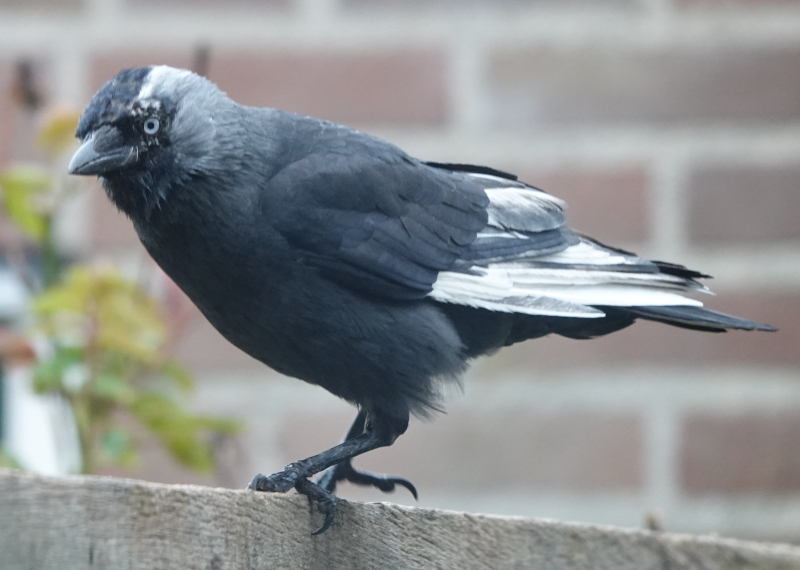
A Western jackdaw ( Coloeus monedula ) with white feathers is
rare. It is a mutation in the melanin pigment producing cells in the
feathers. For the first time this individual visited our garden and I
could make a reasonable good portrait. This individual has been spotted at
least the previous year at other locations nearby together with members of
his own species. Apparently accepted as a member of the group. It seems to
be a healthy and otherwise normal Jackdaw.

|
same individual. 7 April 2023. ©Gert Korthof
|
Some 5 weeks later, on 15 June, I observed the 'white' jackdaw again on a
chimney with a 'normal' partner:

|
15 June 2023 ©Gert Korthof
|

|
15 June 2023 ©Gert Korthof
|
Many Jackdaws here use the chimneys as nesting places. So, maybe the 'white'
and the 'normal' Jackdaw are going to produce young Jackdaws... How will
they look like?
= = =
I found many other pictures on the internet. Keep in
mind that rare birds have a higher probability of being published! The more I searched the more I found!
Wikipedia Western jackdaw:
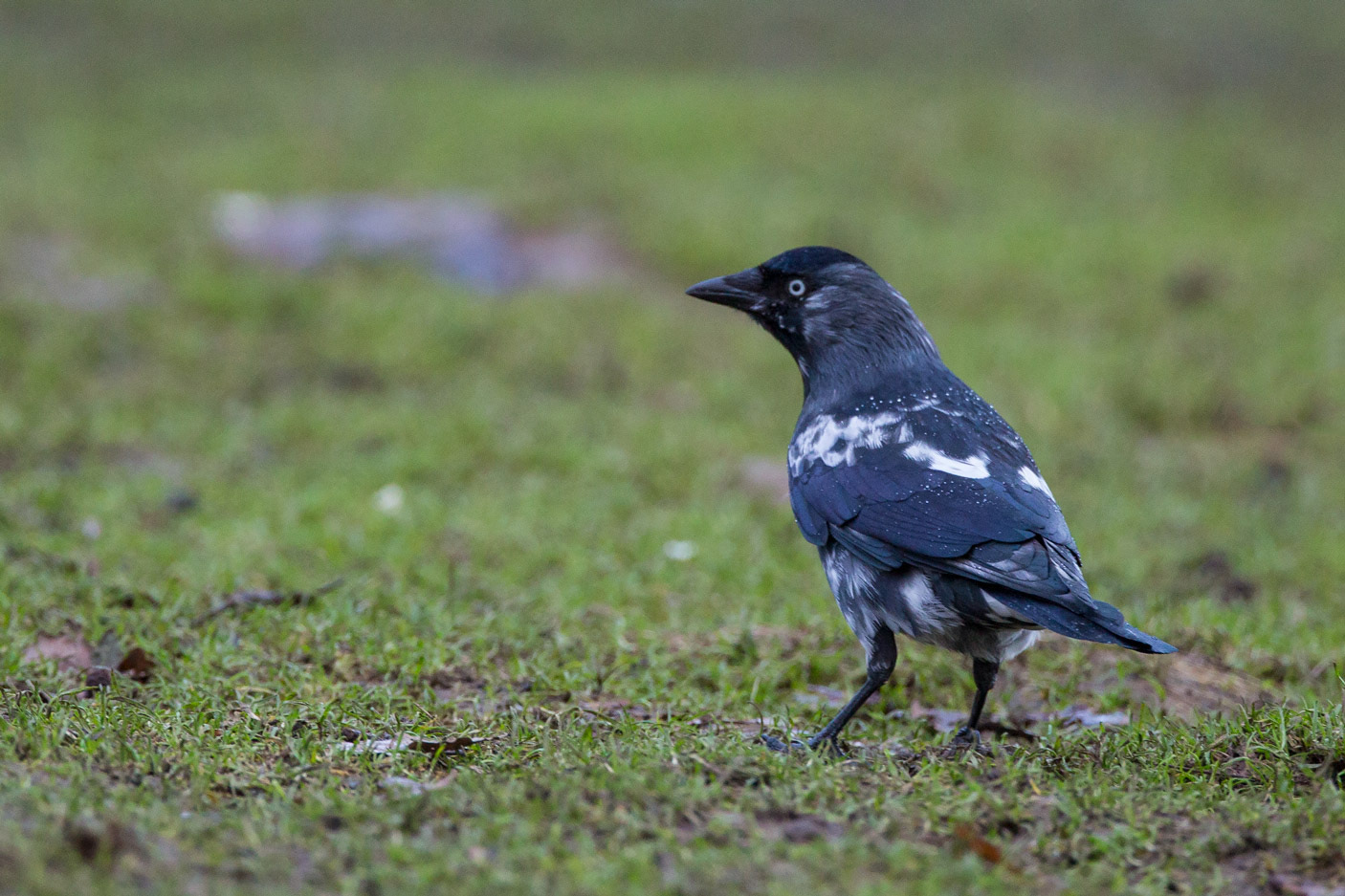
These birds have seemingly random white spots and patches:
'Partial albino' is not a correct description.
Albinism
is the congenital absence of melanin in an animal or plant resulting in
white hair, feathers, scales and skin and reddish pink or blue eyes. So,
this is a leucistic Jackdaw because it clearly has black pigment.

|
White and black Jackdaw together ( BBC )
BBC - Avebury's rare
albino faces black future
|
Please note that the following bird looks like a leucistic Jackdaw:
but do not get confused, the above picture is the Daurian Jackdaw, a
geographic species of the Coloeus genus.
The Hooded Crow (Corvus cornix) is not a leucistic crow but
it is the normal color pattern of the species:
At the
Corvid Research blog
I found a blogpost about leucism in general with some pictures of leucistic
Jackdaws in flight. Corvidae is the family name which includes
Eurasian magpie, Common raven, Carrion crow.
Here is a story at the
Garden Wildlife Health website about leucism with pictures.
The
British Trust for Ornithology
writes that leucism is heritable, but I think this is not always the case.
When the mutation happens after fertilization, thus during
development of the embryo, it is a somatic mutation, and does not occur in
the germline. So, is not heritable.
Finally, a video with a very rare and amazing White
Blackbird:
Last but not least: an extreme form of Jackdaw leucism:

|
Jackdaw extreme leucism! (
flickr
)
|
Automatic species identification software:
The most amazing fact: the rare white blackbird is recognized by
ObsIdentify-NIA
as a Blackbird with 97%! How on earth is he doing that?
Interestingly, all the other leucistic Jackdaws are identified by
ObsIdentify-NIA with 99%-100% certainty as a Western Jackdaw except the
picture by Fredrik Grahn which is identified as a
Nordic Jackdaw
(Noordse Kauw) with 100% certainty. The Noridc Jackdaw is considered a subspecies:
Western Jackdaw ssp monedula. The software is able to identify the Jackdaw despite the white
feathers: how does he do it? [ 6 May ]
Further Reading