In this blog I discuss two remarkable statements I encountered in Philip
Ball's How Life Works. The first is about Watson and Crick's
proposal for the structure of Deoxyribonucleic acid (DNA) and 'the secret
of life'. The second is about the ENCODE project. That's enough for
today.

|
|
Plaque 'DNA The Secret of Life' [1] |
Here is the first quote:
"Some consider the discovery of DNA's double helix to be the most important scientific discovery of the twentieth century. It's not clear how a meaningful ranking of that sort could ever truly be made, but the work certainly launched the genetic age." (chapter 2).
In these two remarkable sentences Ball tries to downplay the importance
of the discovery of the structure of DNA.
Some consider...? At least the five members of the Nobel Prize
committee in Sweden awarded the structure of DNA with the 1962 Nobel Prize
in Physiology or Medicine.
It's not clear how a meaningful ranking of that sort could ever truly be
made?
Do I understand him right? Is he really suggesting that the structure of
Deoxyribonucleic acid (DNA) does not deserve a Nobel Prize? [6]. Ball must be
the first scientist suggesting such a thing. If it is impossible to compare and rank the discovery of DNA with other discoveries, why bring it up at all? It is an odd way to suggest that rewarding it with a Nobel Prize is completely arbitrary. The work certainly launched the genetic age? This must be the
understatement of the century. A quick search for Nobel prizes concerning
DNA results in about 20 prizes! [5]. The most well-known are: the genetic
code (1968), restriction enzymes
(1978), DNA sequencing (1980), recombinant DNA (1980), mobile genetic
elements (1983), PCR (1993), split genes (1993), DNA repair (2015),
CRISPR/Cas9 (2020).
Ball is certainly right that there is more to life than DNA (see my previous blog). And probably he has good reasons for de-emphasizing the relative importance of DNA in the biochemistry of the cell and in the development of an organism. That is one thing. However, it is quite another thing to retroactively cast doubt on the importance of the discovery of DNA. The Nobel Prize was awarded for the scientific merit of the discovery of the structure of DNA, not for 'discovering the secret of life' [4].
Now 'the secret of life':
"A lesser-known fabrication, however, is Watson's claim (which he only recently admitted was pure invention) that when he and Crick finally realized what the structure of DNA molecule must be, Crick regaled the occupants of The Eagle pub in Cambridge, the duo's favorite watering hole, with the claim that they had discovered 'the secret of life'." (chapter 2).
In the eBook version I could not find any source for 'Watson's recently
admission', but I found in Francis Crick (1990) What Mad Pursuit,
"I think we realized almost immediately that we had stumbled onto something important. According to Jim, I went into the Eagle, the pub across the road where we lunched every day, and told everyone that we'd discovered the secret of life. Of that I have no recollection." (chapter 6)which is good evidence that Watson's story is wrong. But, Crick could have forgotten it. Furthermore, in his book The secret of life Howard Markel (2021) refers to this blog: Happy 100th birthday, Francis Crick (1916-2004) which was written by Matthew Cobb:
"Watson’s own description of the discovery of the structure of DNA did not contain any striking new revelations, with one exception. He finally admitted that when he wrote in The Double Helix that Crick strode into the Eagle pub and proclaimed ‘We have discovered the secret of life’, this was not true. Watson said he made it up, for dramatic effect. Crick always denied saying any such thing." June 8, 2016 [2].
In the past I have written
many blogs
about the extraordinary and surprising properties of DNA and I could add
several more. For now, here are a few remarks about the importance of DNA
for evolutionary biologists. Firstly, evolution is the modification of DNA.
It is rewriting the code. If genes do not change during evolution how can
new species originate? How can species adapt? Secondly, if any modification
of metabolism –no matter how useful it may be– is not encoded in DNA,
it is lost forever. Metabolism is necessary for life. The laws of chemistry
and physics determine 'how life works', but they don't need to be encoded in
DNA. Without a carrier of hereditary information there would be nobody
contemplating the secret of life [3]. There would be no human beings at all.
Whether you like it or not, life on earth is based on DNA.
My second remark is about a few curious statements about ENCODE:
"Just how much of that noncoding DNA really makes a difference is another matter. It's probably not 80 percent - ENCODE member Bradly Bernstein guesses that 30 percent might be a more realistic figure.' (chapter 3).
That's only a small difference: 80% or 30%! I leave that up to Larry Moran.
28 Feb: Note 6 about 1962 Nobel prize added.
Notes
- Secret of Life Plaque at The Eagle Inn (Cambridge): it really exists!
- I still can't trace the exact location of 'Watson's admission'. Ball did not give a source.
- So, what Watson and Crick ultimately discovered was the (nearly) universal language of life on earth, the language of DNA, which is evidence for common descent of all life.
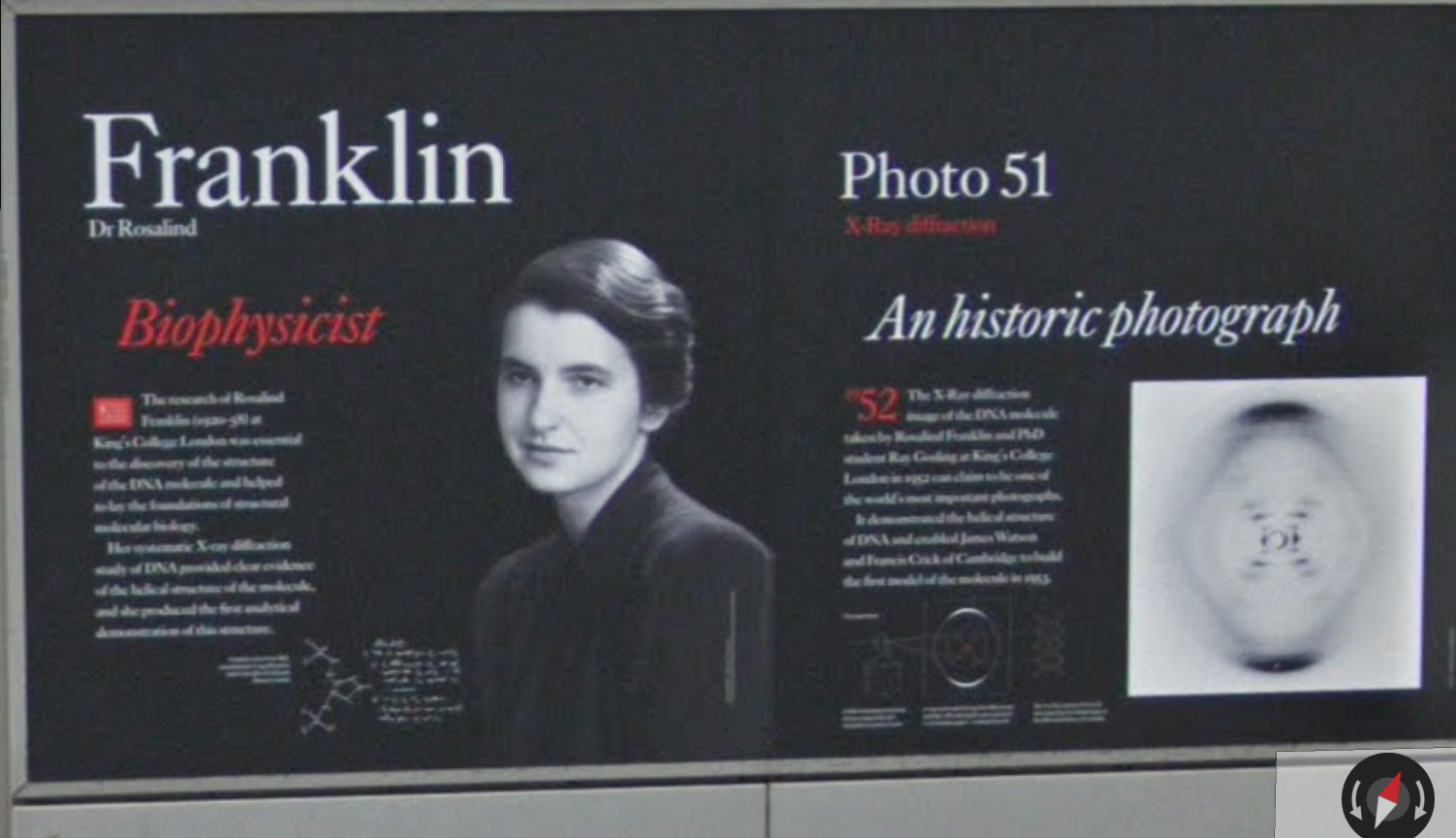
- If the discovery of the structure of DNA is not the most important scientific discovery of the twentieth century, then it's no big deal that Rosalind Franklin did not receive the Nobel Prize for her contribution. See also: What Rosalind Franklin truly contributed to the discovery of DNA’s structure. [22 Feb 2024]
-
All Nobel Prizes in Physiology or Medicine,
All Nobel Prizes in Chemistry.
[24 Feb 2024] Nobel Prizes concerning DNA (the list depends on how precisely the criteria are defined):
- 1933 Thomas Hunt Morgan chromosomes carry hereditary information
- 1946 mutations by means of X-ray irradiation (Muller)
- 1957 nucleotide co-enzymes
- 1959 DNA and RNA synthesis, DNA polymerase
- 1962 Watson-Crick structure of DNA (1953 discovery)
- 1966 DNA is genetic material (Hershey–Chase, 1952) **)
- 1968 genetic code
- 1972 ribonuclease
- 1978 restriction enzymes
- 1980 DNA sequencing
- 1980 recombinant DNA
- 1983 mobile genetic elements
- 1989 catalytic RNA
- 1993 PCR
- 1993 split genes
- 1995 genetic control of
development *)
- 2006 eukaryotic transcription
- 2006 RNA interference- gene silencing by double-stranded RNA
- 2009 telomeres
- 2015 DNA repair
- 2020 CRISPR/Cas9 **)
- 2022 paleogenomics
- 2023 mRNA covid-19 vaccins
- Ball relegates the 1962 Nobel Prize for DNA to a footnote... [28 Feb 2024]

|
|
Plaque at The Eagle (Google streetview) |

|
|
The Eagle, Cambridge (Google streetview) |

|
|
King's College London (1) Franklin-Wilkins Building |
|
| (2) Franklin and Photo 51 |

|
|
(3) Wilkins. Clearly a helix |

|
|
(4) The Double Helix |

|
|
The Francis Crick Institute, London |
(pictures Google streetview)


