Summary
In this post I show that it is pointless to claim that Darwinism undermines the traditional Christian morality and the value of human life, because modern theodicees do precisely that. The sanctity of human life is not threatened from outside religion, but from the inside. Even if it were true that Darwinism undermines the value of human life, and even if Darwinism alone could be blamed for the Holocaust, the question remains why God allows such violations of the sanctity of human life. It is difficult to see how Christians could oppose violations of the sanctity of human life, while at the same time claiming that God has his reasons for allowing precisely those violations.
Introduction
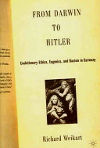
In his 'From Darwin to Hitler' Richard Weikart makes the link between Darwin and Hitler. Weikart contrasts the 'Judeo-Christian conception of the sanctity of human life' with Darwinism: "Darwinism undermined traditional morality and the value of human life" (p.3 'From Darwin to Hitler', or: FDTH). Weikart is not merely describing Darwinist conceptions in a neutral way. He uses emotional and moral words: "brutalizing tendencies of Darwinism" (p.2 FDTH) and "This alone is a shocking demonstration of the devaluing of human life by naturalistic Darwinists" (p. 181 FDTH).
Two Gods
But there are two Gods. The God of the Sanctity of Human Life and the God of the Free Will Defense. They disagree strongly. The God of the Sanctity of Human Life is against abortion and euthanasia, and also against the atrocities of Hitler. The other God, The God of the Free Will Defense, allows the atrocities of Hitler. The first God features in Richard Weikart's From Darwin to Hitler (FDTH). The second God features in books of John Hick and Richard Swinburne.
Now let’s see what philosopher of religion John Hick writes about Hitler:
"It seems to me that once you ask God to intervene to prevent some specific evil you are in principle asking him, or her, to rescind our human freedom and responsibility. Was God supposed to change Hitler's nature, or to have engineered his sudden death, at a certain point in history? But the forces leading to the Holocaust ramify out far beyond that one man. God would have had to override the freedom not only of Hitler and the Nazis, but all participants in the widespread secular anti-Semitism of nineteenth- and twentieth-century Europe, which itself was rooted in nearly two thousand years of Christian anti-Semitism. Further, having prevented this particular evil, God would be equally obliged to prevent all other very great human evils... Where should a miraculously intervening God have stopped? Only, it would seem, when human freedom will had been abolished" ([1], p.107) (my emphasis)
Richard Weikart complains about Darwinism and the devaluing of human life, but now we understand from John Hick that God cannot override Hitler’s freedom. So, Hitler’s atrocities are allowed by God. Maybe Richard Weikart is too squeamish?
Let’s have a look at what Intelligent Design Theorist Michael Behe wrote:
"Malaria was intentionally designed. The molecular machinery with which the parasite invades red blood cells is an exquisitely purposeful arrangement of parts. (...) What sort of designer is that? What sort of "fine-tuning" leads to untold human misery? To countless mothers mourning countless children? Did a hateful, malign being make intelligent life in order to torture it? One who relishes cries of pain? Maybe. Maybe not.". (The Edge of Evolution, or: EE, p.237) [2]
Behe does not know whether that Designer is malicious. The only things he does know is that malaria was intentionally designed, and that the Designer exists:
"Of the many possible opinions, only one is really indefensible, the one held by Darwin. In a letter to Asa Gray, he wrote: "I cannot persuade myself that a beneficent and omnipotent God would have designedly created the Ichneumonidae with the express intention of their feeding within the living body of caterpillars." (EE, p. 238)
"So did Darwin conclude that the designer was not beneficent? Maybe not omnipotent? No. He decided -based on squeamishness [3]- that no designer existed. Because it is horrific, it was not designed - a better example of the fallacy of non sequitur would be hard to find. Revulsion is not a scientific argument." (EE, p. 239) (Note 3 added)
At the time I read The Edge of Evolution I failed to understand why Behe would openly promote a Designer who was responsible for malaria. Isn't it immoral to create malaria? Isn’t it true that we have the moral obligation to eliminate malaria? According to Behe, a cruel designer is no argument against the existence of a designer. Now, after I discovered that many respected theologians and philosophers such as Richard Swinburn and John Hick believe that the most horrific cruelties (Holocaust, Hiroshima) are allowed by God, I begin to see why Behe was not worried by a cruel designer at all. According to Swinburne [7] most theists need an explanation of why God allows evil (a theodicy), and without a theodicy, evil counts against the existence of God. Behe is a Christian, so he must have known those theodicees and that those modern theodicees are regarded as the best solution of the problem of evil.
However, a theodicy is not without consequences. A theodicy has a profound brutalizing effect on thinking about pain and suffering of humans. Michael Behe ridiculed Darwin by calling him squeamish [2]. Behe was not courageous enough to say that Darwin rejected a cruel God for moral reasons. Behe's use of the word squeamishness obscures the fact that we are talking here about morality [6].
We see the same hardening and dehumanising effect of a theodicy on thinking by Richard Swinburne:
"Swinburne tells us that 'a creator who gave them only coughs and colds, and not cancer and cholera would be a creator who treated men as children instead of giving them real encouragement to subdue the world'." [4]
Just as Behe ascribes malaria to God, Swinburne does not hesitate to ascribe cancer and cholera to God. Apparently, the Creator is not squeamish. Indeed, how can one be sensitive to human suffering if God allows it?
Is it squeamish to be horrified by the Holocaust?
According to D. Z. Phillips "Swinburne actually tried to justify God's allowing the Holocaust to occur partly in terms of the bad decisions that led to it." ([1], p.75). But Phillips rejects this kind of theodicy: "It corrupts central moral and religious concepts, and vulgarizes human relationships." ([1], p.76). This a very important remark. And I agree. This is what Swinburne himself writes:
"But the more freedom and responsibility we have, of logical necessity the more and more significant are the bad consequences which will result (unprevented by God) from our bad choices" ([5], p.159).
It is quite shocking to hear that God has his reasons for not preventing the Holocaust. The most shocking is that people are prepared to continue to believe in the moral goodness of such a God. At the same time I want to emphasis that my argument does not depend on my personal squeamishness nor that of D. Z. Phillips. The contradiction is completely within religion. We see that a Christian thinker like Richard Weikart is shocked by the devaluing effect of human life by naturalistic Darwinists. Is Richard Weikart squeamish? No. What Hitler did is morally bad. Weikart is right about that.
Conclusion
Richard Weikart made the link between Darwin and Hitler. This short essay made the link between God and Hitler. Weikart is a Christian and is seriously worried about the dehumanising effect of Darwinism and atrocities committed by Hitler. However, Weikart did not realize that what he thinks is shocking, is unhesitantly, and maybe even enthusiastically, ascribed to God by modern philosophers of religion such as John Hick and Richard Swinburne. This is called a theodicy. Weikart did not realize that God has his reasons for allowing all the violations of the sanctity of human life. According to the Free Will Defense the reasons are the unrestricted freedom of humans to do the greatest evil. God allowed Hitler to do the greatest evil. Whatever the detailed reasons of God, it is a fact that atrocities did occur and God did not prevent them. As a consequence, the 'Judeo-Christian conception of the sanctity of human life' is annihilated. Furthermore, I demonstrated the brutalizing effect of believing in a malaria-designer (Michael Behe). Designing malaria is a way of saying that human life is not sacred. This is the brutalizing effect Weikart is afraid of. The conclusions of these observations are (1) that belief in God causes insensitivity for human pain and suffering and further; (2) if God allows violations of the sanctity of human life, those violations can’t be immoral (otherwise, God would be immoral), (3) therefore it is pointless to fight against those violations or blame Darwinism.
Acknowledgements
I wish to thank Taede Smedes for recommending the book of D. Z. Philips and Harry Pinxteren for reviewing the drafts.
Notes
- D. Z. Phillips (2005) The Problem of Evil and The Problem of God.
- Michael Behe (2007) The Edge of Evolution, Free Press.
- ‘squeamish’: easily shocked, nauseated, upset or easily made to feel sick by unpleasant sights, weak-hearted. Dutch: sentimenteel, overgevoelig, teerhartig. See my review.
- Quoted by D.Z. Phillips, 2005, p. 59.
- Richard Swinburne (1998) Providence and the problem of evil, OUP (Accessible at http://books.google.com).
- As I see it, Darwin had the emotional basis for empathy, sympathy and rejecting cruelty. Sensitivity for pain and suffering of others is the basis of morality (Frans de Waal). Darwin has a non-contradictory foundation for morality. Behe himself and Behe's God apparently misses empathy and sympathy.
- Swinburne: Providence and the problem of evil, page x.
Postscript:
This post will not be updated. For an updated version see my website: God, Hitler and the Free Will Defense.