What is the difference between animals, plants, bacteria and viruses
on the one hand and stars, volcanos, clouds, rivers, and rainbows on
the other hand?
Physicists don't understand the difference between a mouse and a cup
of tea.
This blog post originated from a discussion with physicist Karo
Michaelian about his book
Thermodynamic dissipation Theory of the Origin and Evolution of Life. The difference between physics and biology is a topic that
deserves a blogpost. It will be an informal discussion.
If organisms are just physical objects and must obey the laws of
physics, what biological laws could exist? Physicists explained the
Universe. Physicists have finally arrived at The Theory of Everything
which explains all known physical phenomena in the universe from the
smallest to the most massive things [11]. And organisms are in between.
If organisms are physical objects, they are also explained by The Theory
of Everything. They should also obey physical laws. But then, do we need
Darwin? Do we need Mendel? Do we need Watson & Crick? Could the
biology department be subsumed in the Physics department and send
biologists home? Let's listen to a physicist:
" ...the biologists simply are not trained to think in terms of
symmetries and fundamental laws, as physicists are. (...) Biologist want
simple answers that can be written out in a single paragraph, with
learning as little mathematics as possible, and they found one in the
perspective of Darwin (and, of course it is a perspective and nothing
more). It works as a nice description for some things, but it is only a
poor description of reality and misses completely at understanding the
fundamental function of life. The physicist wants to know what is behind
this Darwinian description and this thermodynamic view opens a
completely new paradigm with a much richer and profound understanding."
Karo
Michaelian, August 12, 2020
No wonder that physicists –in possession of the Theory of Everything–
want to invade and occupy the territory of biology. As if it were a war.
There is only one real science. The usefulness of mathematics for
physics is easily explained. Physics deals with dead things. Dead things
behave rather predictably. They are being moved by external forces.
Newton! The movements of the planets! [12]. But living objects move
themselves. In a way that cannot be predicted by physics. How
come?
The first difference between physics and biology: complexity. There are
only 118 chemical elements, but millions of biological species. The
chemical elements do not vary, except radioisotopes which behave
predictably. Humans have DNA with 3.5 billion bases. All humans differ
genetically. There are 67.3 million single-nucleotide polymorphisms in
the human population [4]. A human body has millions of cells, each
cell contains in total 42 million protein molecules. The majority of
proteins exist within a narrow range - between 1000 and 10,000
molecules. Some are outstandingly plentiful at more than half a million
copies, while others exist in fewer than 10 molecules in a cell [1]. And
these are only proteins. Physics has no laws for this huge amount of
complexity. Physics studies dead and simple things.

|
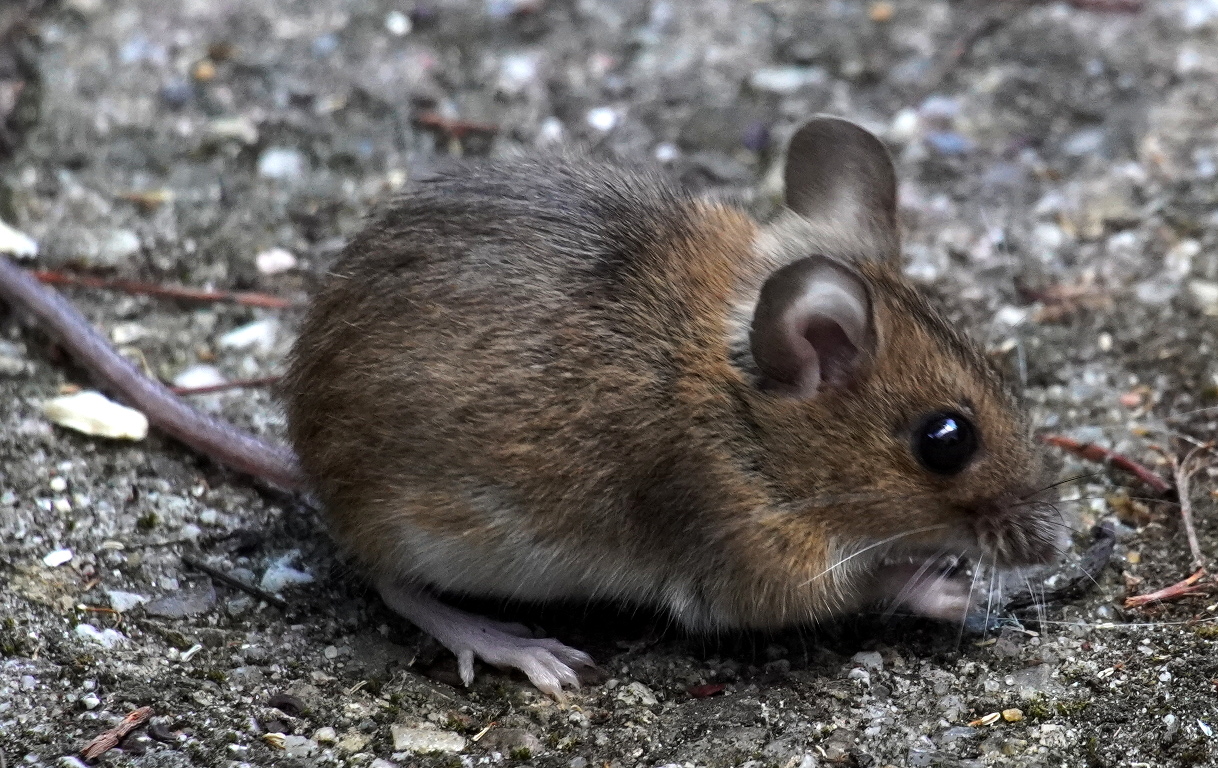
A hot mouse (Apodemus sylvaticus)
©GK
|
Most importantly, physicists don't understand the difference between a
mouse and a cup of tea. A mouse maintains a temperature difference
between its body and the environment. A cup of tea also has a higher
temperature than its environment. But what happens with the cup of tea?
The temperature difference has gone within an hour. Just obeying the
laws of physics. The mouse maintains the temperature difference all its
life. Physical laws don't explain the difference in behaviour between a
cup of tea and a mouse. Physics cannot explain how the physical object
called 'mouse' maintains its temperature. This example alone suffices to
suggest that we need a separate science. It's called biology, the
science of the living things.
Does a mouse maximize heat loss? Being naked would help! That would very
likely maximize heat loss [9]. Heat loss may be a driving force in the
abiotic and pre-biotic world. But living organisms have subsystems that
control energy uptake, energy production, energy use, energy
storage, and heat loss [5]. Those systems by-pass physical laws without
violating them. Just as birds and air-planes do not violate the law of
gravity.
In the living world, energy is under control, it is
regulated: thermo-regulation. Because it is under control, pure physical
laws cannot be applied. Therefore, physical laws cannot be the driving
force of evolution.
Yes, physical laws constrain the properties of living organisms,
but within those constrains there is freedom to shape organisms. And
what a shapes there are! Endless forms most beautiful! Heat loss occurs
in living organisms, but it is not a driving force, certainly not
the driving force. Energy management is one of the fundamental
differences between biological and physical systems. This is under
genetic control. Genetics is information [6]. The control of
chemical and physical processes is the main difference between living
and physical systems [2], [5]. It is part of the definition of life.
I add two important reasons why organisms have energy control systems:
-
without energy control they die. Energy uptake is not maximized, but
optimized.
-
organisms can produce more offspring if they use energy more
efficiently. That's the evolutionary reason.
Organisms that are less energy efficient waste energy and cannot invest
as much energy in reproduction because that's an energetically very
costly process. In general: energy efficient organisms, especially
animals, out-compete less energy efficient organisms. Energy efficient
organisms are winners, energy wasters are losers [3]. Warm-blooded
animals have fat, fur or feathers to prevent heat loss. Whales,
dolphins, seals and other marine mammals can generate their own heat and
maintain a stable body temperature despite fluctuating environmental
conditions. But these animals take thermoregulation to an extreme,
enduring water temperatures as low as –2 degrees Celsius and air
temperatures reaching –40 degrees C [7]. They have biological inventions
that oppose heat loss. That's against the
Thermodynamic Dissipation Theory. Life is a successful fight
against the Second Law of Thermodynamics,
against disorder, against equilibrium
[10], [14]. There is certainly no attempt to lose as much heat as
possible. That would be insane
[13].

|
|
Dead Weasel Mustela nivalis ©GK
|
Even a dead weasel is not quite a dead physical object as can be seen
on the picture above. It is teeming with life. Flies are the first
organisms to occupy the unfortunate animal. Many follow, including
bacteria, worms, beetles, fungi, maybe a fox or a raven [8].
So, if physicists are blind and deaf for the differences between living
and dead objects, no useful exchange of ideas between physicists and
biologists will happen. Arrogance and ignorance will be deadly for any
communication. Only as equal partners in science we will understand
life.
Notes
-
A cell holds 42 million protein molecules, Science daily January 17, 2018
-
I wrote about that in
my review part 2 of Thermodynamic dissipation Theory.
-
See further 'Not Wasting Energy' in
my review part 2. 16 May 2018.
-
For more details see: Open Questions / Genetic variation in
this review.
-
'Processes in living systems must be regulated and controlled' is one
of 5 Real (absolute) life criteria. See my
Ganti review. In engineering it is known as:
Control Theory. Heat production in a 'warm-blooded' animal is regulated. Otherwise
the animal would be overheated and die. The heat is generated by Brown
Adipose Tissue. On the other hand, in some animals
their metabolic rate and body temperature drop during the night to
conserve energy (torpor). To conserve energy! Regulation! Control!
-
Information is the difference between life and matter, A review of Hubert Yockey's 'Information theory and molecular
biology'. Yockey is a physicist.
-
How do marine mammals avoid freezing to death?
Scientific American, 13 May 2009.
-
Thousands of unexpected microbes break down our bodies after
death, Science, Dec. 10, 2015
-
If not maximize and not minimize heat loss (minimize heat loss is
against TDT), than anything goes? Any value would be compatible with
the Thermodynamic Dissipation Theory? But then it would be
unfalsifiable! The theory would not forbid anything. It would not
predict anything. It would not say one thing about the world. It
would make the TDT non-empirical and theory-less. Worst of
all: no mathematics involved!
That's a serious matter.
14 Aug 2020 15:09
-
A friend of mine,
Frank Visser, uses this illuminating metaphor: life behaves like a
sailboat sailing into the wind.
A sail boat has the ability to move forward despite being
headed into the wind. Life is also sailing against The Second
Law of Thermodynamics dictating that order becomes disorder.
21 Aug 2020;
-
In a
comment
Karo Michaelian wrote "Almost all physicists agree that we have discovered
all of the fundamental laws of nature needed to begin
an attempt at describing complex systems through these
formalisms, both living and non-living systems. We do
not need new laws." I would like to see how Michaelian
derives Mendel's laws from physical laws!
23 Aug 2020
-
Newton ignored the composition of the planets, the
elements, the temperature, the composition of the
atmosphere. In short: everything geologists,
biologists and climatologists are interested in.
Newton used abstract planets. Furthermore,
physicists use 'ideal gas' or 'perfect gas' (an ideal gas is a theoretical gas composed of
many randomly moving point particles that are not
subject to interparticle interactions); a
point particle
is an idealization of particles heavily used in
physics: it lacks spatial extension; being
dimensionless, it does not take up space. So, even
dead things are often too complicated for
physicists!
27 Aug 2020
-
To save energy animals go into hibernation or torpor.
Some hummingbirds in South America go into torpor: a
state of reduced metabolic activity and temperature
that is not unlike hibernation, but only one night
long. (Nature)
11 Sep 2020
-
Charles S. Cockell (2018) 'The Equations of Life: How Physics Shapes
Evolution, writes:
- "In Schrodinger's view, life was in a struggle to fight entropy. (...) Indeed, for a long time, it was something of a challenge to biologists and physicists to explain why life seemed to be doing something apparently in violation of the laws of physics. However, when we look at life in another way, rather than viewing it as something anomalous and almost fighting the laws of physics, we can instead see it is a process that accelerates disorder in the universe. (...) Living things show extraordinary local
complexity and organization, but the process they
are engaged in is accelerating the dissipation of
energy and the rundown of the universe. Local
complexity in organisms is an inevitable requirement
to construct the biological machines necessary for
this dissipative effect to occur. As the physical
universe favors processes that more rapidly
dissipate energy, then life is contributing to the
processes resulting from the second law, not
fighting it. At least, that is one way to view the
phenomenon of life." Chapter 1. [my emphasis] 13 Jun 2026
Further Reading
-
Ernst Mayr (2004)
What makes Biology Unique? Considerations on the autonomy of
scientific discipline. (a defence of the autonomy of biology). See my
summary.
-
Stuart Kauffman (2019)
A World Beyond Physics: The Emergence and Evolution of Life.
Stuart Kauffman is a theoretical biologist. Especially relevant is:
Beyond Law: Biology Cannot Be Reduced to Physics in chapter 11.
See
my blog
about the book (11 September 2020).
Postscript 25 Aug 2020
After writing this blog I discovered the views of theoretical
biologist
Robert Rosen:
"By proposing a sound theoretical foundation for studying biological
organisation, Rosen held that, rather than biology being a mere subset
of the already known physics, it might turn out to provide profound
lessons for physics, and also for science in general".
The
wikipedia page
contains a rather detailed description of his theories about living
systems and how they differ from physical systems. His book
Life itself (2005) is still available at amazon. Large parts can be
read at
google books.