|
|
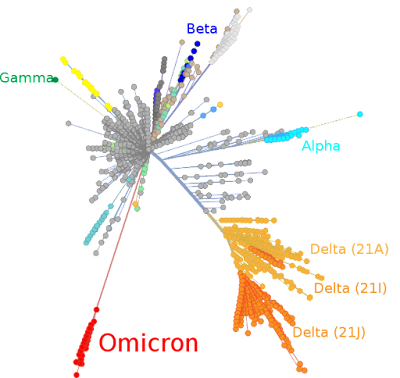
Evolution of Omicron Spike S1.
Science, Vol 374, Issue 6572 red line and dots is Omicron |
Three days ago I illustrated the exceptional nature of the Omicron variant with a stunning evolutionary tree. But now I have found an even better illustration (see above). It shows the mutations Omicron accumulated in the S1 subunit of the Spike protein. It's clear: Omicron stands apart from all the other SARS-CoV-2 variants.
In addition its roots are relatively very old. The data indicate that it should have diverged from other variants as early as February 2020. That is just 2 months after the first covid-19 cases. Why did we detect Omicron only in November 2021? Where has it been hiding? Now Chinese scientists propose a new hypothesis, maybe as weird as Omicron itself: it may have been living and evolving for more than a year in a mouse population!

|
|
Zoonotic jump from human to mouse and back. ©Gert Korthof Green virus is SARS-CoV-2 adapted to human host, Red virus is adapted to mouse host. |
They found that Omicron acquired 45 point mutations since its divergence
from the SARS-CoV-2 B.1.1 lineage. Especially the Spike protein showed an
exceptionally high number of mutations. They concluded that the Omicron spike
protein was subjected to stronger positive selection than that of any reported
SARS-CoV-2 variants known to evolve persistently in human hosts. Further, they
noted that the mutation fingerprint of Omicron was significantly different
from SARS-COV-2 viruses evolving in humans, but was highly similar to that of a virus that had evolved in
a mouse. As if the virus has been evolving in mouse populations. Omicron
seemed to be adapted to the mouse ACE2 receptor, not the human ACE2 receptor.
While the virus was living and evolving in the mouse it went undetected. So
the huge amount of new mutations in Omicron was not really a jump. Those
mutations most likely accumulated gradually in a mouse species. Apparently,
the mouse adapted Omicron seemed to be pre-adapted to the human ACE2 receptor
and started a new outbreak in humans. And it performed very well in humans.
The researchers did not claim anything specific about what mouse species was involved, or where all this happened. They did not mention South-Africa. They did not sample mouse populations in South-Africa. Their conclusion is solely based on comparing the SARS-CoV-2 RNA sequences from humans and other mammals found in public databases (GISAID, Nextstrain). The publication was posted on biorxiv.org and has not yet been peer-reviewed.

This is #38 in the Corona update series
Postscript
3 Jan 2022
The idea that the human SARS-CoV-2 could infect wild animals has shown to be happening: SARS-CoV-2 infection in free-ranging white-tailed deer (Nature, 23 Dec 2021): "that free-ranging white-tailed deer (Odocoileus virginianus) are highly susceptible to infection with SARS-CoV-2 virus, are exposed to a range of viral diversity from humans, and are capable of sustaining transmission in nature." According to NBS News after some time establishing itself in the deer population "We could be caught by surprise with a completely different variant."
My comment: that is exactly what could have happened with the Omicron variant in wild mouse populations!
Postscript
3 Feb 22
See also an article in Nature: 'Where did Omicron come from? Three key theories' paragraph 'Mouse or rat'.
Postscript
7 Feb 22
In an article in Science it is suggested that Omicron could have originated in lab mice! "(There’s no clear explanation for how Omicron arose, which has also fed some speculation the variant came from lab mice infected with SARS-CoV-2 or other research.)"
Postscript
21 dec 2022
Science: A paper [5] published earlier this month by Science claiming the Omicron variant of SARS-CoV-2 arose gradually, across a broad area of Africa, before it was detected was retracted today by its authors. ... that crucial genome sequences on which the study based its conclusions were a result of contamination
Omicron was first discovered in late 2021 in Botswana and South Africa, quickly spread across the world, and has dominated the pandemic since. Its exact origin has been a mystery, in part because Omicron is so different from the variants circulating before it. Researchers have put forth several ideas to explain the genetic gap.
- In one scenario, the virus went through an extended bout of evolution in an animal host and then spilled back into humans.
- In another, it evolved over a long period of time in a single patient with a chronic infection.
- A third possibility was that the virus had been quietly circulating and mutating in an area of the world where few viruses were being picked up and sequenced.
(it seems it is still unclear how Omicron originated)
Sources
- Kai Kupferschmidt (2021) Where did ‘weird’ Omicron come from? Science 1 Dec 2021
- Changshuo Wei et al (2021) Evidence for a mouse origin of the SARS-CoV-2 Omicron variant, 14 Dec 2021
- Gert Korthof (2021) The exceptional nature of the Omicron variant: a picture is worth a thousand words! 14 Dec 2021
- https://cov-lineages.org/lineage.html?lineage=B.1.1 There are 4 Omicron lineages listed on this page.
- Gradual emergence followed by exponential spread of the SARS-CoV-2 Omicron variant in Africa. (retracted!)