Lucy Cooke (2022) 'Bitch. On the Female of the Species', Basic books.
Darwin proposed the theory of sexual selection to explain differences
between males and females. His explanation involves females choosing a
sexual partner: "The female, though comparatively passive, generally
exerts some choice and accepts one male in preference to others"
(Descent); "male animals have
'stronger passions' and the female 'requires to be courted', she is coy"; Darwin's 'Law of battle' means a struggle between males for the
possession of the female and male dominance is considered a basic prediction of Darwin's sexual selection theory. Darwin's views on women: "man has ultimately become superior to woman".
_W_IMG_2806.jpg) |
one female golden orb weaver spider and many small males (wikipedia)
|
According to Lucy Cooke all this is typically the Victorian stereotype forced on to nature. She wrote Bitch to
demonstrate that this view is
one-sided and obsolete. It urgently needs an update.
Cooke aims to give the reader a more complete and truthful picture of the role of females in evolution. One of the many examples is the vicious, promiscuous and dominant
female golden orb weaver spider who devours her sex partner
'in the act'. Another is the lemur society with female dominance. Darwin and other male evolutionary biologists like Robert
Trivers, Richard Dawkins and Stephen Jay Gould wrote a sexist
theory. Apparently, a theory from the male perspective. Cooke
argues that female competition over mates and resources, and
male choice must be added to the picture. But, her book is
more than a scientific argument. It becomes clear that her
personal mission is to fight for equal rights for men and
women (also known as feminism). She writes: "Females are not destined to be
passive and coy". Example: "Female ducks are not passive
victims but active agents driving their own evolution, along
with that of males" (Ch.5). More than once
feminism and biology seamlessly merge into one another:
"Females across the animal kingdom began wresting back control
of their sexual destiny...", "Once females are
liberated from the responsibilities of pregnancy and
lactation" (Ch.6) and uses anthropomorphic language:
"female sexual autonomy", "consensual sexual activity", "from
victim to victor", "even female insects enjoy sex", "sexually
assertive females", "phallocratic", "second-class citizens" when writing about animals. Only when writing about lesbian albatrosses she explicitly recognizes that 'lesbian' is anthropomorphic language. Sometimes
we encounter explicit political expressions such as "Sisters unite!"
and "Termites are the original 'anti-capitalist anarchists". Or is this just popular science writing at its best? writing in an engaging way? So we can easily identify with the animals? Certainly humour ('the singletons' bar', 'albatross discos', etc.) makes this book fun to read. And what about the title 'Bitch"! She could be dead serious and humoristic at the same time.It could be that sexist and political language has been introduced by men in evolutionary
biology in the first place. I guess Cooke doesn't want to write a 'feminist evolutionary
theory' –her book is about non-human animals– but a theory
that has the facts right. I hope she doesn't want to replace the male point of view by a female point of view. That would be just as one-sided as the male point of view.
In each of the different chapters of her book, Cooke presents
animals that differ from the standard heterosexual male-female
model, non-standard male-female behaviour, female promiscuity, mate
choice, unusual sex organs and non-standard sex-chromosomes in
animals such as the mole, spotted hyena, vole, songbirds, langurs,
spiders, praying mantis, opossums, lemurs, chimps, bonobos and orcas. In addition, she writes
about the struggle of female evolutionary biologists to get their revolutionary results published. It costs a lot of energy to
overthrow age-old myths, prejudices and paradigms such as the Male
dominance, Monogamy Myth, the 'sperm is cheap' myth, Selfless
Mothers, The Myth of Maternal Instinct, etc. That is certainly a
recurring theme throughout the book.
During reading and rereading this book, I realized that the
evolutionary biology of sex itself is a battlefield of the sexes.
The battle of the sexes in nature is continued on another level in
the textbooks, universities and scientific journals. So deep is
the divide of the sexes in the human species that an impartial
theory of sexual selection is very difficult.
The diversity of sex and reproduction, parental care, sex
determination, is so big, that it is impossible to give a
summary here. Any summary would seriously diminish diversity.
 |
Was Darwin Wrong?
|
Was Darwin completely wrong in the eyes of Lucy Cooke? No, she is fair enough to admit: "Darwin wasn't all wrong on this score, by any means. Male
competition and female choice do drive sexual
selection, but they are just part of the evolutionary picture. Female choice is indeed a powerful evolutionary force"
(Introduction). Despite recurring criticism of Darwin's
androcentric Victorian views [1] she recognizes Darwin made an
astonishing original claim: "Darwin's controversial claim was
that females were not only sexually autonomous but had the
wherewithal to make decisions that shaped male evolution" and
even his brain! (Ch.2). There is even praise
for Darwin's discovery of the rich diversity of sexual systems in
Barnacles. DNA research has shown that Darwin was right. He was way
ahead of his time. In the Conclusion chapter she
admits that feminist "ideas are now woven into modern
evolutionary thinking."
Not withstanding this, In her book Cooke passionately tries to convince
the public and scientists alike to correct the lopsided pictures of
males and females.
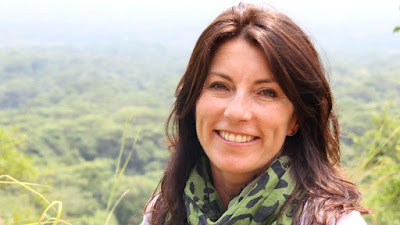 |
Lucy Cooke (BBC)
|
Conclusion
Darwin cannot be corrected –he is dead– but the theory of
evolution and sexual selection can and should be corrected. To a large extent feminism and the progress of evolutionary science go hand in hand, considering the current imperfect status of the field.
The theory of evolution should never be used to justify discrimination against any human. That would be committing the naturalistic fallacy. Evolutionary science should be free of male and female prejudice. Politics and religion should be banished from evolution textbooks. Facts unwelcome to feminists should not be downplayed or eliminated from the textbooks. Such as the fact that "in placental mammals the cost of reproduction is borne by the female" (ch.8). Ideally evolution textbooks should be written by male and female scientists. This is not the case. 'Feminist Darwinians' or ' feminist evolutionary biologists' should be an oxymoron. Both 'patriarchal' and 'matriarchal' animal societies should be reported as they are. Any hypothesis, feminist-friendly or unfriendly, should be published and tested.
We humans can change our society, not 'injustice' in wild animals in nature. Nature is just as it is. Would all non-human animal societies be matriarchal, still that does not justify unequal treatment of men and women or heterosexuals and homosexuals. That would be again committing the naturalistic fallacy. Cooke should have elaborated on the naturalistic fallacy: it is a logical fallacy, it is false, not just 'somewhat misguided' thinking. 'Natural' is not the same as 'good'. 'Unnatural' is not the the same as 'bad'. So, from a logical point of view it is mysterious how the true story of nature could be 'empowering for peoples of minority gender expressions and sexualities'. Never derive moral values from nature. Never insert human values in a scientific theory about non-human animals. Never value biological facts because they make you feel (un)comfortable. Science demands to get the facts right. That should be enough.
I didn't check the correctness of all the 280 Darwin quotes and citations. I hope to check some and publish it as a new page on my WDW website. The book provides more material for discussion than I can handle here. That makes it a good book. Thanks Lucy!
Sources
Lucy Cooke website
Notes
- Paradoxically, androcentric, phallocratic views flourished during the 'Victorian era', named after queen Victoria. A woman! Well, if the most powerful woman of the country was unable to create a more female-friendly society in 64 years, can we really blame Darwin?


_W_IMG_2806.jpg)


