|
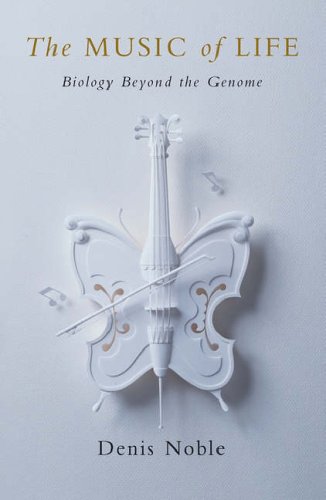
The Music of Life. |
The amazing thing is that Noble's criticism doesn't contain controversial facts. His facts are all mainstream scientific facts. The facts are not the problem. It is just that the views about the precise role of DNA in organisms in mainstream science literature is an inaccurate description of what is really going on in a cell. Noble doesn't deny the importance of DNA. It is the routine mainstream science writing about DNA that is wrong. The way mainstream science writes about DNA is based on a bad habit that crept unnoticed into the literature after the discovery of the structure of DNA in 1953, and culminated in Richard Dawkins' The Selfish Gene in 1976.
The book The Music of Life is about systems biology. It is about putting together rather than taking apart, integration rather than reduction. DNA is important, but is not 'the control centre of the cell'. The genome is not a privileged level of causality in biological systems. The genome is on a 'lower' level than the cell. The cell or the organism is 'the system'. The genome is part of the cell, and the cell is part of the organism. The genome only functions within a system. Reducing the cell to its genome is reductionism. Reductionism as a method to discover the parts of a system is necessary and should not be replaced by anything else. The system level must be built on successful reduction.
According to Noble, DNA as a biological molecule does not do much. The real players are the proteins. DNA is in comparison rather passive. (How could a passive part control anything?). I think that Noble's statement:
'the cell reads the DNA code'
could be called 'the central dogma of systems biology or cell biology'. This statement must be printed in a bold, large font in every biology and evolution textbook. It is a perfect antidote to the DNA-centric worldview. Here, the cell is the active part. The cell is the system. From this principle, it follows that we must describe the genome as a database (or an archive, library, toolbox, memory ) that is transmitted to the next generation, rather than a 'program' that creates organisms. How could a database with protein-coding genes create an organism? There must be an organizing principle. Something has to choose which genes are to be read in which cells (in a multicellular organism like us). Our worldview influences how we describe what happens in a cell. So, the language we use to describe DNA is important. The language that scientists use, reveals the underlying worldview: DNA-centric or cell-centric.
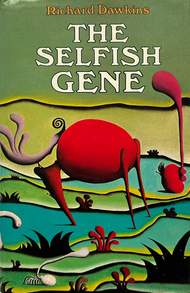 |
| Richard Dawkins: The Selfish Gene |
That is in particular true for expressions such as 'The Selfish Gene'. The way Noble analyses 'The Selfish Gene' idea is enlightening and new to me. 'The Selfish Gene' idea is in fact not a scientific theory at all, Noble says. No empirical test could possibly distinguish between 'selfish genes' and the opposite view 'genes as prisoners'. The genes are prisoners because they are trapped in huge colonies locked inside highly intelligent beings [5]. They are inside you and me; we are the system that allows their code to be read. The selfish genes do not create us, body and soul. Their preservation is totally dependent on our efforts to reproduce. We are the ultimate rationale for their existence. Additionally, Noble mentions that Dawkins agrees with him that the 'selfish gene' idea is not a scientifically testable hypothesis. I didn't realize that. Despite the fact that the selfish gene metaphor is not a scientific hypothesis, it continues to influence scientific research, thinking and writing. However, if it is an arbitrary view, then it doesn't deserve to be the standard view in biology and evolution. Noble presents us with an eye-opening alternative view.
Evaluation
I think, contrary to Noble, that there is a fact that can distinguish between the DNA-centric and cell centric view. That fact is that DNA as a molecule is passive. How could a passive molecule create you and me? A molecule that for every 'action', such as transcription, replication, recombination, repair or whatever, requires enzymes [6]. In my view, this fact contradicts Dawkins' selfish gene view, because that view implicitly claims that genes actively control the actions of the organism. To be precise Dawkins says: we are robots obeying the commands of the selfish genes. I consider that claim as falsified. A database cannot dictate anything. Consequently, a theory of how an individual is created from a fertilized egg is far from complete by summing up all the necessary protein-coding and regulatory genes in the genome. The genes in our genome are an inventory that is necessary, but far from sufficient. Question: how do thousands of individual protein-coding genes and proteins create an individual? [7]. These are fundamental questions in biology which tend to be ignored by the standard gene-centric selfish gene account.
Denis Noble is not a clown!
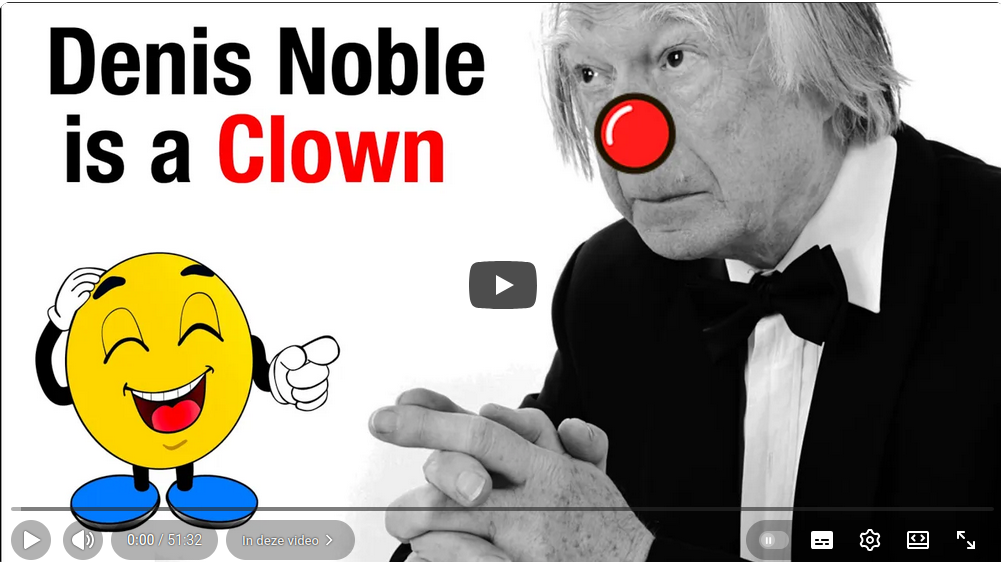 |
| Professor Dave Explains: Denis Noble is a clown [1] |
Contrary to what 'Professor Dave' claims: Denis Noble is not a clown! Don't let the loudmouths scare you away from reading The Music of Life and benefit from his insights. He is a serious and intelligent scientist. Don't be distracted by statements he made later in life.
Notes
- Professor Dave Explains: Denis Noble is a Clown 22 May 2025 is a video fiercely attacking the person Denis Noble.
- Denis Noble (2006) The Music of Life. Biology Beyond the Genome. In this review I use words and expressions from Noble's book to describe his position without giving page numbers.
- Gene-centrism is bad biology. Here is why. my blog 17 December 2025
- What is DNA-centrism? Why is it wrong? my blog 10 November 2025
- 'genes as prisoners' locked inside the nucleus of a cell: to me, it looks similar to the mitochondria which are also locked up in the cell and are completely depended on the host cell! Nice!
- The only 'exception' is self-splicing RNA. But RNA is not DNA, furthermore, RNA is the product of a transcription process that uses enzymes.
- "one of the great unsolved mysteries of biology for nearly two centuries" from: Sean B. Carroll (2005) Endless Forms Most Beautiful (2005), page x Preface. I will return to interesting examples of Carroll's DNA-centric language.


1. you might be interested in:
ReplyDeleteMolecular Systems Biology at 20: reflecting on the past, envisioning the future. Mol Syst Biol 2025 Nov 20;21(12):1667–1673. doi: 10.1038/s44320-025-00170-w
2. You wrote
“ Something has to choose which genes are to be read in which cells (in a multicellular organism like us).”
What about those
Aminoacyl-tRNA synthetases or aaRSs? " the physical bridge that bonds a specific amino acid to its matching transfer RNA (tRNA). " The title "Survival of the Fitting" is no wordplay or metaphor! https://quillette.com/2026/01/13/survival-of-the-fitting-genetics-enzymes-biology/
3. You wrote:
Dawkins says: we are robots obeying the commands of the selfish genes. I consider that claim as falsified.
A simple reminder: He himself did that already long ago *in the very last sentence* of his book
Dear Anonymous, thank you for your references and comments.
ReplyDeleteThe last sentence of The Selfish Gene reads: "We, alone on earth, can rebel against the tyranny of the selfish replicators."
Please explain how that doesn't contradict the whole contents of the book?
It is just like the last sentence of the Holy Bible: "By the way, God does not really exist.".
Dawkins himself -characteristically- still defended that last sentence in the 1989 edition of the book.
It was a pleasure to stumble across a new argument against The Selfish Gene of my own! Okay?
you said "I consider that claim as falsified."
DeleteI wrote: He himself did that already long ago; falsify that is, in one line, his whole book.
and to avoid another misunderstanding: I'm not saying it wasn't okay to find a new argument, I'm just saying you didn't really read what I said properly
DeleteAn I agree with the idea of paradigm shift. To give just one example: "Natural Induction"
Ano... said: " I'm just saying you didn't really read what I said properly." GK: Maybe you should devote more words if you want to be clearly understood?
DeleteI consider 1 line at the end of a book, not a proper scientific argument! It is just a claim without evidence! A statement out of the blue sky! I want to see a detailed argument and facts! It really is not sufficient to throw in one line! You didn't understand what I wrote here: "It is just like the last sentence of the Holy Bible: "By the way, God does not really exist.". A book of 3000 pages, and then writing in passing in the end "By the way, God does not really exist." is more like a joke than an argument!
I can't figure out what you mean by "Natural Induction" without explanation. Context please.
1 so Dawkins was just joking?
Delete2 just do some search using ‘natural induction’ as keywords (of a new paradigm some people have been working on a few years now)
3 for an update of your main point of this blog you better read the article of Job Dekker et al ( see above)
Weer interessante overdenkingen Gert, bedankt.
ReplyDeleteThe way we view the genome and DNA may also have been influenced by the time in which computers emerged. The program determines what the computer does, its output. The computer's binary code is then compared to the four-letter code of DNA. Because the computer code has no influence whatsoever on the hardware, nothing resembling a living being or evolution will ever emerge.
Dawkins is a science communicator, and his "selfish gene" was a milestone. The origin of the first DNA molecules, which formed billions of years ago, starting with LUCA and leading to the evolutionary tree of today, has been explained time and again by Dawkins. That our sex cells are in a way direct descendants of those first primal cells is a wonderful concept, which Dawkins has illuminated well. It should be remembered that the gene and the principles of heredity had only recently been discovered before Dawkins, and the popularized account he wrote about them was entirely new and provided a solid foundation for understanding what evolution is or could be.
It's now clear that natural selection and evolution involve more than just DNA.
Thanks, Marleen for your comment. I can see that you are an excellent science communicator!
ReplyDeleteYou know, once you see the world through different eyes than Dawkins' gene-centric and DNA worldview, you notice everywhere in the literature new things! I am now rereading books I read 20 years ago, and I see new things I didn't notice at the time! A kind of paradigm shift. That's really rewarding and ... fun!
It must be very interesting to reexamine books from a different perspective.
ReplyDeleteI'm glad I read your blog because it helped me understand that Denis Noble sees teleonomy present in living beings. Jacques Monod (there he is again), who first used the term teleonomy, also noticed that life and its components seemed to have a purpose, which had nothing to do with God or religion (teleology).
I found "Noble’s book” (it has many co-authors): Evolution "on Purpose," Teleonomy in Living Systems (2023) and I am going to read it. I'm very curious.
Perhaps you've already found it.
https://share.google/yGBIfRwciLbY0Ehcd
I hope the link works for you.
P.S. I once wrote this article where teleonomy is discussed at the end.
https://en.wikipedia.org/wiki/Molecular_demon (2019)
Marleen, thanks for your comment. It's clear, you are an experienced science communicator yourself!
ReplyDeleteYou mention your wikipedia page 'Molecular demon'.
Did you know that John Odling-Smee (2024) Niche Construction. How Life Contributes to Its Own Evolution, uses Maxwell's demon and von Neumann's universal constructor theory to explain and define life. It's quite surprising for a book about Niche Construction! So maybe you didn't know it. Note that this book has an Open Access edition:
https://direct.mit.edu/books/oa-monograph/5822/Niche-ConstructionHow-Life-Contributes-to-Its-Own
The link to Evolution "on Purpose works for me, it's amazing that a complete book is freely available! Thanks again!
Thanks, Gert, for this information. For now, I'm reading Evolution "On Purpose," which promises a lot of interesting things. I've briefly looked at the book on niche construction. My interest lies primarily in "molecular cognition," or teleonomy at the molecular level (enzymes, membrane receptors, antenna complexes, etc.). But it's also interesting at a "higher" level. There's plenty to read for now.
ReplyDeleteAnonymous, in your first comment, you wrote: "A simple reminder: He himself did that already long ago *in the very last sentence* of his book."
ReplyDeleteThis caused some misunderstandings on my part. 1) it suggested I forgot the existence of that sentence, and therefore my argument against the selfish gene was outdated, superfluous and pointless.
2) I came to develop a new argument of my own. For me that's more satisfying than what Dawkins did.
3) I have another argument in mind that I will blog about in the near future.
4) ‘natural induction’: if I google it, I get confusing results (Natural methods of inducing labor) and I have to guess what you want to say. So: give reasons for why ‘natural induction’ is relevant. It's all right if you want to suggest new literature, but I want the reason why you think it is relevant. And I want a proper link. It's an awful waste of my limited brain time to search in the blue sky without any clue why it is relevant.
Dear dr korthof
Delete1. I only meant that your work is more satisfying 'than what Dawkins did', though i must admit that contradicting the core idea of his own book in one single sentence, is quite an achievement. Right, it is "not a proper scientific argument! It is just a claim without evidence! A statement out of the blue sky!" but still it clearly undermines the very idea of organisms as just 'dna vehicles'
in short: it's just baloney.
3. looking forward to you other argument
4. I mentioned 'Natural Induction' as a possible example of a paradigm shift (and a refutation of Dawkins idea, for that matter)
see f.e.
https://doi.org/10.1098/rsfs.2025.0025
and
https://doi.org/10.1098/rsfs.2025.0036
I think that quantum informationtheory will revive and vindicate Maxwell's demon: it gets myriads of quantumfluctuations for free, and entanglement works miracles, so to say. It's Maxwell's demons - information engines- all the way down, and up!
Marleen, I would not recommend a book for you without reason. I watched your wikipedia page, and remembered that John Odling-Smee wrote a profound analysis of Maxwell's demon and von Neumann's universal constructor theory in his latest book. Of course that is unexpected in a book about Niche Construction. Maxwell's demon and your Molecular demon: aren't they similar? And: isn't Maxwell's demon a demon with a purpose? (separating fast and slow atoms?)
ReplyDeleteDear Dr. Anonymous,
ReplyDelete1. agreed!
3. new blog is coming soon!
4. 'Natural Induction': I browsed the Abstract of the article: it's an almighty abstract and esoteric stuff!
Thanks, Gert, I'll look up the relevant parts and passages. I'm very short on time right now, so feedback will be delayed. Thanks again!
ReplyDeleteMarleen, it's Okay. You don't need to do that. I was just trying to correct a misunderstanding!
ReplyDeletedear dr korthof
ReplyDelete1. we'll get back to this infamous last sentence in due time (may be after your next blog|!)
3 looking forward
4. too much to comment on it in a few lines, but see 1.
have a nice day