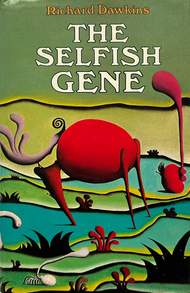
|
| Richard Dawkins (1976) The Selfish Gene |
The Selfish Gene Theory in short:
"Thus Richard Dawkins introduces us to ourselves as we really are - throwaway survival machines for our immortal genes. Man is a gene machine: a robot vehicle, blindly programmed to preserve its selfish genes." (blurb from the publisher).
"The replicators which survived were the ones which built survival machines for themselves to live in." [1-4]
Clearly, this is a gene-centric theory of life and evolution. Bodies are temporary throw-away vehicles to replicate genes. Viewed in this way, there are several problems that are not at all, or not adequately addressed in either the popular press or by Dawkins himself.
I have 5 objections:
- genes (DNA) cannot build organisms. Genes cannot control the organism. Genes are never active elements in an organism, they cannot do anything.
- the history of life on earth shows a remarkable trend from simple to complex organisms, from single cells to increasingly complex multicellular life forms. This makes no sense from the selfish gene perspective.
- repair-DNA genes and enzymes are altruistic genes, not selfish genes.
- the selfish gene theory predicts asexual, not sexual reproduction.
- the selfish gene theory does predict selfish genes, not cooperative genes.

|
| -1- |
1) The first objection to the selfish gene theory is that genes cannot act without the help of the cell, and in case of multicellular organisms cannot act without the help of the organism. The central dogma of systems biology reads: The cell reads the DNA code. The cell decides when and which genes to read. The organism ('vehicle' in Dawkins terminology) uses the genes in its genetic library to build itself. DNA itself does not contain a program for building an organism. DNA only contains the code for producing proteins. That's a huge difference. The cell uses the library of genes to look up the exact specification of a protein and synthesizes it. Enzymes transcribe, translate, replicate and repair DNA. The cell has all the resources (building blocks for DNA, machinery, energy) for the transcription, replication, translation and repair of DNA. The cell has the power and ultimate control. DNA 'self-replication' does not exist. The cell replicates DNA with the help of enzymes. That's not all. An even more shocking fact for the reputation of DNA: the cell manipulates DNA. Specific enzymes turn off/on genes by attaching a methyl group to the DNA base Cytosine (methylation) or removing a methyl group (demethylation). So, genes do not turn themselves on/off. It is clear by now: DNA on its own is totally helpless. DNA is a dead molecule. DNA never initiates anything. DNA never leaves the cell nucleus. How could DNA be a cause?
But enzymes are helpless too, in the sense that they are unable to replicate themselves. They need the specific information encoded in genes to get synthesized. So, genes and enzymes are interdependent. Their very existence depends on each other. It makes no sense to single out one component of a system as being 'selfish'. If there are selfish genes, one could as well say, there are selfish enzymes. Those enzymes, for example: DNA-replicases, helicases, primases and ligases, want to replicate DNA, because their own specification is encoded in that DNA. So, indirectly those enzymes ensure their existence in the next generation. If genes are immortal, so are enzymes. Again: it makes no sense to single out one component of a system as being 'selfish' or as being 'the cause', or as being 'immortal'.

|
| -2- |
2) The second objection starts with an uncontroversial observation: the earth is populated by complex bodies (phenotypes), while genes are still linear sequences of four bases. If selfish genes want to maximize the number of copies in the next generation, and use bodies as temporary throw-away vehicles, why do we see highly complex vehicles with 'extended phenotypes' (9) instead of simple single cells? (bacteria). Single cells leave more descendants in shorter time, so more copies of their genes are produced. A bacterium can multiply in 30 minutes. In contrast, large, complex bodies take longer to grow and usually leave fewer descendants. What a waste! For example, in the human species, the female is only about 20% of the year fertile; it takes 9 months to grow a baby; it takes at least ten years for the newborn to reach sexual maturity, and the number of offspring is significantly smaller compared to mice, flies, bacteria. The selfish gene theory seems to predict single cells multiplying very rapidly as the outcome of evolution. [8]

|
| -3- |
3) The third objection is: the existence of DNA-repair genes refutes the idea that genes are selfish. DNA-repair enzymes repair DNA replication errors. They repair errors in all genes, irrespective of what the genes 'do', if anything. They do not do what one would expect of 'selfish genes': selfishly and selectively repair errors in their own genes. Repair enzymes are blind with respect what the genes 'do'. Hence, DNA-repair genes behave altruistically. This is a new and profound objection to the selfish gene theory.

|
| -4- |
4) The fourth objection: the selfish gene theory predicts asexual reproduction because that is the most efficient method to produce copies of the selfish genes. But that is not what we see. Sexually reproducing species are far more common than asexual species. Sexually reproducing species dilute their selfish genes with foreign genes of an unrelated individual. That means, with sexual reproduction, only half of the alleles of the male and half of the alleles of the female end up in the children. While with asexual reproduction (sort of cloning) 100% of the alleles end up in the offspring [7].

|
| -5- |
5) The fifth objection: the selfish gene theory seems to predict selfish genes within genomes, not cooperative genes. It seems to predict a war of genes within a genome, since every gene wants to become the dominant gene. Yet, the 'selfish' genes of an organism are housed together with all other selfish genes in the same body (vehicle). In other words: they are all in the same boat! The problem is that genes housed in bodies can do nothing on their own. A single gene cannot build an organism. Even the most simple single-cell organisms need thousands of cooperating genes to build the 'vehicle'. The totality of all genes is called the genome. Only a complete genome can be the basis for building an organism. If one gene in a genome replicates significantly more than all the other genes in the same genome (a selfish gene), that could result in the death of the organism. Consequently, it would result in the death of that selfish gene and all the other genes. There is only one option for the 'selfish' genes to survive: cooperate! So, a genome necessarily is a community of cooperating genes. Paradoxically, in order to build their vehicle, those 'selfish' genes need to be altruistic towards all the other genes in the same vehicle. Remember this: The best cooperators build the best vehicles!
Conclusion
The Selfish Gene theory is an extreme form of gene-centrism. The book The Selfish Gene became a bestseller because it resonates with our perception of human nature. The book seems to explain the urge to survive, to have sex, and to have children of one's own. The story that genes make survival machines is intuitively easy to comprehend. But it is misleading. It is wrong. It is not what really happens in the cell. The truth is more complicated than that. Genes do not have the power to control anything. From the perspective of the organism, DNA is nothing more than a storage medium and a vehicle of inheritance. Organisms want to make identical or at least very similar copies of themselves. To make that possible they use DNA. It makes no sense to single out one component of a system as the most important, as Dawkins did. Maybe, in a sense we are programmed to reproduce, but that cannot be attributed solely to genes. If evolution is all about the replication of genes, then why complex bodies? Why sex? They are unnecessary to get genes copied. Bacteria do that much better and faster without complex bodies and sex.
Postscript
22 Feb 2026
Strange things happen at female meiosis. In female animals, three of the four meiotic products are typically eliminated by extrusion into polar bodies, and only one cell develops to produce an ovum. Contrary to male meiosis, which produces 4 functional haploid spermatids. Does The Selfish Gene theory predict that 3 of the 4 meiosis products in females are discarded? Those 3 are not transmitted to the next generation, but contain a full haploid set of chromsomes. The Selfish Gene theory predicts that all genes (and alleles) maximize their transmission to the next generation. Concluding, the Selfish Gene theory predicts asexual reproduction, which is rare. Additionally, sexual reproduction is common, but the details of female sexual reproduction don't allow for a straightforward explanation by The Selfish Gene theory [6].
If that is not enough trouble, "around 30 percent of early pregnancies fail before the embryo implants in the body of the mother, with another 30 percent around that time." [5]. Apparently, reproductive output is not maximized!
Notes
- "We are survival machines - robot vehicles blindly programmed to preserve the selfish molecules known as genes." Preface to the first edition.
- "The replicators which survived were the ones which built survival machines for themselves to live in. (...) They are in you and me, they created us, body and mind ..." page 21, hardback Oxford University Press 1977.
- "This DNA can be regarded as a set of instructions for how to make a body." page 23
- "genes control embryonic development" page 25. (all emphasis is mine)
- Magdalena Zernicka-Goetz (2020) The Dance of Life: Symmetry, Cells and How We Become Human. [22 Feb 2026]
- However, explanations have been proposed for this wasteful behaviour: Instead of producing 4 small, equal gametes (like sperm), the female reproductive system invests all available resources into a single, high-quality, nutrient-dense gamete. The follow-up question is then why female meisosis does not consists of just one reductive division resulting in 2 haploid egg cells thus avoiding wasting 2 haploid cells. [23 Feb 2026]
- In evolutionary biology known as 'The cost of sex': 1) The Two-Fold Cost of Sex (Cost-of-Males); 2) The Cost of Meiosis (Genome Dilution); 3) Three Additional Costs of Sex. Chapter 40 Introductory Biology. (open source, free access, anonymous authors but it looks a complete overview of biology.) Wikipedia doesn't have a page 'Costs of sex'. [24 Feb 2026]
- This argument is also made in chapter 3 of Alfonso Martinez Arias (2023) 'The Master Builder. How the New Science of the Cell is Rewriting the Story of Life.': "When genes became components of cells, they had to abide by the terms and conditions of the cells ever afterwards. Their selfishness was curtailed." [11 Mar 2026]
- Later Dawkins wrote 'The Extended Phenotype' which includes all the effects that genes have on their environment. This is still gene-centrism in my opinion. However, the last chapter of the book is called 'Rediscovering the Organism'. Does this mean 'organism-centrism' or is it just extended gene-centrism? Dawkins leaves the question Why are there large multicellular organisms? unanswered. (page 263) [2 Aug 2026]
Previous blogs
- A review of 'The Music of Life' by Denis Noble. Noble is not a clown! My blog 15 Jan 2026
- Gene-centrism is bad biology. Here is why. My blog 17 December 2025
- What is DNA-centrism? Why is it wrong? My blog 10 November 2025


First sentence preface: "This book should be read almost as though it were science fiction."
ReplyDeleteGerdien, this blog is about valid scientific problems with gene-centrism, and I have tried to give scientific objections in as short and compact a way as possible. They are not science fiction. I think the logic of the arguments presented above is clear and does not really require references. Of course, if you want clarification, just ask me, or you may wish to consult previous blogs, since this blog builds on previous blogs.
ReplyDeleteGerdien, I consider your comment as strange. The full first sentence reads:
ReplyDeleteThis book should be read almost as though it were science fiction. It is designed to appeal to the imagination. But it is not science fiction: it is science. Cliché or not, ‘stranger than fiction’ expresses exactly how I feel about the truth. We are survival machines—robot vehicles blindly programmed to preserve the selfish molecules known as genes. This is a truth which still fills me with astonishment.
So Gerdien, why did yoy left out this: But it is not science fiction: it is science ...
Dawkins present his theory as science, even as the thruth.
I have never thought that his theory gives an accurate description of reality.
The expression "as though" is a favorite one, I counted 29 times.
Here you can read the book in pdf format:
https://ia600602.us.archive.org/14/items/RedpillCollection/The%20Selfish%20Gene%20-%20Richard%20Dawkins.pdf
Rolie Barth gives the most of the first alinea, not the first sentence
DeleteDear Dr Korthof
ReplyDeletewhy bother any longer? *)
Last sentence of the 30th anniversary edition, 2006, p 331, a comment on the infamous last sentence of the first edition:
We, alone on earth, can rebel against the tyranny of the selfish replicators.
"We, that is our brains, are separate and independent enough from our genes to rebel against them. As already noted, we do so in a small way every time we use contraception. There is no reason why we should not rebel in a large way, too."
This isn't even 'journalism', indeed just science fiction.
But you won't hear me complaining: "my brain separate and independent enough from my genes.."
*)Science, 2025; 390 (6772): 495 DOI: 10.1126/science.ads5297
btw they used AlphaFold,... not metaphors or other rhetoric
Deletethank you Dr Anonymous for the references. Indeed, telomerase and replication enzyme A are splendid examples of genes/enzymes that unselfish repair telomeres (=chromosome ends): all the genes on the chromosomes benefit from this action! they help themselves indirectly, plus all the genes on all chromosomes (I assume they are not specific to one chromosome!). I could add it to point 3 above. There are undoubtedly many more examples.
DeleteDr Korthof
ReplyDeletethis might interest you even more|: Rapid compensatory evolution within a multiprotein complex preserves telomere integrity. Science, 2025; 390 (6776): 918 DOI: 10.1126/science.adv0657
I first read the Selfish Gene when was a teenager, back in the 1980s. At the time, it blew my mind. "This is it!" I thought. "This answers questions of life does what it does. It explains why people do what they do."
ReplyDeleteBut then I grew up, but most importantly kept an open, curious mind that still questions almost everything. I too saw some of the holes in Dawkin's thesis that you have elucidated here.
I'm not shocked to see you are getting push back. Deference to authority is a powerful human weakness that we have obviously far from overcoming. Based on my experience in modern academia (in the US) I have no confidence that evolutionary theory will pivot to a more logical and scientific rigorous direction soon, but I maintain hope.
Keep up the good work Gert!
Stephen, thanks for the encouragement!
DeleteDawkins claims his book is science (in the third sentence of the preface).
ReplyDeleteDawkins' main thesis, of replicators and survival machines, is one idea pushed to extremes, without any biological background. The idea is not examined, just run away with. That is not a scientific way to proceed.
Gerdien, let's not waste our time by Biblical exegesis of the first sentence of the first paragraph of the first chapter... of The Selfish Gene!
ReplyDeleteMy question for you is: Am I right or wrong with my 5 points? Am I on the right track? Or have I lost my way? I can't tell from your answers. Please enlighten me!
Your five points are correct. Dawkins forgot biology in his enthousiasm for his idea.
Delete@gerdien
ReplyDeleteAre you suggesting that if we don’t push dawkins idea not ‘to extremes’ we could give it ‘biological background’ ?
Dawkins took several different meanings of the word 'gene', and identified them with each other.
ReplyDeleteOn the one hand, molecular, a string of DNA between a start codon and a stop codon.
On the other hand, the gene as used in theoretical models. The book occasionally reads as a verbal account of the one-locus selection model in populations genetics. The predictions Dawkins mentions are the predictions of the theoretical models, including kin selection and ESS.
Just before 1976, many advances had been made in both fields separately. To identify the gene in the models with DNA was very tempting, and might have accounted for much of the books popularity.
In a case like sickle-cell anaemia, the one-locus selection model and the DNA are next to each other. Here Dawkins' approach holds.
Delete@ Gerdien
DeleteAre you suggesting a 1-to-1 correspondence, say translation, of the tenets of population genenetcics to the popularisation by dawkins? That shouldn't surprise us, I'd say, because both lack 'biological background'.
Yes, that is what I thought. Dawkins adds some molecular genetics, but it is not always easy to see how functional this is.
Deletedear Gerdien
Deletesorry, I am at loss which molecular genetics D added according to you- the kin selection stuff?
'Adds some molecular genetics': I thought of the immortail coil stuff.
DeleteIn chapter 6, Genesmanship, kin selection appears. Note it doesn't matter at all in this chapter what genes might consist of. Kin selection uses the relatedness between individuals in diploids, assuming the laws of Mendel. Dawkins talks about 'a gene for altruism', but I wonder whether the same argument would hold when framed as 'a genotype for altruism'.
Dear Dr Korthof
ReplyDelete"There are undoubtedly many more examples."
Right, and this one might well add to your objection 1 ...
"The results are unexpected given the notion that the probability of a specific mutational event is independent of its value to the organism and underscore the importance of studying mutation rates at the individual-mutation resolution."
PNAS 2025 Sep 2;122(35):e2424538122. doi: 10.1073/pnas.2424538122. Epub 2025 Aug 25.
Dear Dr. Anonymous, the article you referred to is about non-random adaptive mutation. What I don't understand is how the authors explain it. Do you? If this were a general mechanism of mutation, adaptive evolution would be fast! very fast!
ReplyDelete
DeleteDear Dr Korthof
the researchers used a newly developed method: Mutation Enrichment followed by upscaled Maximum Depth Sequencing—MEMDS) I am not an geneticist and I can’t judge this technique
This is the second result "underscoring the importance of high-resolution mutation rate studies." and I can only applaud this development as an example of a new paradigm and support for your first objection, for that matter.- whether evolution works fast, very fast, or slow.
Dear Dr Anonymous, it is perfectly okay to bring up the publication of 'adaptive mutation'. I pointed out that it immediately triggers the question: how does the cell know in advance which mutation would be beneficial? That is the primary question. It could be that the authors were busy doing experiments and establishing facts. That's okay. But if your results go against established knowledge: "A fundamental tenet of evolutionary biology is that mutations are random events”, then at least I expect some explanations... Do you see there is a problem?
DeleteGerdien, do you agree that 'The cell reads the genome' is the correct expression? And that the expression 'a gene causes a phenotypic trait' is at best a shorthand used for practical purposes in genetic and evolutionary research?
ReplyDeleteYes (2x)
ReplyDelete@ Gerdien (and Dr Korthof):
ReplyDelete‘immortail coil stuff’, you worte.
what about:
Job Dekker et al An integrated view of the structure and function of the human 4D nucleome. Nature, 2025; DOI: 10.1038/s41586-025-09890-3 :
‘… extensive catalogues of more than 140,000 looping interactions per cell type, … detailed classifications and annotations of chromosomal domain types and their subnuclear positions, and …. single-cell 3D models of the nuclear environment of all genes including their long-range interactions with distal elements…’… ‘use of computational methods to predict genome folding from DNA sequence, which will facilitate the discovery of potential effects of genetic variants, including variants associated with disease, on genome structure and function”. ?
Sounds like more ‘biological background’ to me, than we ever can find in all of Dawkin’s books
BTW Dekker once quipped ‘nothing in genomics makes sense except in 3D’- now we can update his joke: 4 instead of 3d.
( I mentioned the work of Dekker cs in one of my posts on one of the previous blogs, but I can't find it anymore: just to make sure this interesting research won't be missed in our discussion)
Dr Korthof
ReplyDeleteAs far as I can see, they found the ‘highest de novo origination rate [that] deviates most from the genome-wide average rate for its type’ and these results ‘are unexpected- given the *dogma* that the probability of a specific mutational event is independent of its value to the organism, that is.
Of course, I see the problem here, we’re talking about paradigm shifts, aren’t we?
So looking forward to some explanation, just like you!
All I know is that neurons, nerve *cells* , do have the capacity to predict, allowing ‘ sophisticated anticipation’ in the hippocampus
“Predictive Coding of Reward in the Hippocampus” DOI: 10.1038/s41586-025-09958-0
BTW, speaking of a paradigm shift: I see some interesting parallels here, in the use of new advanced techniques that allow for interesting *experimental* research and yield results that call for new explanations, or upending dogmas..
Dear dr Anonymous,
ReplyDeleteyou should be more careful with killing 'dogmas', and declaring paradigm shifts
1) mutations can be non-random but *not adaptive*
2) there can be selection for mutation *rate* (that is different)
3) Essential genes, such as those involved in translation, can have lower mutation *rates*
but this still is not the same as a mutation that arises purposeful to solve a specific, immediate problem, such as environmental stress (e.g., lack of nutrients).
Right, we should always be careful, even with killing dogmas.
ReplyDeleteAllow me to elaborate a little further.
My point wasn't so much that mutations do or don't anticipate or have foresight. My point was that the whole idea of random mutations is at the heart of the old paradigm and that it's being challenged by new models—e.g., AlphaFold, AlphaGenome—and by new techniques, e.g., optogenetics, CRISPR, and new research possibilities (organioids) that are disrupting the old models of genes as rolling dice (whether or not in a beanbag) with (estimated) parameters like ‘mutation rates’, ‘selection coefficients’, etc.
In contrast to the ‘old school’ these new models and techniques allow us not only to (literally) see more detail, but we also can create a more systematic approach and conduct experiments (in real time, in vivo), and most importantly test hypotheses - instead of just fitting models.
Interestingly enough, at least to me, this applies to both the genome and the connectome (optogenetics f.e.)
New examples are published almost every day. Even though it's only a preprint, I personally think the study (doi.org/10.64898/2025.12.12.693858) is a great example, not only because it perfectly fits your objection 1 (regarding the question of whether this involved some kind of immune response (active fending off) or a lucky physical isolation), but especially because it also refers directly do with Dawkins's infamous last sentence.
Your answer in your previous blog was spot on: "We are the system that allows their code to be read" .
I'd call that a paradigm shift.
As a variation on the title of D. Noble's book (and a paraphrase of a well-known quote), we could conclude : "We must force our old genes to dance by singing their own melody".
Or, with a wink to Dawkins: Darwinists have hitherto only interpreted—and modeled—the genome in various ways; the point is that we are the only organism that can change it.
The problem with articles as doi.org/10.64898/2025.12.12.693858 is nobody knows whether all these retroviral infections concomitant or functional. Despite the suggestive title, the abstract says:
Delete"Notably, the endogenization and proliferation of retroviral infections within host genomes has introduced numerous species-specific regulatory elements that have the potential to influence gene regulation. However, the role of these endogenous retroviruses in hominoid brain evolution remains unclear. "
Molecular biologists are keen to ascribe function, but never show it.
Thanks Gerdien. Very useful information!
DeleteDear Dr. Anonymous, you pointed out a fascinating story 'Retroviral insertions contributed to the divergence of human and chimpanzee brains', are you saying that this is a general mechanism in evolution?
ReplyDelete@ Gerdien de Jong:
ReplyDelete"Molecular biologists are keen to ascribe function, but never show it. “
Are they?
What about the rest of the abstract- and the rest of paper, for that matter?
f.e.:
“We conducted an epigenomic analysis of PTERV1 insertions in chimpanzee neural organoids and found that they are heavily covered by DNA methylation, representing more than 150 species-specific heterochromatin domains with the capacity to influence gene regulatory networks. We identified one such chimpanzee-specific PTERV1 insertion on chromosome 19 that blocks the expression of the long noncoding RNA LINC00662, via DNA methylation spread to the adjacent genomic region. The expression of LINC00662 was restored in chimpanzee induced pluripotent stem cells when we deleted the PTERV1 insertion using CRISPR editing. We found that LINC00662, a human-specific RNA, is highly expressed in the developing brain and plays an important role in the posttranscriptional control of neuronal maturation, axon outgrowth, and neural organoid development. In summary, our findings describe how endogenous retroviral insertions contributed to the functional divergence of the human and chimpanzee brains. This provides a new mechanism by which retroviral pandemics influenced primate brain speciation.
“We were able to restore LINC00662 expression in chimpanzee cells using CRISPR-based deletion of this PTERV1 in chimpanzee induced pluripotent stem cells (iPSCs). We found that LINC00662 is a human-specific transcript with high expression in the developing brain. It is localized in the cytoplasm, where it plays a key role in the maturation of neurons, thereby influencing the development of neural organoids. In summary (sic!), this study describes how retroviral insertions contributed to the functional divergence of the human and chimpanzee brain, providing a new mechanism by which retroviral infections influenced primate brain speciation.”
Assertions, not facts.
DeleteAssertions?
DeleteBtw see my ‘assertion’ below for the real relevance of this (kind of) research.
DeleteDr Korthof
ReplyDeletea general mechanism in evolution, you asked.
discovered in 2005, ERV’s are estimated to comprise up to 5–8% of the human genome (lower estimates of ~1%). So not a general mechanism, I'd say.
The point is that this arxiv paper shows how new research possibilities (high resolution sequencing, testing organoids for investigating long noncoding RNAs and other noncoding regions, to understand what they’re doing in closely related species up ends the kind of old school models Dawkins tried to popularize
In addition, the results of this research directly relate to his infamous last sentence and the subject of this blog
Note that, as far as I know, as of November 2018, by announcing their gene-edited embryos, He Jiankui et al proved that very last sentence as factually correct.
Dr. Anonymous, I guess you would also like the video of Anton Petrov:
ReplyDeleteNew Discoveries Challenge Everything We Knew About Brain Evolution
https://www.youtube.com/watch?v=sKZ18vfweC8
he discusses, among others, this article:
'De novo genes with an lncRNA origin encode unique human brain developmental functionality' (2023).
Dear Dr Korthof
ReplyDeleteThanks for the reference
New discoveries are accumulating!