|
|
Charles Darwin 12 Feb 1809 – 19 Apr 1882 |
Today, Darwin's 213th birthday, I will publish a blog about how the
theory of evolution has changed since Darwin.

|
|
Fig. 1. Two empires: the virus (left) and the cellular (right)
empire (source) coronaviruses (single-stranded
positive sense RNA viruses) (added, modified) |
I am amazed how Darwin could construct a general theory of biological evolution that essentially still holds today considering the biological knowledge of the time. That knowledge of his time is rather primitive compared with our knowledge today. A cursory look at the illustration above is enough to realize that most of our current knowledge of the biological world was simply absent at the time Darwin wrote On The Origin of Species (1859).
Darwin did not know Bacteria. Darwin did not know viruses. Darwin did not know Eukaryota (at least the concept). Darwin did not know Archae. In fact everything that is present in the above illustration!
The concept of the eukaryote has been attributed to the French
biologist Edouard Chatton (1883–1947). It was reintroduced into biology
in 1962. Definitely long after Darwin. Darwin, of course, knew animals
and plants, but he didn't know that they are eukaryotes. So, strictly
speaking he knew nothing of every item in fig. 1. And that is basic
biology today.
Bacteria: at the time of Darwin's 1835
Galapagos Island expedition, the germ theory of disease had yet to be
described. Then, in 1977, Carl Woese proposed that Archaea are
different from bacteria and constitute the third domain of life. The
three domains together constitute the cellular empire (see figure
1). Cellular life is contrasted with viruses which are a-cellular.
The left side of the illustration shows viruses.
Viruses are not cells. These days seven different groups of viruses are recognised. One group
is Corona viruses. One of the
Coronaviruses, SARS-CoV-2, started a pandemic in December
2019. Viruses were unknown in Darwin's time. In 1898 the Dutch
microbiologist Martinus Beijerinck introduced the word 'virus'. Darwin
died in 1882.
But Beijerinck did not know RNA and DNA. He called viruses
contagious living fluid.

|
| Fig. 2. The three-domain tree of life (source) |

|
| Fig. 3. A network representation of the evolutionary process (source) |
The theory of evolution was substantially upgraded with the rediscovery of Mendel's laws of heredity in 1900 and with the discovery of the structure of DNA in 1953. In 2000 the complete human genome was sequenced. Thanks to DNA sequencing and comparative analysis of genomes it was discovered that Horizontal Gene Transfer between Archaea and Bacteria was extensive. The Tree of Life (fig. 2) became a Network of Life (fig. 3). A fundamental change. The green lines in Fig. 1. show extensive gene transfer between the three domains of life and the viruses.
Adaptation of SARS-CoV-2
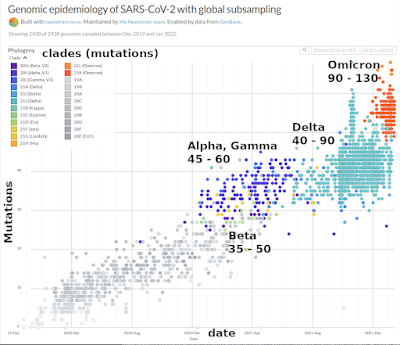
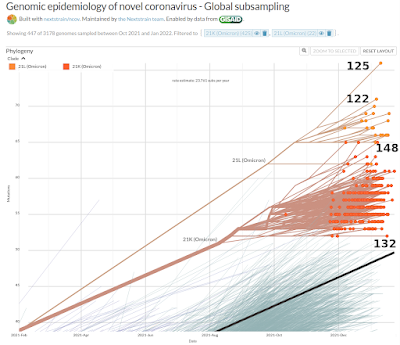
In a previous blog The evolution of a pandemic virus: SARS-CoV-2 I showed an illustration of SARS-CoV-2's growing number of mutations during the past 2 pandemic years. Darwin had no idea of a 'mutation'. He could not know, because a mutation is a change in DNA and he didn't know DNA. However, he did know the concept of heritable variation. He did know some variation is advantageous, and some is disadvantageous. That was enough for him the construct his theory of evolution.
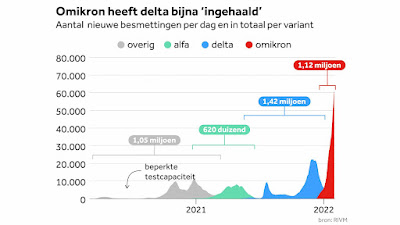
SARS-CoV-2 does not only produce mutations and heritable variation. Some of the variation is advantageous for the virus and increases its fitness. New variants outcompete existing variants. For example the Omicron has outcompeted the Alpha and Delta variant. The SARS-CoV-2 virus is surprisingly well adapted to its human host. Virologists discovered how sophisticated the adaptation of virus to its human host is. For a start, the virus speaks the same genetic language as humans. It has the same genetic code. Its RNA is like a messenger RNA (mRNA). It is the same type as humans use for the transfer of the genetic information from DNA to proteins. That's why human cells start immediately to translate those viral RNAs into proteins. The virus also knows how to enter human cells. It has adapted to the human ACE2 receptor. The virus also knows how to reproduce and self-assemble in human cells. The virus knows how to get out of the cell. The virus has adapted to the human respiratory system. That's its environment. The virus also knows how to evade attacks of the human immune system. The virus knows how to spread from human to human by droplets and aerosols.
These are all adaptations. In other words: SARS-CoV-2 is a prime example of evolution by adaptation and natural selection.
Darwin would have loved it!
Happy birthday!
Sources
-
Eugene V. Koonin and Yuri I. Wolf (2012): Evolution of microbes and viruses: a paradigm shift in evolutionary
biology?
In fig.1. I added 'Coronaviruses'
(red), but note that at the time of the publication SARS-CoV-2 did not yet exist! In Fig.2 and 3 I added the 3 domain names.
- Omicron’s Surprising Anatomy Explains Why It Is Wildly Contagious, Scientific American 11 Feb 2022. This article explains the molecular basis of four adaptations of Omicron to the human host. Impressive how Omicron has discovered new ways to adapt to the human host to increase its own fitness without damaging its host too much!
Postscript 19 Feb 2022
I discovered that I already on 8 June 2020 paid attention to the fact that Corona virus obeys Darwinian evolution: Waarom zijn corona virussen zo groot? KNAW lezing van Eric Snijder 19 mei 2020. (Dutch)
Further Reading
- Thermodynamic Dissipation Theory of the Origin and Evolution of Life by Karo Michaelian. A review by Gert Korthof. 2018
- Review of Karo Michaelian's Thermodynamic Dissipation Theory, Part 2. Darwin and Natural Selection. 2018
- The difference between physics and biology, 14 August 2020