|
Johnjoe McFadden (2021)
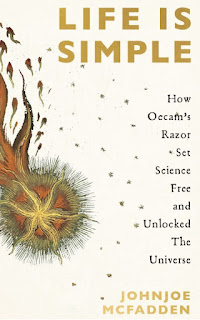
Life Is Simple
|
The book Life is Simple by biochemist and molecular biologist
Johnjoe McFadden is not about life, but is a history of Western
science viewed from Occam's perspective. William of Occam was a
thirteenth century theologian and inventor of what is now known as
'Occam's razor'.
I really have to blog about this useful and entertaining book.
Occam's razor is the preference for the simplest solutions to scientific
problems; theoretical entities should not be multiplied beyond necessity;
plurality should not be posited without necessity; it is vain to do with
more what can be done with less. This seemingly simple principle of
parsimony revolutionized theology, philosophy and science. McFadden
selects various scientific revolutions of the past six centuries to
illustrate Occam's Razor in action.
Occam used his razor to strip away everything in medieval philosophy
except God's omnipotence. Furthermore, he claimed that the only way to
gain knowledge is through experience and observation. Not by syllogism.
For Occam, this was another important distinction between science and
religion. Science, he maintained, yields probabilities, not proof. A very
modern understanding! Despite all this Occam never doubted the existence
of God, nor the central tenets of Christianity. Only faith gives us access
to theological truths, he wrote. Remarkably, McFadden does not comment on
the fact that Occam did not apply his razor to the question whether God
was a necessary entity in our worldview and whether the elimination of the
God hypothesis could simplify our view of the universe.
A good example of the application of Occam's razor is the replacement of
the geocentric model with the heliocentric model of our solar system.
Copernicus argued that
"accepting that the earth rotates every day, rather than the sun, moon,
planets and stars, provides a much simpler cosmos." (214/687, ch
7).
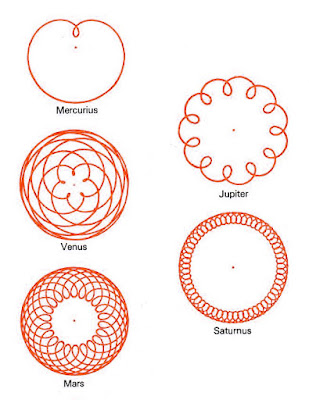
In the geocentric model each planet has its own epicycle:
|
Epicycles of Mercury, Venus, Mars, Jupiter, Saturn
©Vliegende Schotels en andere Raadsels van het Heelal,1978
|
Copernicus eliminated five planetary epicycles and by placing the sun in
the center of the system he removed all epicycles, thereby simplifying the
whole solar system.
Furthermore, "Ptolemy's geocentric system could not explain why Mercury
and Venus are always seen to be closest to the sun at sunrise and sunset".
He added an arbitrary rule to account for this. But Copernicus positioned
"Venus and Mercury to a position between the earth and the sun so that
they became inner planets. In this position, their closeness to the
sun in the sky is simply due to their closeness to the sun in reality. In
this way, an arbitrary feature of the complex model becomes an inevitable
consequence of its simple alternative." Furthermore, the mysterious
behaviour of Mars, Jupiter and Saturn was explained in the heliocentric
model by positioning them beyond the orbit of the earth: they became the
outer planets. This is a very convincing demonstration of the
usefulness of Occam's razor. Although I knew the Copernican revolution,
and I knew that heliocentrism was a simpler theory, I never made the
connection with Occam. I never had any knowledge of the life and work of
William of Occam. His philosophical approach reminds me of modern
philosophers Gilbert Ryle and Alfred Ayer (see notes).
McFadden did a great job. He revisits the big revolutions in science and
shows how Occam's razor is at work, whether or not the scientists involved
acknowledge this. The writing style is certainly not dry or academic.
There are a lot of anecdotes that contribute to the story and make one
continuing reading.
Galileo mentions Occam several times in his early lecture notes, and
argued that "the single daily rotation of the earth is much simpler and
more natural than having the sun, moon, planets and the stars rotating
around the earth every day."
(298/687). A perfect example of
Occam's razor at work. Many of the most important scientists in the
history of science were following Occam. McFadden writes: "The razor had
made its way from the thirteenth century, via the via moderna,
through to Leonardo, Copernicus, Kepler, Galileo, Boyle and now to Newton
to become a central plank of modern science." (Ch11). Add to this list:
Hobbes who took Occam's reductionist approach further than anyone
previously dared and Lavoisier's dismissal of phlogiston. In biology the
vital spirit was shown to be an entity beyond
necessity.
Life's razors
Occam was ahead of his time. Amazingly, he described a form of natural
selection! He wrote that animal properties such as teeth might have arisen
by chance and be retained because 'the animals survive'. Really amazing!
But Darwin made the supernatural watchmaker superfluous.
In chapter 14 McFadden reveals some rather remarkable facts about Darwin
and Wallace. In 1855 Alfred Russel Wallace wrote a paper 'On the law which
has regulated the introduction of new species'. At the time he was
collecting specimen for a living in Indonesia. He sent the manuscript to
the editor of a British natural history magazine. The subject was the same
as the one Darwin had been working on for the past 20 years. Wallace
proposed that any theory about the origin of new species should explain
nine bio-geographic and paleontological facts. Next he formulated a
general law that captured all those facts, the Sarawak law. It was a
descriptive law, without causal mechanisms. But it was a revolutionary
idea. Never had such a law been formulated before. It was 4 years before
Darwin published his Origin of Species. McFadden interprets the
Sarawak law as an example of Occam's principle. I did not know about that
manuscript. And McFadden rightly believes that it should be far more
widely recognized as key to the development of the theory of evolution. In
1858 Wallace (still in Indonesia) wrote a letter to Darwin with his
explanation of the Sarawak law: natural selection. This letter and the
subsequent events are well-known. Except the following: "Despite Darwin's
habit of keeping nearly all his letters, all those written to Darwin by
Wallace, Hooker, Huxley or Lyell during that crucial year of 1858,
including Wallace's original Ternate paper manuscript, have been lost."
Have been lost! Very mysterious! Could that be an accident or is it
intentionally 'lost'? The work of Wallace surely deserves further study.
McFadden concludes that "natural selection is probably the most Occamist
reduction of a multitude of arbitrary facts into a simple law."
Again a new and interesting fact: in 1867 J. D. Campbell noted in his
Reign of Law that Darwin had in fact not explained the origin of
new species. A criticism repeated many times by Darwin critics and
evolutionary biologists in the years thereafter. Again an issue that
deserves further study.
In chapter15 about heredity and genetics McFadden points out the DNA, the
genetic code and mutation are a perfect example of explaining the
diversity of life on earth with a few simple concepts. Indeed, DNA and the
genetic code are universal for life on earth. However, I disagree with his
claim that the genomes of biological species are very nearly as simple as
they can be. They are not (pseudo-genes, junk DNA, introns, Alternative
splicing, X-inactivation, mitochondrial-DNA, etc).
The Cosmic Razor
In Part IV The Cosmic Razor McFadden addresses the laws of physics,
Einstein, general relativity and quantum mechanics. He concludes that
Einstein made the universe less complex and more simple. All this is
evidence of "the unreasonable effectiveness of Occam's razor."
In his final, and I would say speculative, chapter 'The Simplest of All
Possible Worlds?' McFadden concludes that the universe is close to being
as simple as it could be while remaining habitable.
This book is a dazzling tour through the history of science and the
universe. It is also well-researched. McFadden is as equally at ease with
theology, philosophy, biology, physics and astronomy as with the history
of those sciences. The unifying theme is Occam's razor. I think it is a
successful project. But an unfinished project, I think, because there are
so many facts and issues that demand further exploration.
While reading Life is Simple I remembered that theologian Richard
Swinburne based his argument for the existence of God on the same
principle as science does: the simplicity principle or Occam's razor.
Swinburne mentions Occam. But instead of demolishing the God hypothesis,
Swinburne exploits it to argue that God is the most simple explanation of
the universe! Far simpler than the materialist explanation. Not what one
would expect. Is this a bogus or an ingenious claim? I have to read
Swinburne's book again and find out. I would like to know McFadden's
opinion about this! McFadden did not discuss whether Occam's razor would
eliminate God.
Why am I so interested in the history of science? I think the history of
science, as it is described by McFadden, gives us hope. There are things
in this world that show progress in the long run despite a relapse to
barbarism and war. Bombs, tanks and kamikaze drones can destroy cities and
people, but cannot destroy scientific knowledge. That at least may give us
hope.
Update 11-11-22
Sabine Hossenfeld video Dit the Big Bang happen?
In this video she uses Occam's Razor without identifying it as such.
|
the simpler the better (here)
|
"The simplest explanation that we have found is the standard model for
cosmology, which is based on Einstein's equations. The requirement that an
explanation is simple is super important. It's because without it we can't
do science at all."
|
A simpler theory is better, because Occam's razor. (youtube)
|
Update 3 Jan 2023
"While Occam's razor is a useful tool in physical sciences, it can be a
very dangerous implement in biology. It is thus very rash to use
simplicity and elegance as a guide in biological research. While DNA could
be claimed to be both simple and elegant, it must be remembered that DNA
almost certainly originated fairly close to the origin of life when things
were necessarily simple or they could not have got going. (...) The
genetic code is a very good example of what I mean. Who could possibly
invent such a complex allocation of the sixty-four triplets? Surely the
comma-free code was all that a theory should be. An elegant solution based
on very simple assumptions – yet completely wrong."
(p.138-139
Francis Crick (1988) What mad pursuit.)
Notes
I bought this eBook at KOBO bookstore because of its exceptional price:
€ 3,99 and the intriguing title. I found out that McFadden is also
the author of Quantum Evolution. Life in the Universe (which I
listed on my
website) and
Life on the Edge. The Coming of Age of Quantum Biology.
The influence of Occam on Gilbert Ryle: "he claimed that much of his
philosophical work amounted to "Occamizing" (the reference is to William
of Occam and his so-called "Occam's razor," which states that the best
explanation is the simplest, the overly-complicated concepts and work of
other philosophers." (source).
About A. J. Ayer se:
Ayer, Alfred Jules (1910–1989)
(encyclopedia.com) and:
A.J. Ayer And The Elimination Of Metaphysics
in which Ockam is discussed.
I reviewed Richard Swinburne (1997) Is there a God? on my
WDW website. But after reading McFadden I have to reread it and find out how
Swinburne uses Ockam to prove God.
Website JohnJoe McFadden


