According to the Dutch consumer organization 'De Consumentenbond', the
iPhone is more sustainable than the Fairphone.
In
my previous blog
(Dutch) I gave a detailed analysis of how the Dutch consumer organization
'De Consumentenbond' tests the sustainability of smartphones. My
focus was on the methodology of testing and the presentation of the results.
Here I add a new surprising discovery and a summary of the analysis in my
previous blog.
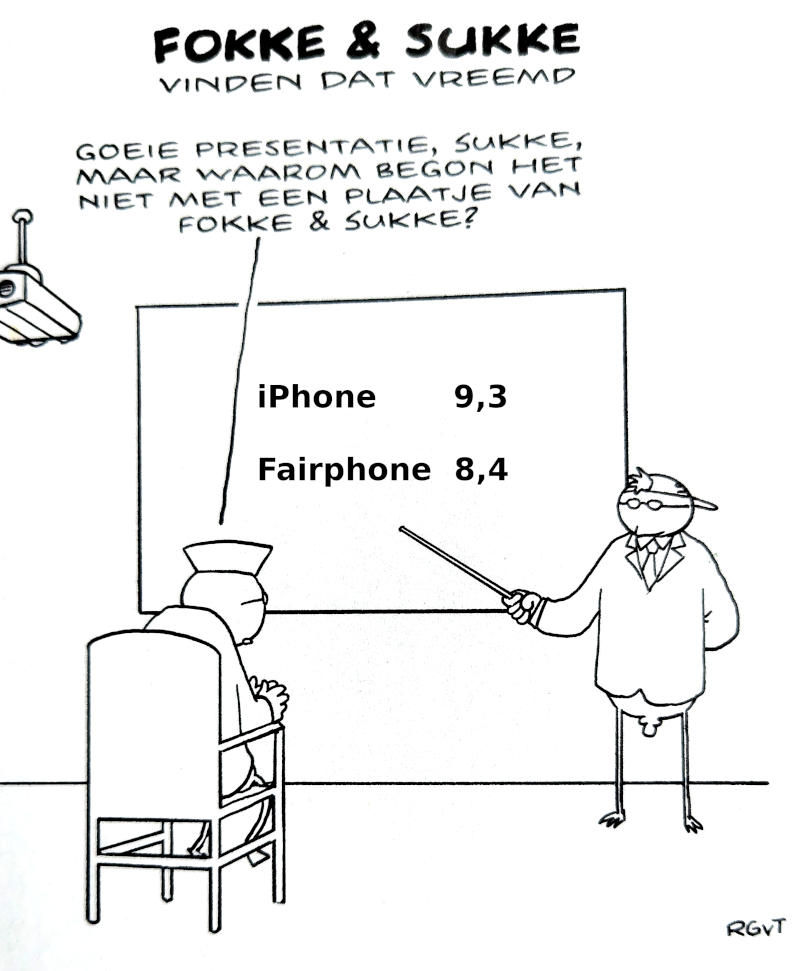
|
Strange results!
(adapted,©RGvT)
|
The smartphone test of De Consumentenbond is a one-dimensional ranking of 311 smartphones
based on a large number of criteria. This results in one top-ranking
smartphone: 'The Best in the test'. The winner is the iPhone. Most
criteria they use have to do with technical performance and features such
as camera, screen, sound, battery longevity, etc. Each property
contributes with a fixed percentage to the total score (100%). The
sustainability filter was introduced only this year on the website in
tests of smartphones. Sustainability is defined by properties such as
conflict minerals, child labour [6], durability, etc. These properties (if
known) are listed for each phone and are given either a quantitative (if
possible) or a qualitative value. Surprisingly, sustainability is not
included in the ranking of the phones (0%). (see my
previous blog). The result is that the 'Best of the test' is not (automatically) the
most sustainable smartphone because sustainability contributes only for a small percentage (if not zero!) to the total score.
That is how 'De Consumentenbond' defines the total score. It is
good to realize that this is a choice, not a test result.
Confusingly, their Sustainability evaluation method gives the iPhone a
9.3 and the Fairphone a 8.4 [1]. This is a mind-blowing result. So, the
iPhone is not only 'The Best', but also the 'Most Sustainable' smartphone
in the world. If true, than what was the point of bringing Fairphone to
the market, if smartphones were already sustainably produced? It would be
economic suicide for a start-up. The result of their evaluation method It
is contrary to what is generally accepted in the smartphone community,
namely that the Fairphone is the most sustainable smartphone
[2]. For example, the company Fairphone is a member of the
Fair Cobalt Alliance. Apple is not a member. So, how does De Consumentbond arrive at this
conclusion? In
my previous blog
I noted that a replaceable battery was not included in the
Sustainability filter on the website, but it is present as a separate
property. Again, this is a choice. Since the iPhone has
no replaceable battery, this decision results in the inclusion of
the iPhone in the group of sustainable smartphones. How wonderful! If they
had chosen to include a 'replaceable battery' in the definition of
sustainability, and implement it in the software on the website, than only
4 or 5 smartphones, including Fairphone, but excluding iPhone, would have
ended up in the group of sustainable smartphones.
Repairability

|
Apple doesn't want you to repair it.
(source)
|
Later I discovered another shocking fact:
Repairability
is not included in the definition of sustainability! Even worse, the whole
concept is absent [4].
Again, this is a choice, not a test result.
Repairability means that the owner of the phone can replace modules. In
the case of Fairphone no less than 11 modules. Clearly,
repairability is connected with the
modularity
of the phone.
Repairability and modularity are the most important sustainability
features. If the owner can replace modules the phone will last longer. And
that is good from a sustainability perspective. It is well-known that
Apple has gone to extreme levels to make their phones
un-repairable by design by gluing parts together so that the owner
of the phone cannot replace them [3]. This is summarized in the discovery
of smartphone expert Hugh Jeffreys: 'Astonishing Anti Repair Practices By Apple In the Last 15 Years' [3]. In 2009 Apple introduced the infamous anti-repair
Pentalobe screw. On the other hand, it is no secret that Fairphone is the most
repairable smartphone on the market [3]. It makes the Fairphone product
unique. It is the raison d'être of the company. Doesn't
De Consumentenbond know this? As professionals they ought to know
these facts. In fact, they know of the existence of the Fairphone. They
published about the Fairphone back in 2016 in their magazine
De Consumentengids [1].
Right to repair: Right to repair: Commission introduces new consumer rights for
easy and attractive repairs. [19 Jan 2024]
Planned obsolescence is an important Wikipedia page in which iPhone is mentioned several times! Read it! [19 jan 2024]
Third party Certifications
[added: 30 dec 2023]
An objective way of rating smartphones is by independent organizations. A
number of third parties rated the sustainability of the Fairphone
company:
-
EcoVadis
-
Benefit Corporations (B Corps)
-
iFixit: Fairphone-5: 10, iPhone-15: 4.
-
French Repairability Index
-
Eco Rating: Fairphone on top of list.
Source:
What do all our certifications mean?
Fairphone 29 December 2023
Fairphone is #1 on
Mobile Phones: Ethical Comparison Ratings Table
and iPhone is #12.
Conclusion
It is one of two things: either the testing of smartphones is a work in
progress and De Consumentenbond struggles to include
'Sustainability' in a straightforward and consistent way in their tests,
or, God forbid it, we see here a bias against sustainable smartphones
disguised as a neutral, independent, objective, and quantitative test
method. It doesn't help to add: "Our tests are professional". It is beside
the point that the tests are being done in highly sophisticated
professional labs. My point here is that a bias creeps in through
the value they give to certain test parameters, the weight they
give it in a percentage of the total, and/or the omission of important
parameters such as repairability. If it is not explained how those values
are established, what the sources are, the values are subjective. That
creates opportunity for personal preferences for a particular smartphone
by the person who writes the reviews. Certifications by independent
organizations should be included as much as possible.
Although I personally value sustainability very high, maybe the highest
of all features, I do not ask 'De Consumentenbond' to do the same.
That would be subjective too [7]. However, if consumers are using the test
results as a guide for buying smartphones, the tests should be objective
and bias-free. And for consumers who value sustainability and
repairability, it should
be easy to select the most sustainable smartphone from the test
results.
Update 3 Dec 23: small edits to eliminate potentially confusing
text and improving and clarifying my point.
Update 30 Dec 23: Added paragraph Third party
certifications.
Sources
Note [1] I am not allowed to quote any of the test results because they
are for members only. Maybe I have revealed already too much. This makes
it risky to discuss their method in public at all!
The Consumentenbond knew of the existence of the Fairphone back in
2016 (see
my blog).

|
Marleen Bekker in
Consumentengids okt 2016.
|
The Consumentengids published an interview with a disappointed
user of a Fairphone 1 (see picture above), she owned a Fairphone 1 but
hesitated to buy a Fairphone 2 because its price (500 euro). The first
fair phone was the most fair, but did not have the same features as other
smartphones on the market at the time. They could have interviewed a happy
Fairphone 2 user, but did not. In 2016 the Consumentenbond did not include
any ethical criteria in their tests. Apparently, a fingerprint scanner was
of higher value than ethical manufacturing practices.
[2]
For example:
- Clove Technology
Fairphone 5 - The World's Most Sustainable Phone
(YouTube, 31 Aug 2023).
- TechAltar:
Is Fairphone really fair?
(YouTube, 13 Oct 2023)
- About the battery:
How we made our fairest battery yet for the Fairphone 5 (Dec 7 2023) added
10 Dec 2023
- Android authority:
All smartphones, including iPhones, must have replaceable batteries by
2027 in the EU. July 13, 2023.
- Tweakers: (Dutch)
Duurzaamheid gaat gepaard met offers. Fairphone 5 Review
(16-09-2023)
- Fraunhofer Institute report 'Life CycleAssessment of the Fairphone 4', March 2022.
- Fraunhofer Institute: Keeping phones for 5 years cuts yearly impact on global warming by around
31%, finds Fairphone’s latest life cycle assessment
May 03, 2022
-
Fair Cobalt Alliance: members are Fairphone, Google, Tesla, LG. Not: Apple!
-
Mobile Phones: Ethical Comparison Ratings Table. Recommended reading.
[3] Hugh Jeffreys
(18 Sept 2022)
iPhone 14 Pro Programmed To Reject Repair - Teardown and Repair
Assessment. (youtube 16 min) Most detailed test of the unrepairability of the
iPhone (swapping parts between two identical iPhones!). Recommended!
Hugh Jeffreys (5 Nov 2023) Astonishing Anti Repair Practices By Apple In the Last 15 Years
(youtube 13:19 min)
Hugh Jeffreys
(29 May 2022)
Apples Self Repair Program Is Not What It Seems
(youtube 18:00 min)
Hugh Jeffreys
(18 Jun 2023) New Laptop Brand Shocked Whole Computer Industry - Framework Laptop -
Teardown And Repair Assessment.
This a review of the most repairable and upgradable Notebook on
the planet.
Hugh Jeffreys (21 aug 2022)
If Apple Really Cared About The Environment They Would Stop Doing
This. (problems with Activation Lock, e-waste issue)
[4] A work in progress? The repairability of Notebooks.
De Dutch consumer organization 'De Consumentenbond' tested the
repairability of 24 laptops/Notebooks in the December
issue of the Consumentengids ('Repareren? Vergeet het maar!', page
16-19). The test did not include the Framework laptop (why?),
although it is mentioned in the text. Repairability was included in the ranking (good!), but contributed only for 5%. Despite the lowest value for
Repairability, Apple MacBook Air was 'The Best of the Test'! So,
in practice repairability is not valued at all. The author Eric Verlooij
wrote that repairability is fine, but the higher price as an obstacle
(!). He is not alone. This is short-time thinking. He did not think of
the consequences of an unrepairable laptop with a broken component.
See
my blog:
The Framework laptop: an upgradeable, modular, customizable,
user-repairable laptop, 5 April 2022.
[5] Alex Alderson:
Fairphone 5: World's most repairable smartphone survives savage
durability tests. notebookcheck.net (Published 08/30/2023)
[6] 'De Consumentenbond' says of the Fairphone: 'Child labour' 'not tested', however Child labour is mentioned on these pages:
[7] There are reviewers of the Fairphone 5 who understand and accept that
Fairphone is a sustainable smartphone, maybe even the most
sustainable smartphone, but in the end prefer a 'better' phone such as the
Google Pixel 7A because it has a better camera, battery, and price! A guy
from CNET claims this choice is 'objective journalism':
Fairphone 5 Review: A Noble Cause, an Imperfect Phone, 30 Aug 2023. Imperfect? Nonsense! All other smartphones are imperfect
according sustainability criteria. Are 'objective journalists'
prepared to state that they don't care about the environmental impact of
the 'best' smartphones? In the very last minute of his video CNET reporter
states that "the Fairphone could actually work out much better value in
the period of its life". Precisely! What is cheap! What is expensive! [
added: 6 Dec 2023 ]
Further Reading
Previous blog


