08 November 2023

Consumentenbond test duurzaamheid smartphones: Apple iPhone is duurzamer dan Fairphone!?

Op de website van de Consumentenbond staan op dit moment de testuitslagen van 312 smartphones. Er is ook gekeken naar duurzaamheid. Wat blijkt? Apple iPhone is duurzamer dan Fairphone! Dat vinden wij vreemd. Reden om op onderzoek te gaan.
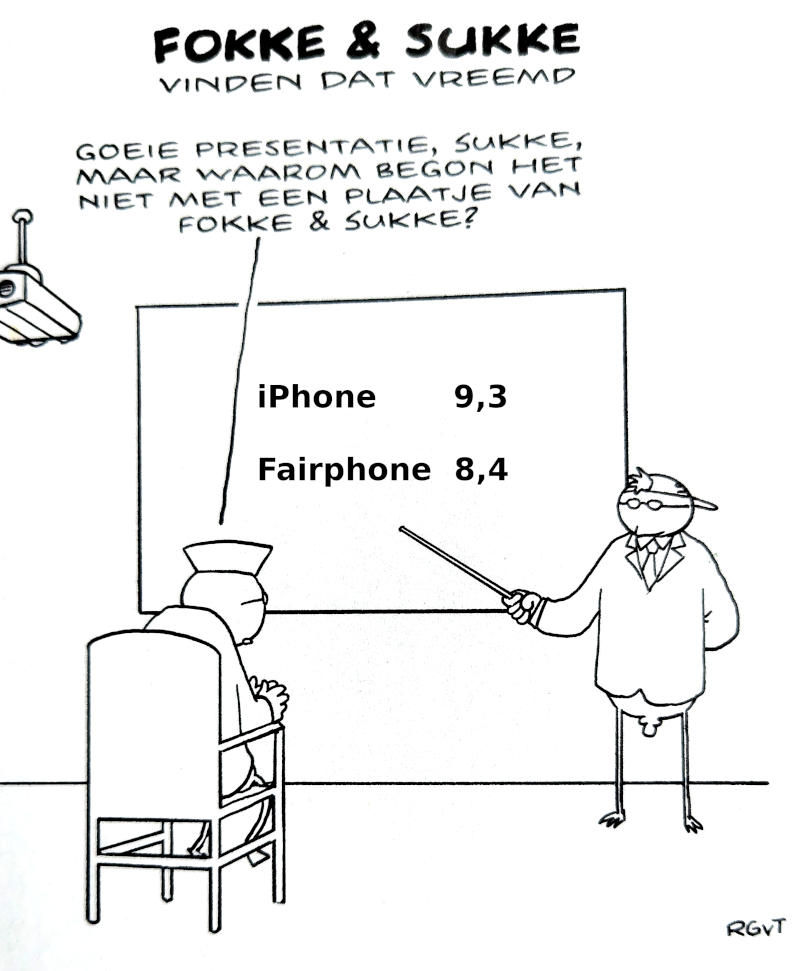
Fokke & Sukke vinden dat vreemd!
(aangepast,©RGvT)

De feiten

Dit zijn de testresultaten op de website van de Consumentenbond:

  • de 'Beste uit de Test' van 312 smartphones: Apple iPhone 15 (3 modellen).
  • de nieuwste Apple iPhones hebben duurzaamheidsscores van 9,1 tot 9,3
  • de nieuwste Fairphone 5 krijgt een 8,4 voor duurzaamheid. 
  • de website heeft een filter voor 'duurzamere keuze': dat levert 96 smartphones (30% van het totaal). Op 8 Nov: 95 smartphones.
  • bij de 'Beste uit de Test' telt 'duurzaamheid' voor 0% mee.
  • De 'Groen Keuze' wordt toegekend aan producten die op het testonderdeel duurzaamheid minimaal een 7 scoren.
  • De 'Groen Keuze' is (nog) niet toegekend aan smartphones, maar volgens hun eigen maatstaven zouden alle iPhones een Groene Keuze zijn. 

Consumentenbond Groene Keuze [4]. (bron)

Wat is duurzaamheid?

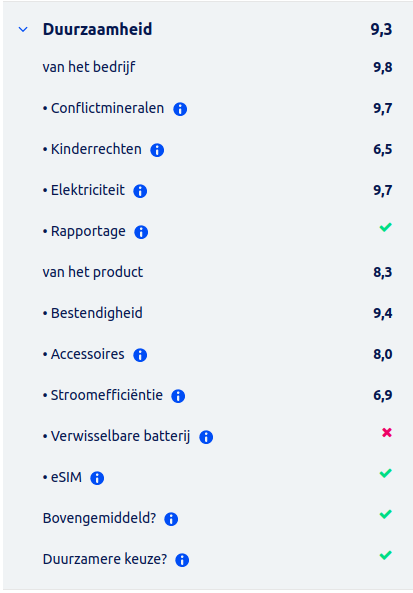
Duurzaamheid (iPhone 15 Pro Max) Screenshot 8 Nov 23 ©Consumentenbond

De definitie van 'Duurzaamheid' van de Consumentenbond bestaat uit 2 delen:

  • Duurzaamheid van het bedrijf: Conflictmineralen, Kinderrechten, Elektriciteit, Rapportage
  • Duurzaamheid van het product: Bestendigheid, Accessoires, Stroomefficiëntie, Verwisselbare batterij, eSIM, Bovengemiddeld, Duurzamere keuze.

Hoe wordt het duurzaamheids cijfer berekend?

Sommige onderdelen krijgen een cijfer, andere een vinkje. Kwantitatief en kwalitatief lopen door elkaar. Dat geeft problemen bij het berekenen van de score. Feitelijk kun je dan geen eindcijfer berekenen. Toch geeft de Consumentenbond een kwantitatief eindcijfer en er wordt niet uitgelegd hoe ze dat doen. Niet transparant en dus onbetrouwbaar.

De resultaten

Het blijkt dat de Apple iPhone 15 Pro Max niet alleen 'De Beste uit de Test' is, maar ook een ongekend hoog rapportcijfer van 9,3 voor duurzaamheid krijgt. Dat is opmerkelijk want Fairphone als bedrijf is in 2014 opgericht om een duurzame smartphone op de markt te brengen [5],[6]. Dat was revolutionair in die tijd. Maar bij de Consumentenbond heeft Fairphone 5 nota bene een lager rapportcijfer van 8,4 voor duurzaamheid. Alle iPhones hebben 9,1 of hoger voor duurzaamheid.  Apple iPhone is duurzamer dan Fairphone?! Dat vinden wij vreemd [2].

Het blijkt dat iPhone op alle duurzaamheids punten beter scoort, behalve 'Accessoires' en 'verwisselbare batterij'. De iPhone heeft géén verwisselbare batterij, Fairphone wel [3]. Maar volgens hun eigen criteria is 'verwisselbare batterij' een van de duurzaamheidskenmerken! Het weglaten van 'verwisselbare batterij' uit de duurzaamheidsscore is dus de verklaring waarom iPhone zo hoog scoort. Ja, zo kan ik ook smartphones testen!

Duurzaamheid telt niet mee

Hoe het testoordeel wordt berekend.
Pop-up op website
©Consumentenbond.
NB: let op Duurzaamheid!

Het verwarrende is dat Duurzaamheid helemaal niet mee telt voor het predicaat 'Beste uit de Test'! (zie screenshot hierboven). Een telefoon kan dus 'de beste' zijn zonder dat duurzaamheid überhaupt wordt meegewogen. Waarom niet? De iPhone heeft de hoogste duurzaamheids scores en die staan ook vermeld bij de kenmerken van de smartphones op de website, maar dit telt kennelijk niet mee bij het eindoordeel. Op grond van die score zouden de iPhones het predicaat 'Groene Keuze' moeten krijgen. Maar geen enkele smartphone heeft dat predicaat. Verwarrend en onbegrijpelijk.


Duurzaamheidsfilter
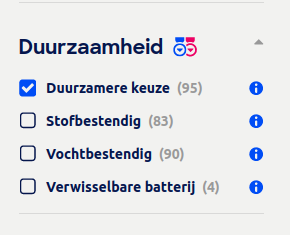
Verwisselbare batterij: 4 van de 95 Duurzamere keuzes!
screenshot 8 Nov 2023
©Consumentenbond
 
Het nieuwe duurzaamheidsfilter op de website levert 96 smartphones op van de 311 totaal (=30%). Op 8 november zie ik 95 smartphones: Apple (45), Fairphone (3), Google (5), Samsung (34), Sony (8). Best een groot aantal. Nadeel: het is onmogelijk om ze te sorteren op duurzaamheid. Er wordt gesorteerd op de 'eindscore' (waarin duurzaamheid niet mee telt!). Dus met dit filter kun je niet de meest duurzame smartphone selecteren. Maar dat is wel wat je verwacht van een duurzaamheidsfilter. 

Bovendien worden de kenmerken van duurzaamheid niet consequent toegepast in het duurzaamheidsfilter: 'verwisselbare batterij' telt op eens niet meer mee met als resultaat dat Apple, Fairphone, Google, Samsung, Sony duurzaam zijn, terwijl alleen Fairphone, Samsung en Shift een verwisselbare batterij hebben. Klopt dus niet.

Eerlijke informatie? (Consumentenbond 5 dec 23)

Aanbevelingen

  • De test scores moeten volledig na te rekenen zijn, er mogen geen geheime factoren zijn die alleen de Consumentenbond kent
  • De duurzaamheids onderdelen moeten transparant zijn: er moet voor iedere fabrikant, product of testonderdeel een link staan naar de webpagina waar de informatie staat met datum van bezoek van die pagina. Het liefst een link naar een rapport van een onafhankelijk certificering/keurmerken instituut. Alleen op die manier zijn beoordelingen controleerbaar.
  • Het duurzaamheidsfilter moet alle duurzaamheidskenmerken meenemen
  • Alle telefoons moeten onpartijdig beoordeeld worden, daarom mogen er geen subjectieve factoren binnensluipen.


Conclusie

Het is goed dat de Consumentenbond duurzaamheid probeert mee te nemen in haar testen. Maar: het is een raadsel waarom duurzaamheid nog steeds niet mee telt de 'Beste uit de Test' bij smartphones. Het is ook een raadsel waarom iPhones duurzamer zijn dan Fairphones. Het is een raadsel waarom het duurzaamheidsfilter niet 'verwisselbare batterij' meeneemt.

De berekening van de eindscores is een mengeling van kwantitatieve en kwalitatieve scores. Die kun je niet optellen en middelen. Deze methode is quasi objectief. Er wordt niet uitgelegd hoe daar mee om gegaan wordt. Zelfs als je je beperkt tot de kwantitatieve scores, dan kloppen de gemiddelden niet [2]. 

Het resultaat van dit alles is dat de testen van de Consumentenbond niet te controleren zijn. Er is geen verantwoording van hoe de Consumentenbond de duurzaamheid van een smartphone (product en en bedrijf) wordt vastgesteld.  Ze zijn ondoorzichtig en daardoor is de waarde van de testresultaten dubieus. De Consumentenbond neemt producenten de maat, maar wie neemt de Consumentenbond de maat? 


Postscript

Ondertussen heb ik een mail naar Jorien van Hoogen (Consumentenbond, expert duurzaamheid) gestuurd (9 nov 23). Ondertussen (16 nov) heb ik een 'formele' reactie van de Consumentenbond (zie hieronder), maar nog geen inhoudelijke reactie. Ik weet niet of de mail daadwerkelijk is doorgestuurd naar Jorien van Hoogen, want ik heb tot nu toe nog geen reactie van haar. 

Het is me nog niet gelukt een bericht bij Fairphone of Fairphone Community achter te laten, want er zijn allemaal barrières en drempels ingebouwd. Als iemand anders een mogelijkheid ziet om Fairphone op de hoogte te brengen van dit blog, heel graag! PS: ondertussen is het me gelukt om een bericht op het Fairhone forum 'The Industry' te posten (19 nov).    

Op 19 nov 2023 verscheen op de website van de Consumentenbond: De beste smartphone voor jou, door ons getest.  "Wij hebben 290 smartphones voor je getest". Laatste update van de test: 9 november 2023. Op 22 nov 23 waren 287 smartphones getest:

Duurzaamheid 22 Nov 2023 ©Consumentenbond
 
De papieren Consumentengids December 2023 heeft op pagina 8 een korte bespreking van de Fairphone 5.
Op 23 Nov zie ik 270 resultaten in de smartphone vergelijker, gisteren waren dat er 287, dus vandaag zijn er 17 minder. 


Postscript 16 nov 2023

Antwoord Consumentenbond:

Geachte heer Korthof,

Dank u voor uw bericht. 

Dank u voor het sturen van deze vergelijking. Ik heb uw bericht ter informatie doorgestuurd naar de verantwoordelijke redacteur onderzoeker. Als mijn collega's aanvullende informatie nodig hebben, nemen zij contact met u op. Omdat wij dagelijks veel meldingen ontvangen, kunnen we helaas niet garanderen dat wij actie ondernemen op uw blog. 

U gebruikt in uw blog een afbeelding van testresultaten van onze website die alleen toegankelijk zijn voor onze leden. Volgens Artikel 21 van onze Algemene Voorwaarden "mag de inhoud van onze periodieke en eenmalige uitgaven, de inhoud van onze website of de inhoud van enige andere onder het Auteursrecht vallende door ons verstrekte of openbaar gemaakte informatie zonder onze toestemming niet vermenigvuldigen en/of voor commerciële doeleinden inzetten." Dit stuur ik door naar onze verantwoordelijke afdeling. Mogelijk nemen zij hierover nog contact met u op.

Heeft u nog vragen? Neemt u dan contact op met de afdeling Dienstverlening & Advisering. U bereikt ons op werkdagen tussen 9:00 en 17:30 uur via telefoonnummer (070) 445 45 45.

Met vriendelijke groet,
Consumentenbond


Postscript 19 jan 2024

 Techniek Nederland: schaf btw op reparaties af, NOS, 19 jan 2024

Het heffen van btw belasting op reparatie is een perverse prikkel om een elektronisch apparaat niet te repareren maar weg te gooien en een nieuwe te kopen. In de Europese Unie geldt vanaf volgend jaar het wettelijke recht op reparatie. Met die wet, Right to Repair, moeten apparaten makkelijker te repareren zijn.


Noten

  1. De kosten van een beter milieu mogen niet volledig op het bordje van de consument komen? Dat is merkwaardig! Dus als consumenten energie slurpende apparaten kopen, moet de overheid en het bedrijfsleven hen daarbij helpen? subsidiëren? In tegendeel: de overheid zou energiezuinige apparaten moeten stimuleren! en energieslurpers belasten! (zie Consumentengids Nov 2023 pagina 58 Jorien van Hoogen). Noot staat niet meer in tekst.
  2. Ga je de berekening van de scores narekenen dan kloppen ze niet. De duurzaamheid heeft 2 onderdelen: duurzaamheid van het bedrijf en duurzaamheid van het product: 
    • duurzaamheid van het bedrijf = 9,8
    • duurzaamheid van het product = 8,3
      gemiddelde =  9,05 terwijl de CB geeft 9,3. Dat is dus te hoog.
    • het is onduidelijk hoe er geteld wordt als een item zoals Kinderrechten niet bekend is
  3. De batterij is nogal belangrijk: wat doen we met de iPhone van €1479 tot 1980 als de batterij degradeert? Een nieuwe smartphone is de enige optie als je de batterij niet kunt vervangen. De vervangbaarheid van de batterij zit niet in het duurzaamheidsfilter voor smartphones! Filter je bovendien op 'verwisselbare batterij' dan houd je maar 4 smartphones en daar zit dus geen  iPhone bij.
  4. Vorig jaar mei heeft de Consumentenbond het predicaat 'Groene Keuze' gelanceerd. Zie: Onze blik op duurzaamheid, 5 mei 2022.
  5. Het bedrijf Fairphone heeft sinds april 2015 een 'B-Corporation' certificaat. Dat vindt U op de website van het bedrijf dat de certificering uitvoert: B lab Europe. "A Certified B Corporation is a company that has voluntarily met the highest standards for social and environmental performance." Toegevoegd 12 nov 2023.  
  6. Helemaal onverwachts is het niet. In een smartphone test uit 2021 gaf Wouter Rensink de Apple iPhone 12 Pro (MAX) naast de Fairphone 3+ een vinkje voor duurzaamheid. Helaas, duurzaamheid telde niet mee voor de berekening van de 'Beste uit de Test'! (er tellen in totaal 13 kenmerken mee). Toegevoegd 16 dec 2023.  


Links

https://www.consumentenbond.nl/duurzaamheid/hoe-adviseren-wij-jou-bij-het-maken-van-een-duurzamere-keuze

https://www.consumentenbond.nl/duurzaamheid#duurzaamproduct

https://www.consumentenbond.nl/smartphone/hoe-wij-testen

https://www.consumentenbond.nl/smartphone/fairphone-3

https://www.consumentenbond.nl/tablet/strengere-regels-voor-duurzame-productie-smartphones-en-tablets 

https://cloudfront.consumentenbond.nl/binaries/content/assets/cbhippowebsite/gidsen/digitaalgids/2023/nummer-6---november/dg202311p40-keuzehulp-duurzame-smartphones.pdf

https://www.greenpeace.org/nl/natuur/6855/groene-elektronicagids-2017/

https://www.fairphone.com/nl/over/over-ons/

https://www.consumentenbond.nl/tablet/strengere-regels-voor-duurzame-productie-smartphones-en-tablets

https://www.consumentenbond.nl/stofzuiger/reparatie-elektrische-apparaten

Mobile Phones: Ethical Comparison Ratings Table !!!

Tweakers: Is dit de duurzaamste telefoon ooit? - Fairphone 5 Review. 15 Sep 2023. Geeft een goed overzicht van de voor- en nadelen.


Vorige blogs over Consumentenbond

20 October 2023

I discovered the beautiful Humming-bird Hawk Moth (Kolibrievlinder) hovering above flowers in a Dutch garden

Humming-bird Hawk Moth visiting flowers
31Aug 23 SRX06805A.JPG©Gert Korthof


This summer I was photographing butterflies in De Tuinen in Demen gardens, The Netherlands. These gardens have literally hundreds of flowering plant species. Unexpectedly, I found myself chasing a Humming-bird Hawk Moth, Macroglossum stellatarum (Dutch: Kolibrievlinder) hovering above the flowers. 

The butterfly was quite difficult to capture because it constantly moved from one flower to the next, and never sat down on a flower. Typically, they hover a few centimeters above a flower and stick their tongue out to enter a flower and quickly move to another flower. This is a very unique behaviour for a butterfly. Most butterflies sit down on a flower for some time. This exotic butterfly certainly deserves its name: it behaves like a hummingbird! It is really acrobatic to enter such a long tongue into flowers while hovering.

Later, when selecting the best pictures, I discovered the long tongue. At that moment I remembered the cover illustration of Mark Ridley's Evolution textbook:

cover Mark Ridley Evolution 3d edition

Ridley writes [1] that Darwin had seen specimens of the orchid Angraecum sesquipedale which has a very long spur. A nectar spur is a hollow extension of a part of a flower. Darwin speculated that a butterfly with a very long tongue must exist. But at the time he did not know such a species. Twenty years later such a butterfly was discovered: the hawk moth Xanthopan morganii pollinating an orchid. The butterfly I photographed, Humming-bird Hawk Moth, is not the same as the one on the cover of Ridley's Evolution. It is another genus. but it belongs to the same family [2]. The plant species my Humming-bird hawk moth visited is not an orchid. Now it gets interesting. Did my butterfly visit the 'wrong' flowers? There are no flowers present that fit the tongue of my Humming-bird Hawk Moth? Upon further inspection of my pictures I noted that the flowers also had a rather long spur:

Size of flower spur indicated with arrow.
31Aug 23 SRX06798A.jpg©Gert Korthof

But this spur is certainly not as long as Darwin's orchid. So, the particular plant species and my Humming-bird Hawk Moth don't seem highly adapted. They did not co-evolve.

This is a mystery. Are there plant species in the Netherlands or elsewhere in Europe which are better adapted to the Humming-bird Hawk Moth? Plant species with a very long spur? I don't know. More observations are needed. In the Netherlands our butterfly is often seen on a common garden plant: Buddleja davidii (butterfly bush, vlinderstruik) native to China and Japan. The problem is that in observation.org and waarneming.nl it is not required to identify the plant species when submitting an observation of a butterfly [3]. It is difficult to identify the plant species from the pictures. Above that, waarneming.nl discourages users to upload non-native plant species and it could be that precisely cultured garden varieties are visited by the Humming-bird Hawk Moth!

Another unique feature of this 'moth' are the eyes. They are looking at you:

He is looking at you!
SRX06802.jpg©Gert Korthof

It looks like a human eye!

Then its wings: rather exceptionally for a moth, its wings have orange patches!

Finally, another mystery: what about pollination? Since it doesn't sit down on a flower, the only point of contact is its tongue! Clearly, this is a wonderful and unique butterfly, or should I say a moth?


Additional nice pictures

https://waarneming.nl/observation/290848030/

https://waarneming.nl/observation/290782391/


Sources


Notes

  1. Mark Ridley (2004) Evolution, third edition, page 617. Ridley discusses the case in the paragraph 22.3 'Insect-plant coevolution'. But also that the case is more complex than just the coevolution of insect tongue length and flower spur length.
  2. Family: Sphingidae (pijlstaarten) is a very species rich family and the genus Macroglossum has nearly a hundred species.
  3. Buddleja davidii  (vlinderstruik), Lavandula species (lavendel), geranium, Valeriana spec (rode valeriaan), Phlox, Verbena officinalis (ijzerhard) are visited by the Humming-bird Hawk Moth.

13 September 2023

The true history of junk DNA (2)

Francis Crick
What Mad Pursuit.
paperback 1988

"The originator of the central dogma, Francis Crick, was well aware of genes that didn't encode protein. They don't figure into the central dogma." (Laurence Moran (2023) What's in your genome, chapter 8 paragraph 'Revising the central Dogma?') (my bold)

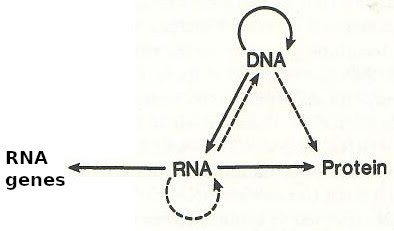
Exactly: They don't figure in the Central Dogma! That is precisely the problem! Crick omitted noncoding DNA from the Central Dogma. Had he included it in his scheme, a lot of confusion could have been prevented.

Central Dogma, from: Francis Crick, What Mad Pursuit, page 168.

Crick could have added an arrow from RNA to for example 'RNA genes'. He did not.

RNA genes added to Central Dogma (©GK)

In this blog I want to explore possible reasons for this omission. They have to do with the historical scientific context of the time that Crick proposed his central dogma. I hope this will show that scientists misinterpreting the Central Dogma are not fools and that Crick himself overlooked non-coding DNA when drawing his Central Dogma diagram. But first a second quote from Laurence Moran:

"Many scientists have a very different view of the central dogma. They were taught, incorrectly, that the real meaning of the central dogma is that DNA makes RNA makes protein and the only function of DNA is to encode protein ... They were somehow led to believe that there was only one kind of gene, namely, protein-coding genes." (Moran, 2023, What's in your genome, Chapter 8) (my bold)

Well, it is certainly not a mystery why many scientists were led to believe that there was only one kind of gene: there is only one kind of gene in Crick's illustration of the Central Dogma.

Why did Crick not add RNA genes to his diagram? It is important trying to understand the historical context at the time that Crick proposed his Central Dogma. Traveling back in time is not easy, therefore I use Crick's own account in What Mad Pursuit.

The central problem of biology at the time was: How could genes possibly construct all the elaborate and beautifully controlled parts of living things? It was known that each chemical reaction in the cell was catalyzed by enzymes. This is a defining property of life on earth. Furthermore, it was known before 1953 that enzymes are proteins. Crick realized that the key problem in biology was to explain how proteins were synthesized. In the 1940s a very influential hypothesis was proposed, the 'One gene - one enzyme' hypothesis. The next question was: How do genes control the synthesis of proteins? (Chapter 3 The Baffling Problem, page 33). Obvious today, but at the time it was a problem at the frontiers of science. Further, it was also known at the time that proteins were made of about 20 different amino acids. 

After the discovery that DNA consisted of a sequence of bases, the next question emerged: what is the precise relation between genes and proteins? Crick proposed the Sequence hypothesis: the sequence of bases in DNA is a necessary and sufficient condition for the sequence of amino acids in proteins. Crick:

"Rereading it, I see that I did not express myself very precisely, since I said "...it assumes that the specificity of a piece of nucleic acid is expressed solely by the sequence of its bases, and that is sequence is a (simple) code for the amino acid sequence of a particular protein." This rather implies that all nucleic acid sequences must code for protein which is certainly not what I meant." (Francis Crick, What Mad Pursuit, Chapter 10, page 108).

Then Crick explains that other parts of the DNA sequence could be used for control mechanisms (today: gene regulation) and he even mentions producing RNA for purposes other than coding (today: RNA genes). Crick concluded: "I don't believe anyone noticed my slip, so little harm was done." (page 109). Unfortunately, Crick underestimated the long lasting influence of the famous Central Dogma diagram.

According to Moran the meaning of the Central Dogma diagram is that the information in proteins cannot get out again. That, indeed, is what Crick himself says (page 109). Unfortunately, the Central Dogma diagram is a weird way to illustrate the non-existence of a specific type of information flow. It is as if one wants to illustrate the absence of something with the absence of something in an illustration. It isn't manifest. It seems rather impossible to me to do that [2].

In my view the point of the Central Dogma was to illustrate (albeit in a partial way) the solution of the central question of the time and indeed of all times: how can genes specify proteins? Crick himself expressed this clearly:

"I shall… argue that the main function of the genetic material is to control (not necessarily directly) the synthesis of proteins." [1] (my bold)

The Sequence hypothesis isn't a hypothesis anymore, and it isn't at the frontiers of science anymore, but 'The Sequence' is still and will always be one of the defining characteristics of life on earth [3]. This is certainly not an outdated idea from the pas. Life as we know it is impossible without enzymes (=sequences) and without genes (=sequences) coding for them. 

The 'protein universe' is very much at the frontiers of science, new protein structures are discovered today [4].


Appendix (1)

All the following concepts are about protein synthesis:  
  1. Mendelian genes specify discrete phenotypic characters (with the benefit of hindsight).
  2. The Sequence Hypothesis states that the sequences of DNA bases specify the sequence of amino acids in proteins. (Chapter 10 Theory in Molecular Biology)
  3. The Central Dogma states the direction of flow of information from DNA to RNA to protein and not back from proteins (chapter 10)
  4. The Genetic Code Table specifies which 61 DNA base triplets which amino acid ('sense' codons) and 3 base triplets which specify STOP chain ('nonsense' codons) Chapter 8 and Appendix B.
  5. The Adaptor Hypothesis  (Crick, Chapter 8 page 95) (the implementation of the Genetic Code in specific molecules: tRNA) doesn't make sense without protein synthesis.


Appendix (2)

The terminology used to describe genes makes only sense (!) in relation to protein synthesis: 

  • sense, nonsense, missense
  • sense, anti-sense strand
  • positive-sense, negative-sense 
  • coding strand, template strand
  • coding, noncoding
  • translation
  • STOP/START codons
  • the Genetic Code Table
  • triplets
  • in-frame/out of frame
  • ORF: Open Reading Frame
  • mRNA: messenger DNA
  • tRNA: transfer RNA
  • rRNA: ribosomal RNA

Also, the concepts: promoter (DNA sequence to which proteins bind) and enhancer (DNA sequence to which specific proteins bind) make only sense (!) in the context of protein synthesis, direct or indirectly, because they promote or enhance gene expression of protein-coding genes (mainly). Using these concepts implies protein synthesis on the basis of DNA sequences.  

However, there are concepts not (directly) related to protein synthesis: base pairing, double helixtranscription, directionality, replication.


Appendix (3)

I wonder whether there is a total absence of any coding signature in non-coding RNA genes. I found it difficult to find clear information about it. For example: do START and STOP codons occur in RNA genes? If so, do they have any effect? Do non-coding RNA genes have a triplet structure? Do single base deletions or insertions have similar effects on RNA genes as on protein-coding genes? (they don't disturb the reading frame). Are there functional RNAs completely independent and unrelated to protein (synthesis)? How did RNA genes originate? Did those they originate from coding sequences or from random sequences?


Notes

  1. Matthew Cobb (2017) 60 years ago, Francis Crick changed the logic of biology, PLOS BIOLOGY. Please note "(not necessarily directly)", this is a very ingenious way of including the indirect way of controlling protein synthesis: via enhancers and promoters. (added 22 sep 2023).
  2. Elsewhere Crick designed another diagram which prevents the dilemma of illustrating the absence of something, see: Larry Moran (2007) Basic Concepts: The Central Dogma of Molecular Biology blog.
  3. See for example my review of Tibor Gánti (2003) 'The Principles of Life'. 
  4. ‘A Pandora’s box’: map of protein-structure families delights scientists,  Nature 13 Dec 2023.


Previous blogs